
Choosing between watch strap types changes how a watch looks, how it wears and where you can safely take it. This guide covers the nine bands you will meet most often, from calfskin to FKM rubber to Milanese mesh, and explains which one suits which watch. It also shows you how to measure lug width, pick a strap length and use quick-release spring bars, details that most strap-shop pages skip.
Table of Contents
Watch Strap Types at a Glance
Most straps fall into four families: leather, rubber or elastomer, textile, and metal. Within those families sit the nine bands this guide covers. Each one makes a trade-off between comfort, water tolerance, durability and formality, and no single option wins on all four.
The matrix below sums up how the common watch strap types behave in real use. Treat the ratings as a practical guide, not lab data. Quality within each category varies widely, and a cheap silicone strap and a well-made FKM strap feel very different on the wrist.
| Strap | Water | Formality | Best on | Main drawback |
|---|---|---|---|---|
| Leather | Avoid | High | Dress, pilot, field | Absorbs sweat and water |
| Natural rubber / silicone | Excellent | Low | Divers, sports | Lint, ageing over years |
| FKM rubber | Excellent | Low to medium | Premium divers, sports | Higher price, stiff at first |
| NATO | Good (dries fast) | Low | Field, military, divers | Adds height under the case |
| Zulu | Good (dries fast) | Low | Large divers, tool watches | Bulky on small wrists |
| Canvas | Poor to fair | Low | Field, pilot, vintage | Holds moisture and stains |
| Sailcloth | Good | Low to medium | Sports, sailing, divers | Thicker than plain leather |
| Mesh (Milanese/shark) | Excellent | Medium | Vintage divers, dress-casual | Can catch arm hair |
| Link bracelet | Excellent | Medium to high | Daily wear, sports, GMT | Weight, scratches, sizing |
Two things the table cannot show: how a strap fits your lug width and how it suits the case shape. Those are covered in the sizing and pairing sections below, because a well-chosen material still looks wrong if the width or taper is off.
Leather Straps: Classic but Water-Shy
Leather is the default for dress watches and many pilot and field pieces. A good calfskin strap softens with wear and moulds to the wrist within a few weeks. Common variants include smooth calf, alligator or crocodile (often sold with CITES paperwork), suede, and distressed or vintage-style leathers.
- Smooth or padded calf: versatile, suits dress and office wear.
- Exotic grain (alligator, lizard): the traditional pairing for formal watches.
- Suede and nubuck: soft, casual, pairs well with field and chronograph watches.
- Distressed or vintage-style leather: suits military-style and older watches, and hides wear well.
Construction matters as much as the hide. Look for stitched edges or neatly painted edges that do not flake, a lining that sits flat, and holes punched cleanly. A strap that is too thick at the buckle end will feel stiff for months.
Can you wear a leather strap in water?
Not if you want it to last. Leather absorbs water and sweat, which leads to swelling, cracking, odour and a darker, stained finish over time. An occasional splash or brief rain will not ruin a good strap, but swimming, showering or diving with leather will shorten its life sharply, even when the watch itself is water resistant.
If a strap does get soaked, pat it dry and let it air-dry away from heaters or direct sun. Some brands sell water-resistant or rubber-lined leather, which is a reasonable compromise for hot climates, but it is still not a swimming strap. For pool and sea, switch to rubber, FKM, a NATO or a bracelet.
Rubber, FKM and Hybrid Sport Straps
Rubber is the natural partner for dive and sports watches. It shrugs off salt water, rinses clean and dries in seconds. The catch is that the word ‘rubber’ covers several materials with different lifespans and feel, so it pays to know what you are buying.
- Natural rubber: very soft and flexible, often vanilla-scented on premium straps, but can harden or crack with UV exposure over years.
- Silicone: inexpensive and supple, tends to attract lint and dust, and can tear at the keeper holes.
- FKM (fluoroelastomer): dense and resistant to UV, heat, oils and many chemicals. Feels stiffer when new and costs more.
- Polyurethane (PU): found on many affordable divers; comfortable but more prone to breaking down with age.
FKM has become a popular choice on higher-end dive watches because it keeps its shape and surface finish for years. Expect it to feel a little rigid out of the box; it relaxes slightly with body heat and wear. Rinse any rubber strap in fresh water after the sea or pool to remove salt and chlorine.
Hybrid metal-and-elastomer bands
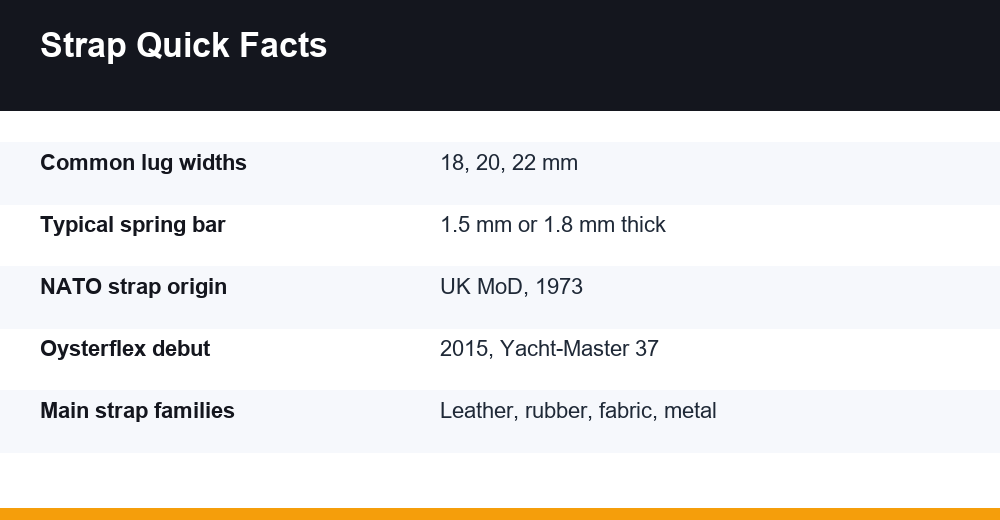
Some brands blend metal and rubber. The best-known example is Rolex’s Oysterflex, introduced in 2015 on the Yacht-Master 37. It uses flexible metal blades overmoulded with a high-performance elastomer, plus a patented longitudinal cushion system on the underside to keep the watch steady. The brand describes the design on its official Oysterflex page. Bands like this give the look of rubber with more structure and a metal clasp.
NATO, Zulu, Canvas and Sailcloth
Textile straps are cheap, light and easy to swap. The NATO traces back to a strap the British Ministry of Defence added to its stores catalogue in 1973. The nickname comes from its NATO Stock Number, while ‘G10’ is shorthand for the G1098 form soldiers filled in to draw kit from stores.
NATO vs Zulu
A NATO strap is a single length of woven nylon that threads under the watch between the spring bars, with a second short flap and keepers. If one spring bar fails, the watch usually stays on the wrist. The trade-off is extra height: the double layer lifts the case slightly off the wrist.
A Zulu strap uses thicker webbing and heavier, often rounded hardware. Some Zulus follow the NATO pass-through design with a flap; others are simple single-pass designs. They suit large divers and tool watches but can overwhelm a small dress watch.
Is a NATO strap better than leather?
It depends on the job. A NATO beats leather for water, sweat, travel and outdoor use: it dries quickly, can be hand washed with mild soap, and adds a layer of security. Leather beats a NATO for formality, refinement and a slimmer profile under a cuff. Many owners keep one of each and swap with the season.
Canvas and sailcloth
Canvas gives a rugged, vintage look and pairs nicely with field and pilot watches, but untreated canvas soaks up moisture and stains. Sailcloth is usually a coated, tightly woven fabric over a rubber or synthetic lining. That build makes it far more water-tolerant than canvas, with a sporty texture that works on divers and chronographs.
Metal Bracelets and Mesh
Metal bracelets are the most durable option and often the most versatile. Common link styles include three-link Oyster-type bracelets, five-link Jubilee-type designs, H-link and beads-of-rice bracelets. Most are stainless steel, with titanium as a lighter alternative and precious metals at the top end.
- Solid end links fit the case closely and feel more substantial than older folded links.
- Micro-adjustment in the clasp (tool-free on many modern bracelets) lets you add a few millimetres when your wrist swells in heat.
- Polished centre links dress a bracelet up but show scratches quickly.
- Screw-in links are easier to resize at home than friction pins, which usually need a pin pusher.
Mesh bracelets come in two main forms. Fine Milanese mesh is flat and smooth, often with a sliding clasp, and suits dress-casual and vintage-style watches. Heavier ‘shark’ or chainmail mesh was popular on dive watches in the 1960s and 1970s and still looks right on sports pieces. Steel mesh is unaffected by water, but cheaper versions can pull at arm hair.
Is a bracelet or strap better for everyday wear?
For a single watch worn daily, a bracelet is usually the better partner. It handles water, sweat and knocks, rarely needs replacing and goes from office to beach. Straps win on lightness, warmth in winter and variety. If comfort in heat matters more, a quality rubber or NATO is a strong everyday alternative.
Which Watch Strap Is Most Comfortable?
Comfort is personal, but across the main watch strap types a few patterns hold. Soft, broken-in leather and good natural rubber tend to feel best against the skin. Nylon NATOs are very light but add height. Bracelets distribute weight well yet can feel cold, heavy or pinchy if poorly sized.
| Situation | Most comfortable choice | Why |
|---|---|---|
| Hot, humid days | Rubber, FKM or NATO | No sweat absorption, dries fast |
| Office and air-conditioning | Leather or bracelet | Smooth feel, holds position |
| Sleeping or long flights | Soft rubber or thin leather | Light, no metal edges |
| Sport and gym | FKM or perforated rubber | Flexes, rinses clean |
| Small wrists | Tapered leather or thin bracelet | Less bulk around the lugs |
Three details matter more than material. First, taper: a strap that narrows from the lugs to the buckle (say 20 mm to 16 mm) feels lighter and less bulky. Second, thickness at the buckle end. Third, correct length, which keeps the watch centred instead of sliding around.
Buckle style plays a part too. A simple tang buckle is light and easy to adjust, while a deployant clasp spares a leather strap from repeated bending and suits people who take their watch on and off often.
How to Know What Size Strap to Buy
Sizing comes down to three measurements: lug width, strap length and spring bar type. Get these right and nearly any of the watch strap types in this guide will fit and sit correctly. If you are unsure whether the case itself suits your wrist, start with our guide to watch case sizes.
Step 1: Measure lug width
- Check the case back, the old strap or the manufacturer’s specifications; lug width is often listed there.
- If not listed, remove the strap and measure between the inner edges of the lugs in millimetres.
- Use digital calipers if possible. Measuring the spring bar itself can mislead, because it compresses.
- Buy that exact width. A 20 mm strap in a 21 mm gap rattles; a 22 mm strap will not fit.
Common lug widths are 18, 20 and 22 mm for men’s watches, with 19 and 21 mm found on some brands and smaller widths on women’s and vintage pieces.
Step 2: Choose a length
Two-piece straps are sold in short, regular and long sizes. A typical regular strap measures about 120 mm on the long side and 75 mm on the buckle side, though brands vary. The figures below are approximate starting points.
| Wrist circumference | Suggested length | Typical pieces (long/short) |
|---|---|---|
| Under 16 cm | Short | about 110/70 mm |
| 16 to 19 cm | Regular | about 120/75 mm |
| 19 to 21 cm | Long | about 130/80 mm |
| Over 21 cm | Extra long | about 140/90 mm or custom |
Aim to use the middle hole, which leaves room for heat swelling and for wearing over a cuff. For NATOs, check total length, since too much leftover strap has to be tucked into the keepers.
What are quick-release spring bars?
A quick-release spring bar has a small lever or pin built into it. Slide the lever toward the centre of the bar, it shortens, and the strap drops out of the lug holes with no tool needed. Standard bars need a spring bar tool instead.
- Bar length must match your lug width.
- Common diameters are 1.5 mm and 1.8 mm; check that your lug holes accept the thicker bar.
- Very tight lug-to-case gaps may leave no room for the release lever.
- Integrated bracelets, screwed bars and proprietary end links will not accept standard quick-release straps.
Caring for Your Strap and When to Replace It
A little routine care noticeably extends the life of most straps. Different watch strap types need different care, so one rule for all of them does more harm than good.
- Leather: wipe with a dry cloth, rotate with another strap in summer, and condition sparingly with a product made for watch or shoe leather.
- Rubber and FKM: rinse in fresh water, wash with mild soap now and then, and keep away from solvents.
- NATO and canvas: hand wash in lukewarm soapy water, then air-dry flat.
- Bracelets and mesh: scrub gently with a soft toothbrush and warm soapy water to clear grime between links, if the watch’s water resistance allows it.
Replace a strap when you see cracks near the lug or keeper holes, stretched or torn holes, fraying webbing or a persistent smell. Check spring bars at the same time: a bent or weak bar is a common reason a watch falls off the wrist.
Pairing Straps with Watches and Occasions
Once fit is sorted, think about matching the strap to the watch’s purpose. A general rule: keep the strap at or slightly below the watch’s level of formality, and match its visual weight to the case thickness.
| Watch type | First choice | Good alternatives |
|---|---|---|
| Dress watch | Thin black or brown leather | Alligator, fine Milanese mesh |
| Dive watch | Bracelet or FKM rubber | NATO, sailcloth, shark mesh |
| Pilot watch | Riveted or distressed leather | Canvas, NATO |
| Field watch | NATO or canvas | Suede, two-piece nylon |
| Chronograph | Bracelet or rally leather | Rubber, suede |
| GMT/travel watch | Bracelet | NATO, rubber |
Formal settings narrow the choice. A slim leather strap on a thin, simple watch is the classic answer; our black tie watch guide covers the details, including when to skip a watch entirely. If your only good watch is a diver, swapping its rubber for a dark leather strap helps, and our guide to wearing a dive watch with a suit explains how far you can push it.
Finally, colour. Match leather tone to belt and shoes for formal outfits, pick a strap that echoes a dial or bezel accent for casual wear, and use contrast stitching sparingly. Owning two or three watch strap types, for example a bracelet, a leather strap and a rubber or NATO, covers almost every occasion for one watch.
Frequently Asked Questions
What type of watch strap is most comfortable?
For most people, soft broken-in leather and quality natural rubber feel best against the skin. Rubber and NATO straps are more comfortable in heat because they do not absorb sweat. Comfort also depends on taper, thickness and correct length, so a well-sized strap in a basic material often beats a premium strap in the wrong size.
Is a NATO strap better than leather?
A NATO is better for water, sweat, travel and outdoor use, because it dries fast, washes easily and keeps the watch attached if one spring bar fails. Leather is better for formal settings and a slimmer profile under a shirt cuff. Many owners keep both and swap depending on the day and season.
How do I know what size watch strap to buy?
Measure the lug width, the gap between the inner edges of the lugs, in millimetres, or check the brand’s specifications. Buy a strap of exactly that width. Then choose length by wrist size: short below about 16 cm, regular for roughly 16 to 19 cm, and long above that. Aim to fasten on the middle hole.
Can you wear a leather strap in water?
It is best avoided. Leather absorbs water and sweat, which causes swelling, staining, cracking and odour over time, even if the watch is water resistant. Light rain will not ruin a good strap if you let it air-dry naturally. For swimming, showering or diving, switch to rubber, FKM, a NATO or a metal bracelet.