
A black tie watch has one job: to disappear under a dinner-jacket cuff until you actually need the time. Most men get it wrong in the same predictable ways, with a chunky diver, a bright bracelet or a dial busy enough to read across the room. This guide sets out the etiquette that still matters, the parts you can relax, and specific watches worth owning at three price levels.
Table of Contents
Should You Wear a Watch With Black Tie?
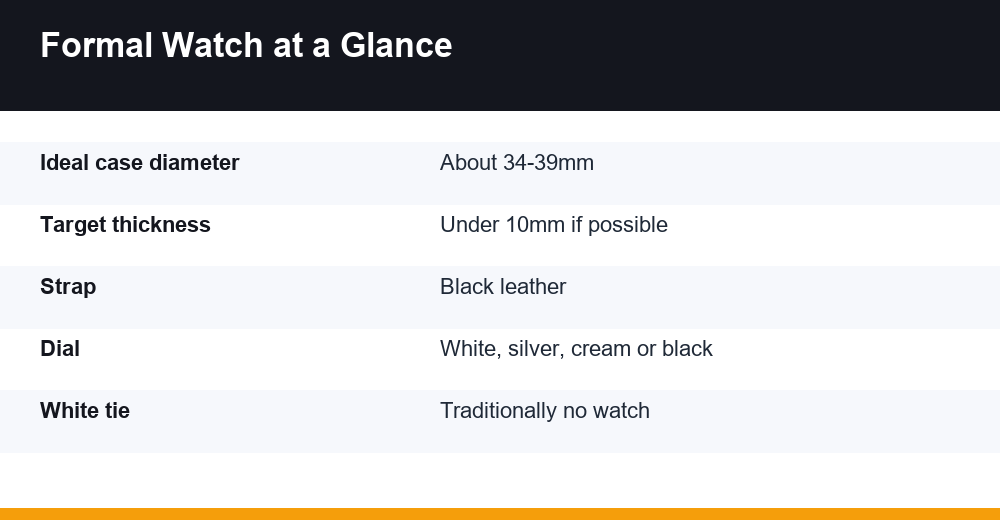
The strict traditional answer is no. Evening dress grew out of a social world where checking the time at a dinner or ball implied you had somewhere better to be. A guest glancing at his wrist during speeches still sends that message, and style writers who follow the old codes continue to recommend going bare-wristed.
That said, almost nobody enforces the rule today. Black tie now covers weddings, galas, award dinners and charity events where you may need to catch a last train or relieve a babysitter, and it is often described as semi-formal evening wear. Wearing a discreet watch is widely accepted; wearing a loud one is what draws comment.
A useful way to decide:
- Go without if the event is genuinely traditional, if you have nothing suitably slim, or if a phone in your inside pocket covers your timekeeping.
- Wear one if you own a thin, simple dress piece and would feel incomplete without it.
- Skip it entirely with white tie. The most formal dress code has long excluded wristwatches; a pocket watch on a chain is the period-correct alternative if you must carry the time.
Whichever way you go, the principle is the same: the watch should be glimpsed when your arm moves, not displayed. If you catch yourself rehearsing how to show it off, that is a sign it is the wrong piece for the evening.
7 Black Tie Watch Rules That Still Matter
So, what watch should you wear with a tuxedo? These seven rules cover almost every situation. Treat the first four as firm and the last three as strong guidance.
- Slip under the cuff. The case must slide beneath a double or single shirt cuff without forcing it open. Thickness matters more than diameter here.
- Keep it modest in size. Roughly 34 to 39mm suits most wrists; rectangular cases such as tank styles wear smaller still.
- Time only, or close to it. Two or three hands, perhaps a small seconds subdial or a discreet date. Chronograph pushers, rotating bezels and GMT scales belong to daytime.
- Black leather strap. It echoes the lapel facings, the bow tie and the shoes.
- A clean, light or black dial. White, silver, cream or black with applied batons or Roman numerals reads as formal.
- Match metals where you can. If your studs and cufflinks are gold, a gold or gold-toned case ties things together. Silver or steel accessories pair with steel or white metal.
- Restraint over value. An expensive sports watch is still a sports watch. A modest quartz dress watch is more correct with a dinner suit than a five-figure diver.
Notice what is missing: brand. No rule says your black tie watch must be Swiss, mechanical or costly. The etiquette is about proportion and simplicity, which is why an inexpensive watch can pass where a famous one fails.
The rules also explain why so many people reach for the wrong thing. The watches men wear most often, and love most, tend to be tool watches: divers, chronographs and pilots. They are well made, but they are designed for legibility and toughness, not for hiding under a starched cuff.
How Thin Should a Dress Watch Be?
There is no official standard, but a practical rule of thumb among collectors and tailors is that under 10mm slides easily beneath most shirt cuffs, under 8mm feels almost invisible, and anything above 12mm starts to catch. Evening shirts often have closer-fitting cuffs than business shirts, which makes the difference more noticeable.
Quartz movements and hand-wound mechanical calibres make thin cases easier, because neither needs the winding rotor of an automatic. That is one reason formalwear favourites such as the Cartier Tank and the Jaeger-LeCoultre Reverso run on one or the other.
| Case thickness | How it wears with a dress shirt | Typical examples |
|---|---|---|
| Under 7mm | Disappears under any cuff | Cartier Tank Must, small model (about 6.6mm) |
| 7-10mm | Ideal; slides in without effort | JLC Reverso Classic Medium Small Seconds (7.46mm per JLC) |
| 10-12mm | Comfortable with most cuffs | Grand Seiko SBGW231 (about 11.6mm) |
| 12-13mm | Workable on a strap; can snag a tight cuff | Orient Bambino 38 (about 12mm), Seiko Presage Classic 38mm (12.9mm) |
| Over 13mm | Too tall for formal cuffs | Most dive and sports watches |
Lug shape also matters. Lugs that curve down toward the wrist let a slightly thicker case sit lower, while a flat, slab-sided case of the same height will catch more often. A domed crystal adds height in the centre but usually slides under fabric better than a sharp-edged bezel.
Diameter still plays a supporting role. On a slim wrist of around 16cm, a 36mm case often looks more elegant than a 40mm one, while larger wrists can carry 39mm comfortably. When choosing a black tie watch, measure the case against your wrist rather than following a fixed number: the lugs should not overhang the edges of your wrist.
If you can, try the watch on with the exact shirt you plan to wear before buying. Cuff cut varies widely between makers, and a 12mm case that snags one shirt may glide under another.
Dial Colours and Case Metals That Work
The classic formal dial is white, silver or cream, with thin applied indices or printed Roman numerals and slim hands. It gives the best legibility in dim restaurant lighting and contrasts neatly with a black strap.
Black dials are an equally strong option and mirror the dinner jacket itself. A black dial in a polished steel or white-gold case, on a black strap, is about as quiet as a watch can be. A deep midnight-blue dial is a reasonable choice with a midnight-blue dinner suit, which has been a classic alternative to black for decades.
Dials to think twice about
- Bright colours such as green, orange or salmon, unless they are subdued and the rest of the outfit is very traditional.
- Heavy lume plots and large Arabic numerals, which read as military or sporty.
- Busy complications: a small moonphase is borderline but can work, while chronograph subdials and skeleton dials compete with the shirt studs.
Case metal
Polished steel is the most versatile and pairs with silver, mother-of-pearl or onyx studs. Yellow or rose gold cases look excellent with gold cufflinks but clash if everything else on you is silver. Brushed finishes are fine, but a polished case catches candlelight in a more formal way. Avoid two-tone cases and coloured ceramics for evening wear.
Gold-toned plating on an affordable case is a respectable way to match gold studs, provided the finish is even. A worn or scratched plated case, however, draws exactly the attention a black tie watch is supposed to avoid, so check it under strong light before the event.
| Your studs and cufflinks | Best case metal | Best dial |
|---|---|---|
| Silver, onyx or mother-of-pearl | Polished steel or white gold | White, silver or black |
| Yellow gold | Yellow gold or even gold-tone | Cream, ivory or white |
| Rose gold | Rose gold | Cream or silver |
| Mixed or no visible studs | Polished steel | Any classic dial |
Straps, Shoes and the Steel Bracelet Question
With formal dress, the strap does most of the visual work. Black is the default, and the finish is a matter of taste: smooth calfskin, a fine-grained leather, or alligator for a dressier look. Keep the strap slim and tapered rather than padded or stitched in a contrasting colour. If you are unsure which leather or construction suits your watch, our guide to watch strap types explains the differences.
Should a watch strap match your shoes?
In everyday menswear the rule is loose: belt and shoes should match, and the strap should sit in the same colour family. With a tuxedo the question answers itself. Your shoes are black, usually patent or highly polished, and there is normally no visible belt. A black strap is therefore correct, and a semi-gloss or alligator finish nods to patent leather without needing an exact match. Brown, tan or coloured straps should stay at home.
Can you wear a steel bracelet with a tuxedo?
Traditionalists say no, Milanese mesh included. A metal bracelet adds shine and bulk at the cuff, and it reads as daywear. In practice, a slim, integrated bracelet on a thin dress watch is far less jarring than a chunky sports bracelet, and plenty of guests wear one without comment.
If your only option is a bracelet watch, the simple fix is to buy a black leather strap in the correct lug width and swap it for the evening. Most watches with standard spring bars can be changed in minutes with an inexpensive tool, and quick-release spring bars make it easier still.
- Measure the lug width in millimetres before ordering a strap.
- Choose a black buckle or polished steel buckle that matches the case.
- Fit it a day early so the leather has time to soften.
Black Tie Watch Picks at Three Budgets
Prices below are approximate, vary by market and retailer, and change often, so treat them as a guide at the time of writing (late 2026) and check an authorised dealer before buying. For a broader list beyond formalwear, see our roundup of the best dress watches.
Under $1,000
- Orient Bambino 38. Domed crystal, simple dial and automatic movement, usually found for roughly $220 to $330. At about 12mm it is on the tall side, so pair it with a roomier cuff.
- Seiko Presage Classic Series (38mm). Textured, silk-inspired dials and a refined finish for roughly $950 to $1,000 in the US. At 12.9mm thick, pick a light dial and a black strap to keep it formal.
Roughly $2,000 to $5,000
- Longines Flagship Heritage. A 38.5mm automatic with a restrained 1950s look; Longines lists the Flagship Heritage L4.795.4.78.2 at $2,150 on its US site.
- Cartier Tank Must. Probably the most natural formal watch at this price: rectangular, about 6.6mm thick in the small model, quartz-powered, on black leather. Small steel versions on a leather strap retail at roughly $3,600 to $4,100 depending on reference.
- Grand Seiko SBGW231. A 37.3mm hand-wound, time-only watch with exceptional dial finishing. It has been discontinued (the SBGW301 is widely cited as its successor), so expect to buy pre-owned.
Above $5,000
- Jaeger-LeCoultre Reverso Classic. Art Deco rectangle, hand-wound, with a case that flips over. The Medium Small Seconds measures 7.46mm thick according to JLC. Some references have left the catalogue, and new steel models generally sit in the high four figures.
- Jaeger-LeCoultre Master Ultra Thin Moon 39. A round, slim classic built for the cuff, with a subtle moonphase. Steel versions are listed at US retailers at around $12,600 to $12,900.
| Watch | Shape / size | Movement | Approx. price |
|---|---|---|---|
| Orient Bambino 38 | Round, 38mm | Automatic | $220-$330 |
| Seiko Presage Classic | Round, 38mm | Automatic | $950-$1,000 |
| Longines Flagship Heritage | Round, 38.5mm | Automatic | $2,150 |
| Cartier Tank Must (small) | Rectangular | Quartz | $3,600-$4,100 |
| Grand Seiko SBGW231 | Round, 37.3mm | Hand-wound | Pre-owned only |
| JLC Reverso Classic Medium | Rectangular | Hand-wound | High four figures |
| JLC Master Ultra Thin Moon 39 | Round, 39mm | Automatic | $12,600-$12,900 |
If you are buying one black tie watch to cover weddings, galas and office dinners for years, the Tank Must is the safest single answer. If you prefer a round case and a mechanical movement on a budget, the Bambino remains the obvious place to start.
What to Leave in the Drawer
Most mistakes come from wearing an everyday favourite simply because it is the best watch you own. With evening dress, these are the usual offenders:
- Dive watches. Rotating bezels, thick cases and steel bracelets are built for the water, not a dinner jacket. They can work with a business suit in some settings, as we cover in our piece on wearing a dive watch with a suit, but black tie is a step too far.
- Smartwatches and fitness trackers. A glowing screen and buzzing notifications are exactly what the no-watch tradition was trying to avoid.
- Large chronographs and pilot watches, which bring too many subdials and too much height.
- Rubber, NATO and fabric straps. Even on a dress case, they cancel out the formality.
- Gem-set bezels on men’s watches, unless the rest of your outfit is equally flamboyant by design.
If you own none of the right pieces, going bare-wristed is better than any of the above. A clean cuff never looks wrong, and nobody at a formal dinner will wonder where your watch is.
A Quick Check Before You Leave
Run through these points while you dress. They take a minute and catch most problems:
- Shoot your cuff: does the watch disappear when your arm hangs naturally?
- Does the strap colour agree with your shoes and bow tie (black, in almost every case)?
- Do the case metal and your studs or cufflinks match?
- Is the time set and, for a mechanical watch, is it fully wound?
- Is the strap clean and the crystal free of fingerprints?
Then forget about it. The best formal watch is one nobody notices until you quietly check it on the way out, once the speeches are over.
Frequently Asked Questions
What watch should you wear with a tuxedo?
Choose a slim, simple dress watch: roughly 34-39mm, ideally under 10mm thick, with a white, silver, cream or black dial and two or three hands. Put it on a black leather strap. Rectangular classics like the Cartier Tank Must or a round time-only piece suit evening wear far better than sports, dive or smartwatches.
Should you wear a watch with black tie?
Tradition says no, because checking the time at a formal event can seem rude to the host. Today most people accept a discreet dress watch with a dinner suit. If yours is thick, sporty or on a bracelet, leave it at home. With white tie, a wristwatch is still considered a breach of etiquette.
Can you wear a steel bracelet with a tuxedo?
Purists advise against any metal bracelet, including Milanese mesh, because it adds shine and bulk at the cuff and reads as daywear. A thin, integrated bracelet on a slim dress watch is a tolerated compromise. The better fix is to fit a black leather strap for the evening, which takes minutes on most watches.
How thin should a dress watch be?
No official standard exists, but as a rule of thumb, under 10mm slides easily under a dress shirt cuff and under 8mm is almost invisible. Watches of 12-13mm can work on a leather strap with a looser cuff. Quartz and hand-wound movements make thinner cases easier to achieve than automatics.