
This watch size guide is built to solve one frustration every buyer knows: a watch that looked perfect online and then swamps or shrinks on the wrist the moment it arrives. The culprit is almost never the case diameter alone; it is the interplay of diameter, lug-to-lug, thickness and your own wrist that decides how a watch actually wears. Get those four numbers talking to each other and you can buy with confidence, even sight unseen.
Table of Contents
Why Watch Size Matters More Than the Number
Case diameter is the number brands print, retailers list, and enthusiasts argue about. It is also the least reliable predictor of how a watch will actually wear. A 40 mm diver with stubby lugs can sit smaller than a 38 mm field watch whose long, straight lugs reach right past your wrist bones.
The reason is simple: your wrist is not a diameter, it is a landscape. It has a width across the top, a circumference around it, and a curve that drops away on each side. A watch has to land inside that footprint. When it does, the piece looks intentional; when it does not, it reads as borrowed from someone else.
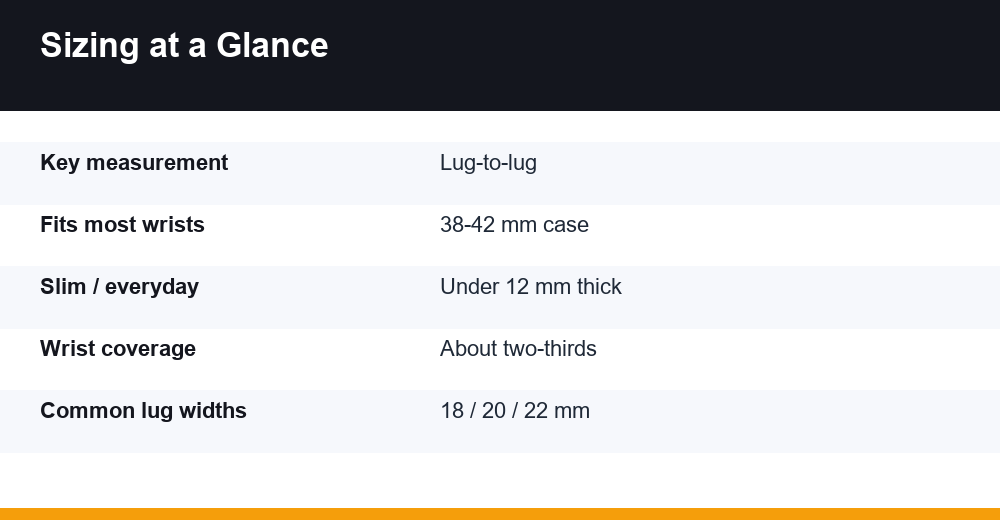
So treat this watch size guide the way a tailor reads a body: proportionally, not by a single statistic. The traditional target is a watch that covers roughly two-thirds of the flat of your wrist, and the sections below translate that idea into specific ceilings that keep a case from overhanging the edges.
Start Here: Measure Your Wrist
Every recommendation that follows depends on one honest number. Wrap a soft tailor’s tape, or a strip of paper you mark and hold against a ruler, around your wrist just past the wrist bone, where a watch actually sits. Pull it snug but not tight, and record the circumference in both millimetres and inches.
While you are there, take a second measurement most guides skip: the flat width across the top of your wrist. This is the runway your lugs must stay within, and it predicts overhang far better than circumference does. A caliper is ideal, but eyeballing it against a ruler is good enough to spot trouble.
- Small: under 6.5 in (about 165 mm) circumference
- Medium: 6.5-7.5 in (about 165-190 mm)
- Large: 7.5 in (about 190 mm) and above
Note which band you fall into, but do not stop there. Someone with a flat, wide 7-inch wrist can carry a larger footprint than someone with a round, tapered 7-inch wrist. The shape of your wrist matters just as much as the tape measure, which is why two people who share a size can disagree completely about the same watch.
Measure at the end of the day if you can, and take the reading twice to average out any wobble. Warm weather and exercise both swell the wrist, so an evening figure reflects the fit you will live with most often. Write both numbers down, because you will reuse them constantly from here on.
The Four Measurements in This Watch Size Guide
Four dimensions do almost all the work. Learn what each one tells you and you can decode any listing in seconds, instead of trusting a single headline figure that hides the truth.
- Case diameter – the width of the case across the bezel, excluding the crown. It sets first impressions but over- or understates fit depending on everything else.
- Lug-to-lug – the vertical distance from the tip of the top lugs to the tip of the bottom lugs. This is the true footprint, and the single most important fit number.
- Case thickness – the height from caseback to the top of the crystal. It governs comfort, whether the watch clears a cuff, and how top-heavy it feels through the day.
- Lug width – the gap between the lugs where the strap or bracelet attaches, usually 18, 20 or 22 mm. It dictates your strap options and the visual balance of the whole watch.
A simple way to remember it: diameter tells you how a watch photographs, lug-to-lug tells you how it fits, thickness tells you how it lives on your wrist, and lug width tells you how you can dress it. These terms are used consistently across the industry, and the broader anatomy of a watch follows the same conventions worldwide.
Wrist Size to Case Size Chart
Here is the heart of any practical watch size guide: a chart pairing wrist circumference with a diameter range and, just as important, a lug-to-lug ceiling and a comfortable thickness band. Read the diameter as a starting suggestion and the lug-to-lug figure as a limit you should be reluctant to exceed.
| Wrist (circumference) | Case diameter | Lug-to-lug (max) | Comfortable thickness |
|---|---|---|---|
| Under 6.5 in / 165 mm | 34-39 mm | up to ~47 mm | 7-11 mm |
| 6.5-7 in / 165-178 mm | 38-42 mm | up to ~49 mm | 8-12 mm |
| 7-7.5 in / 178-190 mm | 40-44 mm | up to ~52 mm | 9-14 mm |
| 7.5-8 in / 190-203 mm | 42-46 mm | up to ~55 mm | 10-15 mm |
| Over 8 in / 203 mm | 44 mm and up | 55 mm and up | 12 mm and up |
These are guidelines, not laws. A dress watch can drop a millimetre or two below its band for elegance, while a purpose-built diver can sit at the very top and still look right. If you want to test a size before committing serious money, our roundup of the best affordable watches is a low-risk place to start.
One habit pays off forever: whenever a watch fits beautifully, write down its diameter, lug-to-lug and thickness. Those three figures become your personal reference and will serve you far better than any generic chart, because they describe watches you have already proven on your own wrist.
Lug-to-Lug: The Measurement That Decides Fit
If you check only one number before buying, make it lug-to-lug. It is the watch’s true span from top to bottom, and the moment it exceeds the flat width of your wrist, the lugs hang over the edge and the piece looks oversized, no matter how modest the diameter on the spec sheet.
This is exactly why two watches with the same diameter can fit completely differently. Long, straight lugs stretch the footprint outward, while short or steeply downturned lugs pull it in. Downturned lugs are especially helpful on smaller wrists, because they curl toward the arm and shorten the watch’s effective reach across the top.
- A 38 mm field watch can post a lug-to-lug near 47 mm, larger in practice than the diameter implies.
- A 45 mm cushion-cased diver can wear shorter than its diameter suggests, thanks to compact, integrated lugs.
- A rectangular dress watch may measure under 28 mm across yet stretch well past 45 mm from lug to lug.
How should it sit? Ideally the lug tips land right at, or just inside, the point where your wrist begins to curve down each side. A slight overhang is forgivable on a rugged sports watch; on a refined dress watch it quietly undermines the effect, so aim tighter when the occasion is formal.
Thickness, Stack, and the Shirt-Cuff Test
Thickness is the dimension buyers underestimate most, because it barely registers in a catalogue photo and then dominates the experience on the wrist. A tall case rocks when you rest your forearm on a desk, catches on the inside of a shirt cuff, and can make an otherwise trim watch feel far bulkier than its diameter promised.
A useful sanity check is the ratio of thickness to diameter. Broadly speaking, a case under about 12 mm reads as slim, 12-14 mm as everyday, and above 15 mm as deliberately chunky. Water resistance, a display caseback and an automatic rotor all add height, so a genuinely slim automatic is a real engineering achievement and usually priced accordingly.
This is where dress watches show their value. A true dress watch is often 6-9 mm thick so it slips under a cuff without a fight, and the classic test is whether the cuff glides over the crystal cleanly. If you want pieces built around that discipline, see our guide to the best dress watches for examples that pass it.
Sports and tool watches get a pass here, since height is part of their purpose and their appeal. But if you spend your days in long sleeves or a suit, weigh thickness as heavily as diameter. It is often the difference between a watch you wear daily and one that ends up in a drawer.
Case Shape and Dial Ratio: When the Diameter Lies
Two 40 mm watches can look a full size apart, and shape is usually the reason. A round case shows its diameter honestly. A cushion, tonneau or square case fills more of the wrist for the same nominal width, so it wears larger than the number suggests. A sensible rule is to drop one to two millimetres from your usual diameter for any non-round case.
The dial-to-bezel ratio is the other quiet influence. A slim bezel around a broad, open dial makes a watch feel generous and elegant, while a thick bezel around a small dial makes the same case feel cramped and heavier. When you compare two watches of equal diameter, look at how much of the face is actually dial.
- Round case: wears true to its diameter.
- Cushion, tonneau or square case: wears one to two millimetres larger, so size down.
- Slim bezel with a wide dial: feels balanced, open and refined.
- Thick bezel with a small dial: feels heavier and larger than it really is.
Colour and finish play a supporting role too. A dark dial or a matte case recedes and reads a touch smaller, while a bright dial or a high-polish case advances and reads larger. None of this overrides the tape measure, but it neatly explains the gap you sometimes see between the spec sheet and the watch in person.
How Size Rules Shift by Watch Type
Different categories carry different proportions, so a size that flatters a dress watch can look timid on a diver. Once you know your wrist, use the watch’s intended role to fine-tune the numbers rather than applying one blanket rule to everything you consider.
| Watch type | Typical diameter | Typical thickness | What to watch |
|---|---|---|---|
| Dress | 34-40 mm | 6-9 mm | Slim, round, minimal bezel; sized to slip under a cuff. |
| Field | 36-40 mm | 10-12 mm | Often long lugs, so check lug-to-lug closely. |
| Dive | 40-44 mm | 12-15 mm | A rotating bezel adds visual bulk. |
| Chronograph | 40-44 mm | 13-15 mm | Pushers and sub-dials read busy; size down if unsure. |
| GADA all-rounder | 38-40 mm | 11-13 mm | Balanced pick for a one-watch collection. |
These ranges are conventions, not rules, and plenty of admired watches sit outside them. Treat the table as a sanity check: if a diver measures 34 mm or a dress watch measures 44 mm, it is doing something unusual, which may be exactly what you want or a fit you will come to regret.
Sizing Straps and Bracelets
Fit does not end at the case. The strap or bracelet is what holds the watch in position on your wrist, and getting it wrong undoes good case sizing. Start with lug width, the 18, 20 or 22 mm gap between the lugs, because it decides which straps will physically fit in the first place.
As a rough visual rule, lug width should sit a little under half the case diameter. A 40 mm case with a 20 mm lug width looks balanced; the same case on a 16 mm strap looks starved, and on a 24 mm strap it looks overloaded. Trust your eye, but let that ratio point you in the right direction.
- Metal bracelets: remove links for a rough fit, then use the clasp’s micro-adjustment holes for the final couple of millimetres.
- Half-links: prized because they let you dial in a fit between full-link increments, invaluable when your wrist falls between sizes.
- Leather and rubber straps: choose the length that centres the buckle on the middle hole, so the tail is neither stubby nor flapping.
- Quick-release spring bars: swap straps in seconds without tools, letting one watch move from boardroom to weekend.
Wrists swell across the day and in warm weather, so size for late-afternoon comfort rather than first thing in the morning. A bracelet that feels perfect at 8 a.m. can feel tight by evening. The strap is the last mile of any watch size guide, and a clasp with an on-the-fly extension handles that swelling neatly if your bracelet offers one.
Common Watch Sizing Mistakes to Avoid
Most disappointing purchases trace back to a handful of avoidable errors. Knowing them in advance is often more useful than any chart, because they are the traps that survive even careful measuring.
- Buying on diameter alone and ignoring lug-to-lug, then finding the lugs hang over the wrist.
- Forgetting thickness, so a watch that measures well still feels top-heavy and catches on cuffs.
- Trusting stock photos, which are often shot on mannequin wrists or props that flatter the case.
- Overlooking case shape, so a cushion or square case wears a size larger than expected.
- Sizing a bracelet in the morning, when your wrist is at its smallest of the day.
A low-tech fix beats all of them: print or trace the watch at its true diameter and lug-to-lug, cut it out, and tape the paper shape to your wrist. It is crude, but it previews overhang and proportion with surprising honesty. Run this test alongside the watch size guide chart above and you will rarely be surprised on delivery day.
Frequently Asked Questions
What is the most important watch measurement for fit?
Lug-to-lug. It is the vertical span from the top lugs to the bottom lugs, which is the watch’s true footprint on your wrist. If it exceeds the flat width of your wrist the watch overhangs, so check it before diameter whenever a listing provides it.
What size watch fits a 7-inch wrist?
A 7-inch (178 mm) wrist comfortably carries roughly a 38-42 mm case with a lug-to-lug up to about 49 mm. Shape matters too: a flat, wide wrist can push toward the top of that range, while a round, tapered wrist sits happier toward the bottom.
Does case thickness really change how a watch wears?
Yes, more than most buyers expect. A tall case rocks on a desk, snags on cuffs and feels top-heavy. Under about 12 mm reads as slim, and a dress watch meant to slip under a shirt cuff usually stays between 6 and 9 mm thick.
Can I choose a watch online without trying it on first?
Yes. Once you know your wrist circumference and flat width, compare a listing’s diameter, lug-to-lug and thickness against the chart above. Those three numbers predict fit reliably, which is the whole point of a watch size guide: buying with real confidence, unseen.