
Knowing how to spot a fake watch has become an essential skill in today’s pre-owned and grey markets, where the best counterfeits are convincing enough to fool casual buyers and even some dealers. The reassuring part is that almost every fake slips up somewhere, and a patient look at nine specific details will expose the vast majority. This guide works through those checks in the order an experienced collector would use them, then adds a printable checklist and the red flags that should end a deal on the spot.
Table of Contents
Counterfeit vs. Grey Market vs. Franken-Watch
Before learning how to spot a fake watch, it helps to get the categories straight, because the word “fake” gets used loosely and the differences change how worried you actually need to be.
A counterfeit is a watch built to imitate a brand it has no right to carry. A grey-market watch, by contrast, is genuine but sold outside the brand’s authorised network: real, frequently discounted, and usually a bargain rather than a threat. The main catch with grey-market pieces is the missing manufacturer warranty.
The trickiest category is the franken-watch: a genuine watch rebuilt with incorrect, aftermarket, or service-replacement parts. It may carry a real serial yet no longer be true to its original model. A watch can pass a quick glance and still be a Frankenstein of mismatched components, which is why buyers who only ask “is it real?” sometimes come unstuck.
- Counterfeit: a non-genuine watch imitating a brand; the outright fake.
- Super-fake (superclone): a high-grade counterfeit, sometimes built on a genuine base movement.
- Grey-market: authentic but unofficially imported; legitimate, though without a brand warranty.
- Franken-watch: a genuine watch with swapped or aftermarket parts; part real, part not.
Only counterfeits and frankens are the real enemy here; grey-market watches are a legitimate way to save. If you are new to the market, our first luxury watch guide covers where each of these categories tends to surface and how to shop around them with confidence.
The Tools That Make Authentication Easier
You do not need a workshop to inspect a watch properly, but a handful of inexpensive tools sharpen every check that follows. Most seasoned buyers carry them to any in-person viewing, and together they cost far less than a single mistake on a high-value purchase.
- A 10x loupe: the most useful item of all, revealing print quality, machining, and engraving that the naked eye misses.
- Digital calipers: let you measure case diameter, thickness, and lug width against the brand’s published specifications.
- A UV torch: helps you judge how evenly the lume charges and can reveal markings that fluoresce on some brands.
- A timing app or timegrapher: reads the beat rate and running quality of a mechanical movement by sound or through the caseback.
- Reference photos: high-resolution images of a confirmed-genuine example of the exact reference, ready for side-by-side comparison.
None of these tools passes judgement on its own; they simply help you gather cleaner evidence. Pair them with strong, even lighting and, wherever possible, a known-genuine example or trusted photos to compare against as you work through the checks below.
Checks 1-2: Weight, Materials and Case Finishing
Weight is the first thing an experienced hand notices. Solid stainless steel, gold, and titanium each have a distinctive density, and most fakes cut costs with lighter alloys or hollow components. A dive watch that feels like a toy in the palm is an instant warning, and a gold piece that feels suspiciously light rarely holds the gold it claims.
Weight alone never convicts a watch, though. Better counterfeits now add ballast to reach the right heft, so treat mass as an opening signal rather than a verdict, then move on to finishing, which is far harder to imitate.
Dimensions are worth measuring too. Counterfeiters often get the case diameter, thickness, or lug width slightly wrong, so a quick check with calipers against the brand’s published figures can expose a fake that otherwise looks convincing.
Case finishing separates the serious fakes from the rest. Genuine cases show crisp transitions between brushed and polished surfaces, sharp lug edges, and clean, evenly cut knurling on the crown. Counterfeits tend to look soft, rounded, or gritty under a loupe, with polishing that spills over onto areas that should be brushed.
Check the crystal too. Most modern luxury pieces use synthetic sapphire, which ranks 9 on the Mohs scale of mineral hardness and resists the scratching that quickly mars the mineral or acrylic glass many fakes use. Sapphire also tends to bead water rather than smear it, a quick and cheap thing to test.
- Heft: does the mass match the metal the watch claims to be?
- Dimensions: diameter, thickness, and lug width match the published specs.
- Edges: crisp, defined lugs and bezel teeth, not soft or mushy.
- Crown: clean knurling and a logo with sharp, deep detail.
- Crystal: sapphire beads water and strongly resists scratches.
Check 3: The Movement and the Second-Hand Myth
The movement is where most fakes fall apart, because finishing a mechanical calibre to genuine standards is slow, skilled work. Through a display caseback, a real movement shows decorated bridges, polished screw heads, and a properly engraved rotor; a fake usually looks crude, generic, or stamped, with rough edges and mismatched components.
When it comes to how to spot a fake watch, little beats a look at the movement, yet it is also the part most buyers never see. If the calibre type is unfamiliar, our guide to watch movements explained breaks down automatic, manual, and quartz movements and what good finishing actually looks like.
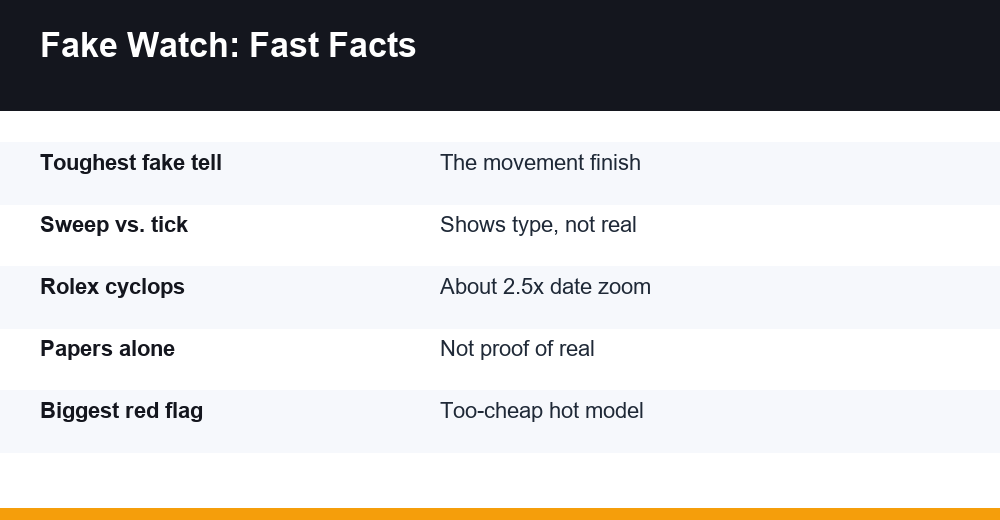
Now the myth. You will read everywhere that a genuine watch always has a smooth, sweeping seconds hand while fakes tick. This is unreliable. Genuine quartz watches tick once per second by design, and modern super-fakes run automatic movements that sweep convincingly. The sweep tells you the movement type, not whether the watch is authentic.
What does help is watching the sweep closely. Many mechanical watches beat at 28,800 vibrations per hour, producing a smooth, high-frequency glide; a slow, choppy, or stuttering motion can betray a cheap replacement. Watch the seconds hand line up with the minute track, and listen too, since some counterfeits are noticeably loud, buzzy, or rattly at the ear.
- Display back: expect genuine decoration, not a plain plate.
- Beat: a real automatic glides evenly; a jerky, stuttering sweep is suspect.
- Sound: excessive rattle or buzzing hints at a low-grade movement.
- Reality check: sweep versus tick proves movement type, not real versus fake.
Checks 4-6: Dial, Cyclops, Date and Lume
Dial printing is the counterfeiter’s most common failure. Under a loupe, genuine text is razor-sharp and perfectly aligned; fakes reveal fuzzy edges, uneven spacing, thin or blobby print, and occasionally a misspelling or the wrong font. Compare the dial side by side with high-resolution photos of a confirmed genuine example of the exact reference.
The date and its magnifier matter on any model fitted with one. On a Rolex, the cyclops lens magnifies the date roughly 2.5x and fills the window; many fakes under-magnify, leaving the numerals small and floating off-centre. Confirm the date sits centred in the aperture and that the numeral font matches the brand’s own.
Hands deserve their own look. On a genuine watch they are cleanly finished, correctly shaped for the reference, and set at a length that reaches the relevant tracks. Fakes often fit hands that sit a fraction too short, carry a slightly different lume tone, or look faintly misshapen against reference photos.
Lume reveals a surprising amount. Charge the watch under a bright light, then step into the dark: genuine luminous material glows strong, even, and uniform across every marker and hand. Counterfeit lume is often patchy, weak, fades within minutes, or shows one colour on the hands and a different tone on the dial markers.
- Dial text: sharp, aligned, correctly spelled, and evenly spaced.
- Date: centred in the window with a brand-correct font.
- Cyclops (where fitted): fills the window and magnifies clearly.
- Hands: correctly shaped, right length, and matching lume.
- Lume: bright, even, consistent in colour, and slow to fade.
Checks 7-8: Caseback, Serials and Papers
The caseback is a frequent giveaway. Some brands, Rolex among them, almost never fit display casebacks to their sports models, so a see-through back on a watch that should be solid is a red flag in itself. Engraving should be deep, crisp, and evenly cut, never shallow, dotted, or acid-etched with soft, blurry characters.
Brand-specific quirks help as well. Rolex, for example, stopped using holographic caseback stickers around 2007, so a fresh holographic sticker on a watch presented as newer is a contradiction worth questioning rather than a reassuring sign of a full set.
Serial and reference numbers should be cleanly machined and must match the accompanying paperwork. Counterfeiters routinely reuse the same serial across thousands of units, so a number that turns up on collector forums attached to a completely different model or year is a strong sign something is wrong.
Papers help, but they never prove authenticity on their own. Warranty cards, boxes, and receipts are all faked, and genuine papers are sometimes paired with a swapped or franken watch. Verify the serial on the card against the case, check that the dealer stamp and date look right, and treat a full set as supporting evidence rather than a guarantee.
Where a brand offers it, you can ask an authorised dealer or the manufacturer to confirm a serial before you buy. Avoid relying on public serial-lookup websites, which are frequently inaccurate, scraped, or gamed, and can give false confidence in either direction.
| Feature | Typically genuine | Common on fakes |
|---|---|---|
| Case finishing | Crisp brushed and polished zones | Soft, gritty, mushy edges |
| Movement | Decorated, engraved rotor | Plain, generic, crude |
| Dial text | Sharp, aligned, correct font | Fuzzy, uneven, misspelled |
| Caseback engraving | Deep and crisply cut | Shallow or acid-etched |
| Lume | Bright, even, long-lasting | Patchy, weak, mismatched |
| Weight | Matches the claimed metal | Light or oddly balanced |
Check 9: Price, Seller and Provenance
The oldest tell is price. Sought-after models hold their value, and sellers know it, so a steep discount on a hot reference is a warning rather than a windfall. If a deal feels too good to be true, assume there is a reason and slow the whole process down until you understand it.
Seller reputation and provenance carry as much weight as any physical check. Buy from established dealers with verifiable histories, real addresses, and clear return policies. On peer-to-peer platforms, read feedback carefully, insist on fresh photos with a handwritten dated note, and be wary of stock images, thin profiles, or pressure to pay quickly.
Payment method is part of authentication. Use options that offer buyer protection, avoid irreversible transfers to strangers, and for high-value purchases consider an in-person deal at a bank or a reputable third-party authentication service that inspects the watch before any funds are released.
- Compare the asking price to recent sold listings for that exact reference.
- Verify the seller’s history, real address, and return policy.
- Ask for original, dated photos of the actual watch, not stock images.
- Pay with a method that offers genuine buyer protection.
- For big-ticket pieces, use professional authentication or escrow.
How to Spot a Fake Watch: The Full Checklist
This is the practical core of how to spot a fake watch. Run these nine checks in order and most counterfeits and franken-watches will reveal themselves. Print it, or keep it on your phone, and work from top to bottom before any money changes hands.
- Weight: does the mass match the claimed metal?
- Case and crystal: crisp finishing, sharp edges, scratch-resistant sapphire.
- Movement: real decoration and a steady, correct beat.
- Dial: sharp, aligned, correctly spelled printing.
- Date and cyclops: centred, brand-correct, properly magnified.
- Lume: bright, even, and long-lasting in the dark.
- Caseback: correct type with deep, clean engraving.
- Serial and papers: matching numbers and corroborating documents.
- Price and seller: sensible pricing from a trustworthy source.
No single check is decisive; authenticity is a weight-of-evidence judgement. The real skill is not one killer test but stacking small signals until the picture becomes clear. When two or more of these checks fail, walk away or pay for a professional opinion before committing.
Red Flags That Should Stop the Sale
Some signs are serious enough to end a conversation on their own. If you see any of these, the burden shifts entirely to the seller to prove the watch is genuine, and you should be ready to walk if they cannot.
- A discount far below the going rate, backed only by a vague reason.
- A seller who won’t send original, dated photos or allow an inspection.
- A display caseback on a model that never came with one.
- Serial numbers that don’t match the papers, or that won’t be shown at all.
- Misspellings, wrong fonts, or crooked, blurry dial printing.
- Pressure to pay fast by an irreversible transfer.
- Weak, patchy lume that dies within a few minutes.
Ultimately, learning how to spot a fake watch buys you time and leverage, but it is not infallible against the very best super-fakes. For any significant purchase, pair your own inspection with an independent watchmaker or a reputable authentication service; a caseback pull and a close look at the movement settle most doubts within minutes.
Frequently Asked Questions
Can you spot a fake watch just by the ticking second hand?
No. That test only reveals the movement type. Genuine quartz watches tick once per second, while the best super-fakes now use automatic movements that sweep smoothly. Use the sweep to identify the calibre, then judge authenticity on finishing, dial printing, and the movement itself.
Do original box and papers guarantee a watch is real?
Unfortunately not. Boxes, warranty cards, and receipts are all counterfeited, and genuine papers are sometimes paired with a swapped or franken watch. Treat a full set as supporting evidence, verify the serial matches the case, and never let paperwork override what the watch itself shows.
What is a super-fake, and can anyone spot one?
A super-fake is a high-grade counterfeit, sometimes built on a genuine base movement, that fools casual inspection. Enthusiasts can still catch most through finishing, weight, and dial detail, but for expensive pieces the safest move is an independent watchmaker who can open the case.
Is a heavily discounted luxury watch always fake?
Not always. Grey-market dealers sell genuine watches below retail because they bypass official channels, and private sellers sometimes need a quick sale. But an extreme discount on a sought-after model is a classic warning sign, so let a low price trigger more scrutiny, not less.