
Watch movements explained in plain language: the movement is the small engine inside your watch that keeps time and drives the hands. Whether it runs on a battery or a coiled spring shapes almost everything about how the watch feels, how accurate it stays, and how much care it asks of you. This beginner’s guide breaks down quartz, manual-wind and automatic movements clearly, without jargon and without a sales pitch, so you can read any spec sheet with confidence.
Table of Contents
What Is a Watch Movement?
A watch movement, also called a calibre, is the mechanism that measures time and drives the hands, the date window and any other function on the dial. Everything around it – the case, the crystal, the strap – is essentially packaging. When collectors discuss a particular watch, they are usually talking about the movement hidden inside.
Movements fall into two broad families defined by how they are powered. Electronic movements run on a battery or a charged cell, while mechanical movements store energy in a wound spring. From these two families come the three types almost every buyer will meet.
- Quartz – electronic and battery-powered, valued for accuracy and low upkeep.
- Manual-wind – mechanical, powered by a spring you wind by hand through the crown.
- Automatic – mechanical, wound by the natural motion of your wrist.
The difference matters because it shapes the whole ownership experience: how often you interact with the watch, how precisely it keeps time, and how much maintenance it will eventually ask for. A battery watch and a spring watch behave very differently, even when they look identical on the wrist.
Anything a movement does beyond showing hours, minutes and seconds is called a complication – a date, a chronograph, a moon phase, a second time zone. Each one adds parts, cost and usually thickness. Beginners rarely need many, so it is worth paying for the complications you will actually use rather than the ones that simply look impressive.
Once you have the core watch movements explained, the numbers on a product page stop reading like a foreign language. You will understand why one watch ticks while another glides, why one needs winding and another does not, and where your money is genuinely going.
Quartz Movements: Battery-Powered Precision
A quartz movement keeps time with a tiny sliver of quartz crystal and a small battery. Current from the cell makes the crystal vibrate at a precise 32,768 times per second. An integrated circuit counts those vibrations and, once per second, sends a pulse to a motor that advances the seconds hand by one step.
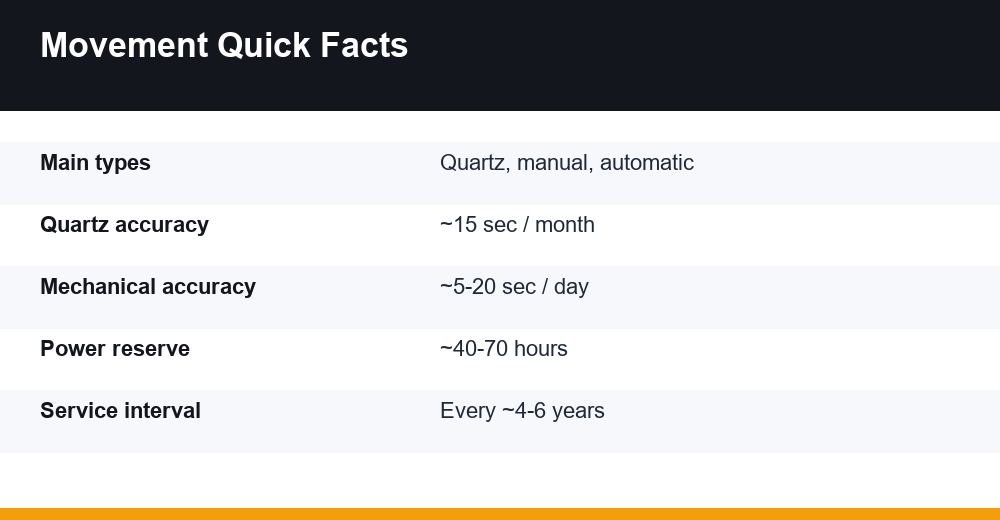
That once-per-second pulse is why most quartz watches tick in visible steps rather than sweeping smoothly. It is also why they keep time so well: a typical quartz watch drifts only about 15 seconds a month, while thermocompensated high-accuracy quartz can hold to roughly five to ten seconds a year.
Quartz excels wherever dependability and low fuss matter most – field watches, tool watches, travel watches and slim dress pieces too thin for a mechanical calibre. Set the time, wear it, and forget about it for years at a stretch.
Not all quartz relies on a disposable battery. Solar models, such as Citizen’s Eco-Drive and Seiko’s solar line, charge a rechargeable cell from light, while kinetic watches use a wrist-driven rotor to generate that charge. Both keep quartz accuracy while avoiding frequent battery changes, though the rechargeable cell itself may need replacing after many years.
- Everyday reliability with almost no attention required.
- Tight budgets, or very thin and lightweight cases.
- Anyone who dislikes resetting the time.
The trade-offs are honest ones. Batteries need replacing every two to five years, and inexpensive quartz modules are often swapped whole rather than repaired. Many enthusiasts also feel quartz lacks the mechanical character of gears and springs. Yet for pure performance per unit of cost, quartz remains very hard to beat.
Running costs stay low over a lifetime, since quartz rarely needs a full service. The main thing to watch is a dead battery left inside for years, as it can leak and corrode the movement. Replace flat batteries promptly and a good quartz watch will serve reliably for a very long time.
Mechanical Manual-Wind Movements
Mechanical movements are the oldest design and the most direct link to traditional watchmaking. Instead of a battery, they store energy in a coiled spring called the mainspring. You wind that spring by turning the crown, and as it slowly unwinds it feeds energy through a train of gears to the hands.
The heart of the movement is the balance wheel, which swings back and forth at a steady rate, released in tiny even steps by the escapement. Many modern movements run at 28,800 vibrations per hour – eight beats a second – which produces the near-smooth sweep that mechanical fans prize.
A manual-wind watch must be wound regularly, usually once a day, to keep running. Many owners grow to enjoy the small ritual. The reward is a battery-free mechanism that can run for generations with proper care, and often a slim case, since there is no winding rotor taking up room.
- If your watch has a screw-down crown, unscrew it first.
- Turn the crown forward, away from you, roughly 20 to 30 times.
- Stop as soon as you feel firm resistance – never force it.
- Screw the crown back down to protect water resistance.
You may have read warnings about over-winding. On virtually all modern watches this is not worth worrying about, because the mechanism simply resists once the mainspring is full. Stop at that point of resistance rather than cranking harder, and the spring will be perfectly happy.
Manual-wind watches suit people who want the most hands-on connection to their watch, collectors of vintage pieces, and anyone drawn to ultra-thin dress designs. For many owners the daily wind becomes a brief, deliberate pause in the morning – a small but genuine part of the appeal.
Automatic Movements: Self-Winding Mechanicals
An automatic movement is a mechanical movement with one clever addition: a weighted, semicircular rotor that pivots freely on your wrist. As you move through the day, the rotor swings and winds the mainspring for you, so a watch worn regularly never needs winding by hand.
This is why automatics dominate mid-range and luxury collections – they pair mechanical character with everyday convenience. Wear one daily and it simply keeps running. Set it aside for a weekend and it may stop once its stored power runs out, which is entirely normal rather than a fault.
- Full rotor – a large weight that sweeps across the movement; the most common design.
- Micro-rotor – a smaller weight recessed into the movement, allowing a thinner case.
- Peripheral rotor – a ring around the edge that leaves the movement fully visible.
Most automatics can also be wound by hand through the crown, which helps after the watch has stopped. If yours has been sitting, give the crown around 30 turns to start it, then wear it and let your wrist take over. A few movements cannot be hand-wound at all, so check the specification first.
Two features are worth checking for: hacking and hand-winding. Hacking stops the seconds hand when you pull the crown out, letting you set the time to the exact second against a reference. Older or budget automatics sometimes lack one or both, which surprises many first-time buyers.
If you have a very still, sedentary day, an automatic may not fully wind from wrist motion alone and can lose a little power overnight. Wearing it actively, or adding a few crown turns, keeps it running at its best.
Owners who rotate several automatics sometimes use a watch winder, a small motorised box that gently turns a resting watch to keep it wound and set. It is a convenience rather than a necessity, and is most useful for watches with fiddly calendars that are tedious to reset each time you switch.
Jewels, Power Reserve and Accuracy Demystified
Look at a movement’s specification and you will see a jewel count – often 17, 21, 25 or more. These are small synthetic rubies used as bearings at the points of highest friction. They are extremely hard and smooth, so they reduce wear and help the movement run steadily. More jewels is not automatically better; the number simply reflects how many pivots and complications need them.
Power reserve is how long a fully wound movement keeps running once you stop winding or wearing it. Most mechanical watches offer between 38 and 70 hours, with 40 to 50 hours being typical. Longer reserves exist, some running several days, but they usually add cost and complexity more than everyday usefulness.
You may also see a beat rate quoted in vibrations per hour. Common rates are 18,000, 21,600 and 28,800 vph, with high-beat movements reaching 36,000. A faster beat can improve stability and gives a smoother-looking seconds hand, but it is not a simple measure of quality – many excellent movements run at more relaxed rates.
Accuracy is where the movement types diverge most sharply. Quartz is measured in seconds per month, mechanical in seconds per day. A mechanical watch holding within a few seconds a day is doing very well, even though an inexpensive quartz will out-measure it with ease.
Several everyday factors nudge a mechanical watch faster or slower:
- Position – a watch runs slightly differently lying flat versus standing on edge.
- Temperature – heat and cold subtly change how the balance spring behaves.
- Magnetism – phones, laptops and speakers can magnetise a movement and speed it up.
- State of wind – the rate can drift as the mainspring’s power tapers off.
For mechanical watches, the recognised benchmark is chronometer certification. The Swiss COSC standard requires an average daily rate of -4 to +6 seconds. Some brands go further with stricter in-house or independent testing, promising tighter tolerances still.
| Movement type | Typical accuracy | Measured in |
|---|---|---|
| Standard quartz | Around 15 sec | Per month |
| High-accuracy quartz | Around 5-10 sec | Per year |
| Everyday mechanical | Around 5-20 sec | Per day |
| Chronometer-certified | -4 to +6 sec | Per day |
Watch Movements Explained: Quartz vs Mechanical vs Automatic
With each type covered, a side-by-side view makes the differences click. That is really the value of having watch movements explained together rather than in isolation: you can weigh accuracy, convenience and cost at a glance, and see which trade-offs you actually care about.
| Feature | Quartz | Manual-wind | Automatic |
|---|---|---|---|
| Power source | Battery or solar | Hand-wound spring | Self-winding spring |
| Accuracy | Highest | Good | Good |
| Maintenance | Battery every 2-5 yrs | Service ~4-6 yrs | Service ~4-6 yrs |
| Winding | None | Daily, by hand | Wrist motion or hand |
| Seconds hand | Ticks | Sweeps | Sweeps |
| Relative price | Low | Mid to high | Mid to high |
| Best suited to | Fuss-free daily wear | Purists and slim dress watches | Enthusiasts wanting both |
No column in that table makes a watch better outright. A ticking quartz field watch and a sweeping automatic dress watch are each ideal in their own setting, so read the table as a map of trade-offs rather than a scoreboard.
If you are torn between the two most common choices, our closer look at automatic vs quartz watches walks through the day-to-day reality of living with each. For many buyers the honest answer is that both are excellent, and the decision comes down to whether you want a dependable tool or a mechanical companion.
Servicing, Winding and Long-Term Care
Ownership gets easier once you have the upkeep side of watch movements explained. Mechanical and automatic watches need periodic servicing, when a watchmaker strips, cleans, re-oils and reassembles the movement. Most makers suggest every four to six years, though some modern calibres comfortably stretch longer between visits.
Servicing is not cheap, and it is a recurring cost worth budgeting for from the start. A routine mechanical service is a meaningful expense, and complex or luxury calibres cost considerably more. Quartz rarely needs a full service – usually a fresh battery every few years is enough, and a whole quartz module can sometimes be swapped for less than one mechanical service.
You need not watch the calendar obsessively, but a few signs suggest a service is due:
- The watch gains or loses noticeably more time than it used to.
- The power reserve shortens and it stops far sooner than before.
- Moisture, fogging or dust appears under the crystal.
- The crown, pushers or winding action feel gritty or stiff.
A service is also when gaskets are replaced and water resistance is re-tested, which is why the two topics are linked. If sealing and depth ratings are new to you, our guide to watch water resistance explained covers what those numbers really mean in daily use. Between services, keep watches away from strong magnets and extreme heat.
Which Watch Movement Should You Choose?
There is no single best movement, only the best one for how you live and what you value. Keep the watch movements explained above in mind and match the type to your priorities rather than to marketing or online tribalism.
- Quartz – for accuracy, low upkeep and a watch you can genuinely forget about.
- Manual-wind – for ritual, slim dress watches and mechanical purity.
- Automatic – for mechanical character without the daily winding.
It also helps to know that reliable movements come from many makers. Japanese calibres from Seiko and Miyota, and Swiss calibres from ETA and Sellita, all power excellent watches at sensible prices. A movement’s origin matters far less than its condition and how well it has been finished and regulated.
If you are buying your first serious watch, decide your budget first, then let the movement follow. In the entry range, a well-made quartz or a dependable Japanese automatic offers the most watch for the money. As budgets rise, in-house movements and finer finishing justify more of the price, but they are a want rather than a need.
Do not let anyone convince you that one type is inherently superior. A precise quartz diver and a hand-finished mechanical dress watch are simply different tools for different moods. Start with the movement that fits your daily life, and let your taste develop from there.
Frequently Asked Questions
What is the most accurate type of watch movement?
Quartz is the most accurate everyday movement, typically drifting only about 15 seconds a month, and high-accuracy quartz far less. Mechanical and automatic watches are measured in seconds per day, so even a fine example cannot match quartz on raw precision.
Do automatic watches need winding?
If you wear an automatic most days, wrist motion keeps it wound and you rarely need to touch the crown. After it has been sitting and has stopped, wind it about 30 turns by hand, or simply put it on, to get it running again.
How often should a mechanical watch be serviced?
Most brands recommend a full service every four to six years, when a watchmaker cleans, oils and reassembles the movement and checks the seals. Wearing the watch regularly actually helps, since the oils stay distributed rather than settling and drying out.
Is quartz or automatic better for a first watch?
Neither is objectively better. Quartz is cheaper, more accurate and needs almost no attention, which makes it a stress-free first watch. An automatic offers mechanical character and tends to hold interest longer. Choose quartz for pure convenience, automatic if the craftsmanship draws you in.