
The automatic vs quartz question is one of the first every watch buyer runs into, and it quietly shapes everything from price to how often you reach for the crown. One type runs on centuries-old mechanical engineering; the other on a battery and a vibrating crystal. This guide explains how each works, how they truly compare on accuracy, cost and longevity, and which one earns a place on your wrist.
Table of Contents
Automatic vs Quartz: How Each Movement Works
Before you can judge the two, it helps to picture what happens inside the case. The engineering could hardly be more different, and nearly every practical difference that follows flows from it.
A quartz movement runs on a battery. A small current passes through a sliver of quartz crystal cut to vibrate exactly 32,768 times per second. A tiny integrated circuit counts those vibrations and sends one pulse per second to a stepper motor, which nudges the hands forward. That once-a-second jump of the seconds hand is the classic quartz signature.
An automatic watch carries no battery at all. A coiled mainspring stores the energy, and a semicircular weight called the rotor swings with the motion of your wrist, winding that spring as you go about your day. The unwinding spring drives a balance wheel that oscillates back and forth several times a second, typically at 3 to 4 Hz, producing the smooth, gliding seconds hand.
How long an automatic keeps running once you take it off is called its power reserve. Older movements held around 38 to 42 hours; many modern ones now stretch to 70 hours or more, so a watch worn on Friday can still be ticking on Monday. Quartz sidesteps the question entirely, running for years on a single cell.
Automatics are simply one branch of mechanical watches. The other is the manual, or hand-wound, watch, which works in exactly the same way but relies on you turning the crown each day rather than a rotor doing it for you. Both are mechanical; only the self-winding version is truly automatic.
There are also hybrids worth knowing, from solar and kinetic quartz that rarely need a battery to Seiko’s Spring Drive, which pairs a mainspring with a quartz regulator. For a full tour of every movement family, see our watch movements explained guide.
A Short History: Why the Debate Exists
The rivalry has roots in one of the biggest upheavals in watchmaking history. On 25 December 1969, Seiko unveiled the Astron, the first commercial quartz wristwatch. It kept time far more accurately than any mechanical watch of the era, and at launch it cost about as much as a small car.
What followed is often called the quartz crisis. Cheaper, ever more accurate quartz watches flooded the market through the 1970s, and Switzerland’s mechanical industry nearly collapsed. Tens of thousands of jobs disappeared, and many long-established firms closed or merged simply to survive the decade.
The recovery came from two directions. Swatch’s affordable plastic quartz watches, launched in 1983, restored Swiss volume and profits, while a growing circle of collectors rekindled demand for traditional mechanical craftsmanship. That revival is why a hand-finished automatic can still command a premium today, long after quartz won the accuracy argument outright.
Accuracy and Precision Compared
Precision is where the two technologies diverge most sharply, and for many buyers it is the deciding factor. In the automatic vs quartz accuracy contest, quartz wins comfortably on paper.
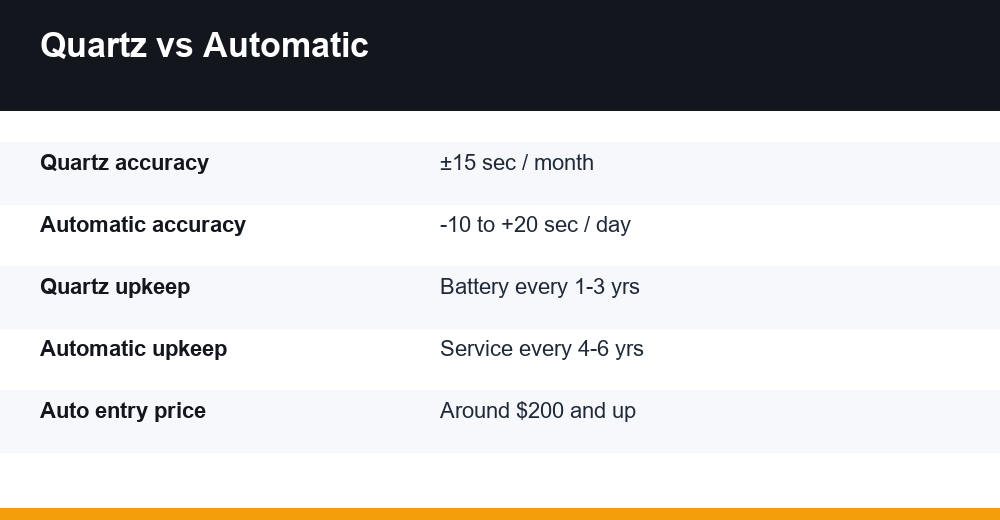
A standard quartz watch keeps time to within roughly ±15 seconds per month. A good automatic usually runs somewhere between about -10 and +20 seconds per day. Certified chronometers do better: to earn official Swiss chronometer certification (COSC), a mechanical movement must stay within -4 to +6 seconds per day across fifteen days of testing.
But quartz is not a single thing. High-accuracy thermocompensated calibres, found in watches such as the Grand Seiko 9F and the Longines Conquest V.H.P., correct for temperature drift and can hold to roughly ±5 to ±10 seconds a year. That is an order of magnitude beyond anything a purely mechanical watch can manage.
It is worth being realistic, too. No mechanical watch, however beautifully finished, will out-measure a decent quartz over the course of a month. Precision and romance are different things, and mechanical watches are rarely bought for the former.
At a Glance: The Full Comparison
If you want the short version, the table below sums up how the two movement types compare across the factors buyers care about most.
| Factor | Automatic | Quartz |
|---|---|---|
| Power source | Wrist motion winds a mainspring | Battery (or solar / kinetic) |
| Typical accuracy | -10 to +20 sec/day | ±15 sec/month |
| Seconds hand | Smooth sweep | Once-per-second tick (usually) |
| Maintenance | Full service every 4-6 years | Battery every 1-3 years |
| Lifespan | Decades, even generations | 10-20+ years; module may be sealed |
| Weight | Heavier (rotor and gears) | Lighter and slimmer |
| Entry price | Around $200 and up | Around $30 and up |
| Resale / heirloom value | Often strong | Usually minimal |
| Best for | Enthusiasts and collectors | Everyday accuracy, low fuss |
Maintenance, Lifespan and Cost of Ownership
Purchase price is only the start. Over ten years, the automatic vs quartz decision often comes down to how much upkeep you are willing to pay for and carry out yourself.
A quartz watch needs a fresh battery roughly every one to three years, an inexpensive job, though water-resistant models should be pressure-tested afterward. Beyond that, quartz is often treated as semi-disposable: if the electronic module fails years later, replacing it can cost more than the watch is worth.
An automatic asks for a full service, which means disassembly, cleaning, fresh lubrication and reassembly, roughly every four to six years. Depending on the brand this ranges from around $150 for an entry-level piece to several hundred dollars or more for luxury calibres. Skip it and the oils dry out, letting parts wear against one another.
There is a smaller quirk to plan for, too. An automatic left unworn for a day or two simply stops and needs resetting. A few turns of the crown or an inexpensive watch winder solves it. The upside is longevity: a well-serviced mechanical watch can run for generations, which is exactly why so many are handed down as heirlooms.
Resale is worth weighing as well. Mechanical watches from respected makers tend to hold their value far better than quartz, and a select few even appreciate. You do not need a large budget to begin, though; our guide to the best affordable watches covers strong options in both camps.
Durability, Magnetism and Everyday Wear
Beyond accuracy and cost, the two movement types behave differently in daily life, and that can matter more than a few seconds of drift either way.
Mechanical watches dislike strong magnets. Fields from laptops, speakers, phone cases and tablet covers can magnetise the hairspring and make an automatic run fast until it is demagnetised, a quick job for any watchmaker. Quartz movements are largely immune, which makes them a practical choice for anyone who works around magnetic equipment.
Shocks are the other difference. A hard knock can disturb a delicate balance wheel, whereas a quartz circuit shrugs most impacts off, one reason quartz dominates rugged sport and field watches. Extreme heat or cold can also slow an ordinary quartz movement slightly, which is precisely the drift thermocompensated calibres are built to cancel out.
Water resistance depends on the case and gaskets rather than the movement, so both types can be equally waterproof. Just remember that any watch opened for a battery change should be resealed and pressure-tested, and that seals age and need periodic checking whichever movement sits inside.
For frequent travellers, quartz has a quiet edge: leave it in a drawer for a month and it is still running and on time when you return. An automatic will have stopped and will need winding and resetting, though a good one with a long power reserve softens that inconvenience.
Beyond Battery and Mainspring: Hybrids Worth Knowing
The classic split is not the whole story. Several movement types blur the line, and each one solves a genuine drawback of the two main camps.
Solar and kinetic quartz
Solar watches such as Citizen Eco-Drive, Seiko Solar and Casio Tough Solar charge a rechargeable cell from any light, so you may go a decade or more without a battery swap. Kinetic movements charge that same cell from wrist motion instead, blending quartz accuracy with automatic-style self-charging. Both keep the low-maintenance appeal while sidestepping disposable batteries.
High-accuracy and thermocompensated quartz
Ordinary quartz drifts slightly as the temperature changes. Thermocompensated calibres measure that temperature and adjust for it, reaching around ±10 seconds a year or better. The Grand Seiko 9F and Longines V.H.P. show that quartz can be a premium, precision-first choice rather than a budget default.
Spring Drive
Seiko’s Spring Drive is the truest hybrid of all. A mainspring powers it like an automatic, but an electronic quartz regulator governs its rate. The result is a perfectly smooth, gliding seconds hand and accuracy of roughly ±1 second per day, offering mechanical character with near-quartz precision.
Common Myths, Cleared Up
A few stubborn beliefs muddy the comparison. Here are the ones most worth setting straight before you buy.
- Only mechanical watches have a sweeping seconds hand. A handful of high-frequency quartz movements, including Bulova’s Precisionist, glide just as smoothly.
- Automatics never need winding. They wind from wrist motion while worn, but sit idle for a day or two and they stop, needing a few turns of the crown to restart.
- All quartz watches are cheap. Thermocompensated pieces like the Grand Seiko 9F sit firmly in luxury territory and cost far more than many automatics.
- A pricier watch always keeps better time. A $30 quartz will usually out-measure a five-figure mechanical watch; you pay for craftsmanship and materials, not raw accuracy.
- Automatics are fragile antiques. A modern automatic is a robust everyday watch; it simply prefers regular service and a wide berth from strong magnets.
Keep these in mind and the marketing around both camps becomes much easier to see through.
Pros and Cons of Each
Neither type is objectively better; each gives something up for what it does well. Here is the honest balance sheet.
Automatic watches
- Smooth sweeping seconds hand and visible craftsmanship, often shown off through a display caseback
- No batteries to replace, plus strong heirloom and resale potential
- Centuries of history and a large, engaged enthusiast community
- Less accurate day to day, and needs periodic professional servicing
- Heavier, usually pricier, and stops if left unworn for a day or two
- More sensitive to strong magnets and hard knocks
Quartz watches
- Excellent accuracy with almost no attention required
- Affordable to buy, lighter on the wrist and often noticeably slimmer
- Shrugs off daily knocks and keeps perfect time even when unworn
- Batteries need changing over time, and older modules can become unrepairable
- Less romance for purists, and typically weak resale value
- Disposable-battery models carry a small ongoing environmental cost
Which Should You Choose?
The right pick depends on how you use a watch and what you want from it. Run through the profiles below; most people recognise themselves in one, and that usually settles the automatic vs quartz question fast.
- Choose quartz if you want set-and-forget accuracy, a light everyday or beater watch, a dependable tool watch for sport and travel, or simply the lowest entry price.
- Choose automatic if you are drawn to mechanical craftsmanship, wear a watch most days so wrist motion keeps it wound, want something to service and keep for decades, or care about heritage and resale value.
Plenty of collectors happily own both: a rugged solar-quartz diver for travel and an automatic dress watch for occasions. There is no rule that you must commit to a single camp for life.
The Verdict
There is no universal winner in automatic vs quartz, only the right tool for your priorities. Quartz delivers precision, convenience and value; automatics offer artistry, longevity and the quiet appeal of a machine you can watch working.
If you judge a watch purely by how accurately and cheaply it tells the time, quartz is hard to beat. If you see a watch as a small machine to be admired, wound and eventually passed on, an automatic earns its keep. Buy the one that makes you want to glance at your wrist, even when you already know the time.
Frequently Asked Questions
Is an automatic watch better than a quartz watch?
Neither is simply better. Quartz is more accurate, cheaper and lower-maintenance, making it ideal for everyday reliability. Automatics offer craftsmanship, longevity and resale value that appeal to enthusiasts. The right choice depends on whether you prioritise precision and convenience or mechanical artistry and heritage.
How long do automatic and quartz watches last?
Both can last a very long time. A quartz watch typically runs 10 to 20 years, though a failed electronic module may be unrepairable. A well-maintained automatic can last for generations, because worn parts can be replaced and it never depends on discontinued electronics. Regular servicing is the key.
Do quartz watches need servicing like automatics?
Not to the same degree. Quartz mainly needs a new battery every one to three years, plus a water-resistance check afterward. Automatics require a full service, meaning cleaning and re-lubrication, every four to six years at a much higher cost. Solar quartz avoids battery changes altogether.
Why is my automatic watch losing time each day?
A few seconds of daily deviation is normal for a mechanical watch. Losing more can signal a low power reserve, so wear it more or wind it fully, or point to magnetisation or an overdue service. A watchmaker can demagnetise and regulate it to run within a few seconds a day.