
Buying your first luxury watch is exciting, expensive, and surprisingly easy to get wrong. This guide walks through budgets, movements, brands, where to buy, and how to protect the value of whatever you choose, so your money lands on a piece you will genuinely keep. There is no hype and no affiliate spin here, only the questions a thoughtful buyer should work through before spending four or five figures.
Table of Contents
Why Your First Luxury Watch Deserves a Plan
A fine watch is one of the few things you can buy that may hold, or even grow in, value, provided you choose carefully and look after it. It is also one of the easiest things to overpay for, chase as a passing trend, or cool on within a year. A little patience is worth more than almost any other advantage a buyer can have.
The 2026 market rewards informed buyers. Long authorized-dealer waitlists, shifting grey-market discounts and a deep pre-owned scene mean the same reference can vary by hundreds, and sometimes thousands, of dollars depending purely on where and how you buy it.
There is also the grail trap. Many beginners fixate on one famous model, then feel strangely flat when it finally arrives. Casting a slightly wider net almost always leads to a happier long-term purchase, and often a cheaper one.
So treat your first luxury watch as a decision with three moving parts: what you buy, where you buy it, and how you look after it afterwards. Get those three right and the rest is detail.
What Actually Makes a Watch ‘Luxury’
The word luxury gets stretched to cover almost anything with a high price tag, so it helps to know what you are really paying for. Genuine watch luxury usually combines quality materials, a well-regarded movement, careful hand-finishing, and a brand with real heritage rather than borrowed prestige.
Marketing can blur these lines. A fashion label may charge luxury prices for a mass-produced quartz movement in a plated case, while a specialist brand may offer a superb automatic, a sapphire crystal and crisp finishing for less. Learning to tell the two apart is the single most valuable skill a new buyer can build.
Provenance matters too. A design with decades of continuous production, a recognisable silhouette and a clear story tends to age better, both emotionally and financially, than a watch chasing a short-lived trend.
Setting a Budget That Includes the Full Cost of Ownership
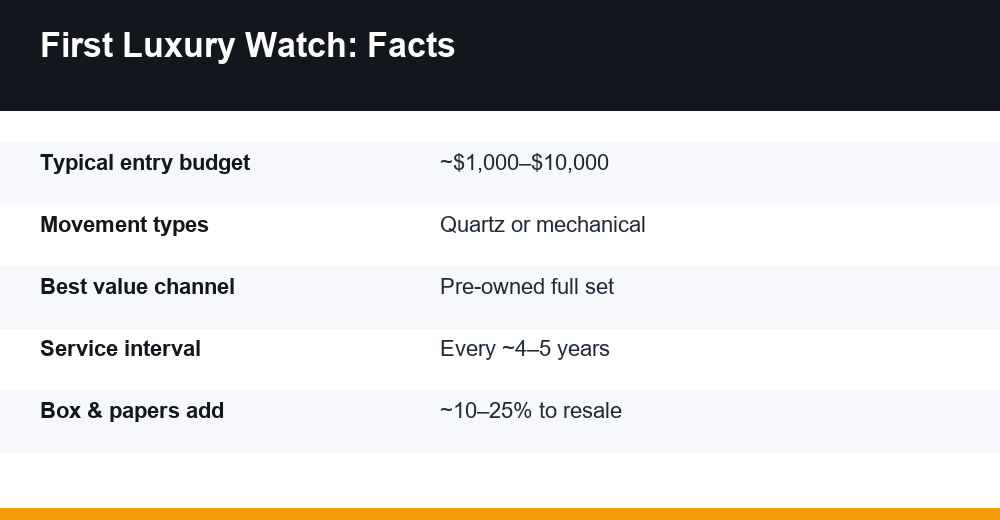
Most people enter the category somewhere between roughly $1,000 and $10,000. Below that, you are usually paying mainly for a name; above it, you move into serious collector territory that a first-time buyer rarely needs.
The sticker price is only the start. Build a realistic picture of the total cost of ownership before you commit, because a watch you cannot comfortably afford to maintain becomes a burden rather than a pleasure.
- Servicing: a full service every few years typically starts from a few hundred dollars, and costs more for chronographs and other complicated movements.
- Insurance: usually a small annual percentage of the watch’s value, and well worth it for anything you wear daily.
- Straps and bracelets: quality leather, rubber or metal options add up quickly if you like to change the look.
- Taxes, duty and shipping: these can be significant, especially on imported or grey-market pieces.
A useful principle is to buy once and buy well. Stretching a little for the watch you actually want usually beats buying two compromises you later sell at a loss.
One 2026 wrinkle is worth noting. Recent tariff and pricing changes have narrowed the gap between grey-market and authorized-dealer prices in several markets, so always compare the true landed cost rather than the headline discount.
Finally, resist the urge to finance a first watch you cannot pay for outright. A watch is a discretionary purchase, not something you must own, and buying within your means keeps the experience enjoyable rather than stressful.
Movements, Materials and What You’re Paying For
Understanding what sits inside and outside the case helps you judge whether a price is fair, and it stops you paying luxury money for fashion-watch engineering.
Movement: quartz versus mechanical
A quartz movement is battery-powered, highly accurate and low-maintenance. A mechanical movement, most often automatic (self-winding), is driven by a wound mainspring, and it is what most enthusiasts mean by a ‘real’ watch. Neither is better in absolute terms; they simply suit different priorities and budgets.
Set realistic expectations for a mechanical piece. Even a fine automatic may gain or lose a few seconds a day, and it will stop if left unworn and unwound. That is normal behaviour, not a fault. If set-and-forget accuracy matters most to you, quartz is the sensible choice.
Two everyday terms are worth knowing. Power reserve is how long a mechanical watch runs once fully wound, commonly around two days on modern movements. Complications are functions beyond telling the time, such as a date, chronograph or moonphase; each one adds cost and servicing complexity.
If precision is a priority, look for chronometer certification, an independent accuracy standard. You can read neutral technical background on COSC chronometer certification before you start shopping.
Materials, water resistance and finishing
- Case: stainless steel is the sensible all-rounder; precious metals add cost, weight and softness.
- Crystal: sapphire resists scratches far better than mineral glass or acrylic.
- Water resistance: read the rating conservatively, and never assume an older or unserviced watch is still sealed.
- Finishing: crisp edges, even brushing and clean dial printing are what separate genuine luxury from imitation.
Water-resistance ratings confuse many first-time buyers. They are tested under stable laboratory conditions, so treat the figures as a guide rather than a promise, and have the seals checked at every service. As a rough real-world guide:
| Rating | In practice |
|---|---|
| 30m / 3 bar | Rain and splashes only, not swimming |
| 50m / 5 bar | Light swimming in shallow water |
| 100m / 10 bar | Swimming and snorkelling |
| 200m / 20 bar | Recreational scuba diving |
| 300m+ / 30 bar+ | Serious and professional diving |
Brands and Iconic Entry-Level Models Worth Knowing
You do not need to memorise the whole industry. A handful of brands reliably offer strong value and genuine watchmaking at the entry level, including Tudor, Omega, Longines, Oris, Grand Seiko, TAG Heuer, Cartier and, at the upper end, Rolex.
Character matters as much as the badge. Omega leans sporty and space-age, Cartier is elegant and design-led, Grand Seiko obsesses over dials and finishing, and Tudor offers Rolex-adjacent toughness at a friendlier price. There is no wrong answer, only the one that speaks to you.
A few references have earned near-iconic status and make sensible first purchases. The notes below are deliberately general, so always confirm the current specification and price with a trusted source before buying.
- Omega Speedmaster Moonwatch: a hand-wound chronograph with genuine space heritage and timeless looks. Our Omega Speedmaster Moonwatch review covers the variants in detail.
- Tudor Black Bay 58: a compact, vintage-flavoured automatic diver that is often available without a long wait, as we explain in our Tudor Black Bay 58 review.
- Rolex Oyster Perpetual: the most accessible way into Rolex, though popular sizes and dial colours can carry long authorized-dealer waitlists.
- Cartier Tank: the archetypal dress watch, offered in both quartz and mechanical forms across a wide price range.
- TAG Heuer Carrera: a motorsport-inspired chronograph with accessible Swiss appeal.
- Longines, Oris and Grand Seiko: quieter names that deliver excellent movements and finishing for the money, and rarely require queuing.
Fit is personal. A 39mm watch can look large on a slim wrist and modest on a broad one, so pay attention to case diameter, thickness and lug-to-lug length rather than headline numbers alone. The most striking watch in photos is worth little if it wears awkwardly on you.
Above all, buy a style you will actually wear. A dive watch, a dress watch and a chronograph are very different companions, and the best first luxury watch is the one that fits your daily life rather than the one with the loudest online following. Try pieces on in person whenever you can.
Where to Buy: New, Pre-Owned and the Grey Market
Where you buy matters almost as much as what you buy. Each channel trades price against safety, so match it to your appetite for risk and your need for a warranty.
| Channel | Typical price | Warranty | Main risk |
|---|---|---|---|
| Authorized dealer | Full retail (MSRP) | Full factory | Waitlists, premium |
| Brand boutique | Full retail (MSRP) | Full factory | Limited stock |
| Grey market | ~10–30% below MSRP | Dealer, not factory | No factory cover |
| Pre-owned specialist | Below new, varies | Dealer warranty | Authenticity |
| Private sale | Lowest, varies | None | Fakes, no recourse |
Authorized dealers and brand boutiques give you a full factory warranty and complete peace of mind, at full retail. Building a genuine relationship with a dealer can also help you reach waitlisted models over time.
The secondary market often offers the best value, but only when you buy from someone who authenticates the watch and stands behind the sale. Established online marketplaces can be excellent too, provided they offer buyer protection, authentication or escrow. The platform’s safeguards, not the listing alone, are what protect your money.
- Ask for clear, current photos of the dial, caseback, clasp and any serial numbers.
- Confirm a return window and a written authenticity guarantee in advance.
- Check the seller’s track record and independent reviews before you pay.
- Be wary of prices well below market; a deal that feels too good usually is.
If you are buying pre-owned, a quick independent valuation or a second opinion from an enthusiast forum can save you from a costly mistake. A few minutes of research often reveals whether a price is fair or optimistic.
Resale Value, Papers and Servicing
Even if you never plan to sell, buying with value in mind protects you. The single biggest factor is completeness.
A full set, meaning the watch with its original box, warranty card, manuals and receipt, typically commands noticeably more than the same watch sold alone, often in the region of 10 to 25 percent.
- Condition: light, honest wear is expected; deep scratches, dings and a battered bracelet are not.
- Originality: swapping dials, hands or bezels for non-factory parts can sharply reduce value.
- Over-polishing: aggressive polishing removes metal and blurs the crisp edges collectors prize.
- Service history: documented, on-time servicing reassures the next owner and supports the price.
Bear in mind that some watches are far more liquid than others. Popular steel sports models from strong brands sell quickly and hold value well, while unusual sizes, colours or obscure references can take longer and fetch less. Liquidity is worth weighing even on a first purchase.
On maintenance, a widely used guideline is a full service every four to five years, though several modern movements comfortably go longer. Follow the manufacturer’s advice, keep the receipts, and store the watch safely when it is off your wrist.
Insurance deserves a line of its own. A specialist watch policy, or a rider on your home cover, guards against loss, theft and accidental damage for a modest yearly sum, and it is far cheaper than replacing an uninsured piece.
Common Mistakes to Avoid With Your First Luxury Watch
A few predictable errors trip up almost every beginner, and avoiding them is far easier than fixing them later.
- Buying on hype. Chasing whatever is trending online often means overpaying for a watch you will not love in three years.
- Ignoring fit. Check the case diameter and, just as important, the lug-to-lug distance against your own wrist before you commit.
- Forgetting the running costs. Budget for servicing and insurance from the very first day.
- Skipping authentication. On the secondary market, never send money before you have verified both the seller and the watch.
- Neglecting the details. Losing the papers or over-polishing the case quietly erodes value over the years.
Approached calmly, your first luxury watch should bring pleasure for decades and, quite possibly, prove a sound store of value. Buy the piece you genuinely want, from a source you trust, then simply enjoy wearing it.
A Simple Step-by-Step Buying Process
If it all feels overwhelming, a simple sequence keeps you on track and reduces the risk of an expensive impulse.
- Set a firm all-in budget, including servicing and insurance, and stick to it.
- Shortlist two or three styles you would happily wear every week, not just admire online.
- Research honest reviews and real transaction prices, not just list prices.
- Try the shortlist on in person to judge size, weight and comfort.
- Compare the channels, then buy from the safest source your budget allows.
- Keep every box, paper and service receipt from the moment the watch is yours.
There is no prize for rushing. The right watch bought a month later almost always beats the wrong watch bought today.
Frequently Asked Questions
What is a sensible budget for a beginner?
Most newcomers spend somewhere between roughly $1,000 and $10,000. That range buys genuine Swiss or Japanese watchmaking without pushing into pure collector territory. Whatever figure you settle on, leave room for servicing and insurance, which are ongoing costs rather than one-off ones.
Is it better to buy new or pre-owned?
Neither is automatically better. New from an authorized dealer gives you a full factory warranty and complete peace of mind. Pre-owned from a reputable specialist usually offers more watch for the money, especially with box and papers. Match the choice to your budget and your comfort with risk.
Do box and papers really matter?
Yes, more than many first-time buyers expect. A complete set, meaning the watch with its original box, warranty card and receipt, typically resells for noticeably more than the watch alone. Keep everything from day one; it costs nothing and protects your future resale value.
How often should a luxury watch be serviced?
A common guideline is a full service every four to five years, though some modern movements comfortably go longer. Watch for warning signs such as poor timekeeping or a shorter power reserve. Regular, documented servicing keeps the watch reliable and reassures any future buyer.