
Shopping for the best gmt watches under 1000 is easier once you know whether a watch is a flyer or a caller GMT, because that one detail decides how it behaves when you land somewhere new. Most roundups skip it. This guide explains the mechanics first, then gives you eight mechanical and quartz picks sorted by budget and GMT type.
Table of Contents
What Is a GMT Watch and How Does It Work?
A GMT watch shows at least two time zones at once. Alongside the usual hour, minute and seconds hands, it has a fourth hand that makes one full turn every 24 hours. That hand points to a 24-hour scale, printed on the dial, on a flange (the inner ring around the dial) or on a rotating bezel.
Because the extra hand moves at half the speed of the normal hour hand, it tells you whether it is 3 a.m. or 3 p.m. in the second zone. That is the whole trick, and it is why pilots, frequent flyers and people with family abroad keep coming back to the complication.
The name comes from Greenwich Mean Time, the old reference for world time. Today most owners simply use the function to track home time while travelling, or to keep an eye on a colleague’s working hours on another continent.
- 12-hour hand: one zone, read normally
- 24-hour hand: a second zone, read against the 24-hour scale
- Rotating 24-hour bezel (on many models): lets you add a third zone
One thing to watch for in this price range: some quartz models are sold as “dual time” rather than GMT. They still show two zones, but the second zone may sit in a small sub-dial instead of being read from a central 24-hour hand. Every watch in this guide uses the classic central-hand layout.
Flyer vs Caller GMT: The Difference Most Lists Skip
Every GMT shows two zones, but movements differ in which hand you can adjust on its own. That choice changes how convenient the watch is in daily use. If you want the background on calibers first, our guide to how watch movements work covers the basics.
Flyer GMT (also called traveller or true GMT)
On a flyer, the main 12-hour hand jumps in one-hour steps while the watch keeps running. The 24-hour hand stays on home time. When you land in a new city, you pull the crown out one click and move the local hour hand. On most flyer movements the date follows the local hour hand, so it changes correctly as you cross midnight in either direction.
Caller GMT (also called office GMT)
On a caller, the 24-hour hand is the one you set independently. The main hands stay on the time where you are, and the GMT hand tracks the person you need to call. To change local time after a flight, you reset the main hands, which on most mechanical callers means briefly stopping the seconds and losing a little precision.
| Feature | Flyer GMT | Caller GMT |
|---|---|---|
| Independently set hand | Local 12-hour hand | 24-hour GMT hand |
| Best for | Frequent flyers | Office use, remote teams |
| Changing local time | Quick, watch keeps running | Reset main hands |
| Date follows | Local time (usually) | Main hands |
| Typical budget calibers | Miyota 9075, Sellita SW330-2, Citizen B877 | Seiko 4R34 |
Neither design is wrong. A caller is perfectly useful if you mostly stay home and work across zones, because you rarely touch the main hands. Collectors call flyers “true” GMTs because they suit the original travel purpose of the complication, and that label matters if you plan to resell.
How to Read Three Time Zones on a GMT Watch
If your watch has a rotating 24-hour bezel, you can track a third zone. It sounds complicated, but the routine takes about ten seconds once you have done it twice.
- Zone 1: read the main hour and minute hands as normal.
- Zone 2: set the 24-hour hand to home time, with the bezel at its neutral position (the 24 or triangle at 12 o’clock). Read the GMT hand against the bezel.
- Zone 3: rotate the bezel by the hour difference between zone 2 and zone 3. For a zone five hours ahead, turn the bezel so the scale shifts five hours. The GMT hand now reads zone 3 on the bezel.
- Read zone 2 again by mentally reversing the offset, or by turning the bezel back to neutral.
A worked example: you live in London, you are working in Dubai, and your client is in New York. Set the local hands to Dubai time, the GMT hand to London on a neutral bezel, then turn the bezel so New York (five hours behind London) reads off the same hand.
A bezel with clicks (ratcheting) makes this easier because each click maps cleanly to an hour or half-hour. A friction bezel works but needs more care. Watches with a fixed 24-hour scale on the dial or flange, such as most Seiko 5 Sports GMT references, show only two zones.
Best GMT Watches Under 1000 Compared
Here are the best gmt watches under 1000 side by side, including one stretch pick for those happy to go a little over. Prices are approximate US retail figures at the time of writing and move with sales, tariffs and colourways, so treat them as a guide and check current listings before buying.
| Watch | Movement | GMT type | Approx. price |
|---|---|---|---|
| Q Timex GMT | Quartz | Quartz 24-hour hand | About $180-$230 |
| Citizen Promaster GMT (BJ7) | Eco-Drive B877 quartz | Flyer-style | About $440-$595 |
| Seiko 5 Sports GMT | Seiko 4R34 automatic | Caller | From about $475 |
| Lorier Hyperion | Miyota 9075 automatic | Flyer | About $799 |
| Bulova Wilton GMT | Miyota 9075 automatic | Flyer | About $875-$895 |
| Traska Venturer GMT | Miyota 9075 automatic | Flyer | About $950 |
| Christopher Ward C63 Sealander GMT 36mm | Sellita SW330-2 automatic | Flyer | Around $1,000 (varies) |
| Baltic Aquascaphe GMT Mk-II | Miyota 9075 automatic | Flyer | From €850 (stretch pick) |
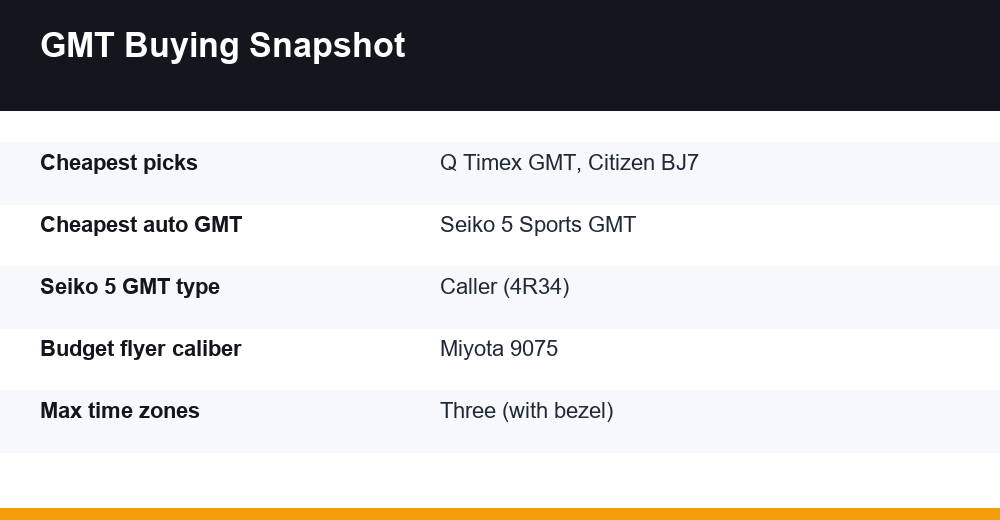
The table follows a simple logic. Quartz sits at the bottom, Seiko’s caller holds the cheapest automatic slot, and the Miyota 9075 cluster fills the $800 to $1,000 band. The Swiss-powered Christopher Ward and the Baltic sit right on the line.
If you are not set on a second time zone, our wider list of the best watches under $1,000 covers divers, field watches and dress pieces in the same bracket.
Mechanical Flyer GMT Picks
The Miyota 9075 reshaped the market for the best gmt watches under 1000. It is an automatic flyer GMT running at 28,800 vibrations per hour with roughly 42 hours of power reserve. The local hour hand jumps in one-hour steps and drags the date with it. One trade-off: there is no separate quick-set date, so correcting the calendar means cycling the hour hand.
Bulova Wilton GMT: the big-brand flyer
Bulova launched the Wilton GMT at a suggested $875 for the steel, blue-dial version and $895 for the gold-tone version. It is one of the few watches from a mainstream brand with a true GMT movement under $1,000, which matters if you want easy servicing and wide retail availability. Authorised dealers sometimes discount it noticeably.
The styling is dressier than most travel watches, with a world-map dial on some versions. Note the modest water resistance: it is a city and airport watch rather than a swimmer.
Lorier Hyperion: compact and vintage-flavoured
Lorier’s relaunched Hyperion is listed at $799 with a 39mm case and 100m water resistance, powered by the Miyota 9075. It suits smaller wrists and people who like a 1960s look. Lorier tends to sell in batches, so stock can come and go.
Traska Venturer GMT: the tough daily option
The current Venturer GMT debuted at $950. It measures 38.5mm with 150m water resistance, a screw-down crown and a sapphire crystal. Earlier generations sold for less, so used examples can be good value. It is the pick for someone who wants one watch for travel, the office and the beach.
Christopher Ward C63 Sealander GMT 36mm: the Swiss stretch
The 36mm C63 Sealander GMT starts at roughly £895 to £905 on a strap in the UK, with bracelet versions costing more. It uses the Swiss Sellita SW330-2 flyer movement with a 56-hour power reserve and 150m water resistance. In US dollars it sits right around the $1,000 line, so it only qualifies on the right strap or during a promotion.
Baltic Aquascaphe GMT Mk-II: just over the line
Baltic’s second-generation Aquascaphe GMT switched to the Miyota 9075, which made it cheaper than the model it replaced. It starts at €850 on rubber and €915 on a steel bracelet, with a 39.5mm case and 200m water resistance. Depending on exchange rates and import costs, US buyers will land close to or slightly above $1,000.
Is the Seiko 5 GMT a True GMT?
No, not in the collector’s sense. The Seiko 5 Sports GMT uses the caliber 4R34, a GMT version of the 4R36 found in time-only Seiko 5 Sports models, with the day display replaced by a 24-hour hand. On the 4R34, the 24-hour hand is the one you set independently, which makes it a caller GMT.
That does not make it a bad watch. According to Seiko’s official launch announcement, the series went on sale worldwide from July 2022. The 4R34 beats at 21,600 vibrations per hour with a 41-hour power reserve, in a 42.5mm case with 100m water resistance. It launched at around $475 in the US, and newer colourways and limited editions cost more.
- Choose it if you want the cheapest automatic GMT from a major brand and mainly track a second zone from home.
- Skip it if you fly often and want to jump local time without touching the minute hand.
- The fixed 24-hour scale on the flange of most references means two zones, not three.
For many buyers, the Seiko 5 GMT is the most sensible entry into mechanical GMTs. It is also an easy watch to service and modify, with a huge aftermarket. Just know what you are buying.
Quartz GMT Picks for Tight Budgets
Among the best gmt watches under 1000, quartz is the honest answer if accuracy and price matter more than a sweeping seconds hand. Both picks here usually cost well under $600. For more budget options without a GMT, see our roundup of the best affordable watches.
Citizen Promaster GMT (BJ7 series)
Citizen’s BJ7 Promaster GMT models use the solar-powered Eco-Drive B877. Citizen’s own manual describes moving the hour hand in one-hour increments to show a different time from the 24-hour hand, which is flyer behaviour in a quartz watch. Retail runs from about $440 on sale to around $595, and Eco-Drive keeps it running for months without light.
One caveat: the date is linked to the local hour hand, and Citizen advises setting the date after adjusting the hour and avoiding date changes between 9 p.m. and 1 a.m. Do not confuse the BJ7 with the newer Promaster Land GMT, which uses a different caliber.
Q Timex GMT
The Q Timex GMT is the lowest-cost route here, typically selling around $180 to $230 depending on version and sales. It has a 38mm steel case, a domed acrylic crystal, a quartz movement with a 24-hour hand and a two-tone bezel. Reviewers praise the vintage look and criticise the bracelet and the non-ratcheting bezel.
It is a style piece first, but the GMT function genuinely works for tracking a second zone. Timex has also released a related 39mm Q Timex Continental GMT, so check which model you are looking at.
What Is the Cheapest True GMT Watch?
It depends on whether you count quartz. Among quartz models, a Citizen BJ7 Promaster GMT on sale is likely the cheapest watch with an independently jumping local hour hand from a major brand. Discounted examples regularly appear below list price.
Among automatics, the Miyota 9075 sets the floor. Lorier’s Hyperion at around $799 and the Bulova Wilton GMT at about $875 are the most affordable new options we could verify, and they anchor any shortlist of the best gmt watches under 1000. Microbrands release 9075 watches regularly, so prices shift and limited runs sell out.
| Category | Cheapest verified option | GMT type |
|---|---|---|
| Any GMT, any movement | Q Timex GMT | Quartz 24-hour hand |
| Quartz flyer-style | Citizen Promaster GMT (BJ7) | Flyer-style |
| Automatic, any type | Seiko 5 Sports GMT | Caller |
| Automatic flyer, new | Lorier Hyperion | Flyer |
| Automatic flyer, big brand | Bulova Wilton GMT | Flyer |
Pre-owned changes the picture. Earlier Traska and Lorier models, and discounted Bulovas, sometimes trade well below the new prices above. Buy from a seller who offers returns, and ask whether the GMT complication was tested.
How to Choose the Right Travel GMT
Narrowing down the best gmt watches under 1000 comes down to how you actually use a second time zone. Run through these questions before you buy.
- Do you fly often? Pick a flyer such as a Miyota 9075 watch or the Citizen BJ7.
- Do you mostly work across zones from home? A caller like the Seiko 5 Sports GMT is fine and cheaper.
- Need three zones? Choose a rotating 24-hour bezel, ideally one that clicks.
- Small wrist? Look at the 36mm Christopher Ward, 38mm Q Timex or 38.5mm Traska.
- Hate setting watches? Quartz Eco-Drive keeps running for months without wearing.
A few practical checks matter too. Look at bracelet quality, since budget bracelets are often the weak point. Check whether the crown screws down if you swim. And confirm whether the date follows local or home time, because that affects how often you will reset it.
Whichever you choose, read the product description for the GMT type. Brands rarely put “caller” on the spec sheet, but phrases like “independently adjustable hour hand” or “jumping local hour” signal a flyer, while “independently adjustable 24-hour hand” signals a caller.
If you are still torn, think about your next five trips. Frequent time-zone changes favour a flyer. Calls and meetings across zones from one desk favour a caller or a quartz piece, and save you money for a second strap.
Frequently Asked Questions
What is a GMT watch and how does it work?
A GMT watch tracks two time zones with an extra hand that rotates once every 24 hours. You read it against a 24-hour scale on the dial, flange or bezel. Because it moves at half the speed of the normal hour hand, it shows whether the second zone is in the morning or evening, which a regular 12-hour dial cannot.
What is the difference between a flyer GMT and a caller GMT?
On a flyer GMT, the local 12-hour hand jumps in one-hour steps while the 24-hour hand stays on home time, which is ideal when you travel. On a caller GMT, the 24-hour hand is set independently and the main hands stay on local time, which suits people tracking a colleague abroad from home.
Is the Seiko 5 GMT a true GMT?
Not in the collector’s sense. The Seiko 5 Sports GMT uses the caliber 4R34, where the 24-hour hand is set independently, making it a caller GMT. It still shows two time zones accurately and is one of the cheapest automatic GMTs from a major brand, but it is less convenient for frequent flyers.
What is the cheapest true GMT watch?
Counting quartz, a discounted Citizen Promaster GMT with the Eco-Drive B877 is among the cheapest flyer-style options from a big brand. For automatics, Miyota 9075 watches set the floor, with the Lorier Hyperion at about $799 and the Bulova Wilton GMT at about $875. Prices change, so check current listings.