
The best watches under 1000 sit in a narrow but rewarding band: past the entry-level Seiko 5 and Orient territory, but well short of the luxury tier. This guide covers only the $500 to $1,000 step-up range and explains, part by part, what the extra spend actually buys you. Movement specs are checked against brand information, and prices are given as approximate ranges because they shift often.
Table of Contents
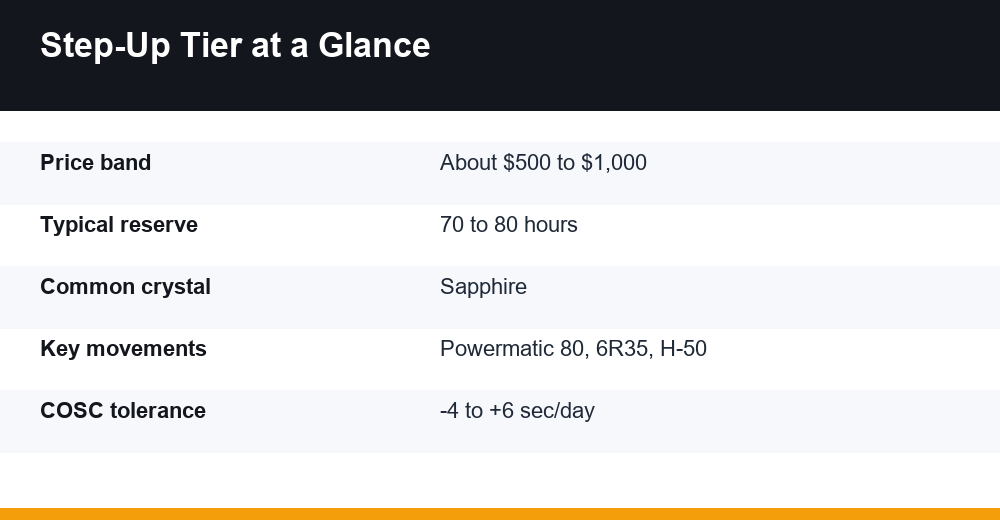
What the extra money buys over sub-$500 watches
Below $500, the market runs on excellent workhorse movements such as Seiko’s 4R family and the Miyota 8 and 9 series. They are reliable, but they usually offer around 40 to 50 hours of reserve, fairly wide accuracy tolerances and, on many models, mineral or Hardlex crystals. That is the territory we cover in our guide to the best affordable watches.
Step up to the $500 to $1,000 tier and four things change at once. None of them is dramatic on its own, but together they make the watch noticeably nicer to live with every day.
- Power reserve: Tissot’s Powermatic 80 and Hamilton’s H-50 and H-10 offer up to 80 hours, Seiko’s 6R35 about 70. Take the watch off on Friday evening and it is still running on Monday morning.
- Sapphire crystal: close to standard at this price, and far more scratch-resistant than mineral glass.
- Magnetism resistance: Tissot’s Nivachron balance spring is a titanium-based alloy designed to shrug off everyday magnetic fields from phones, laptops and bag clasps.
- Finishing and bracelets: better-machined clasps, solid end links, cleaner dial printing and sharper case edges.
Is a $1000 watch worth it over a $300 watch?
For most people, yes, but only if you wear a mechanical watch several days a week. The jump from roughly 40 to 70 or 80 hours of reserve removes the routine of resetting the time, and sapphire keeps the watch looking new for years. If your watch lives in a drawer most of the week, a well-chosen $300 piece will serve you just as well.
What you do not get is a fundamentally different object. Timekeeping on a $900 automatic is not in quartz territory, and the gains are refinement rather than revolution. The best watches under 1000 reward daily wear, not bragging rights.
| Feature | Typical under $500 | Typical $500-$1,000 |
|---|---|---|
| Power reserve | About 40-50 h | About 70-80 h |
| Crystal | Mineral or Hardlex common | Sapphire common |
| Magnetism protection | Basic | Nivachron or silicon spring on some models |
| Bracelet | Folded or hollow links common | Solid links, better clasps |
| Swiss-made options | Few | Many |
How we chose the best watches under 1000
We limited the list to watches whose regular new price sits roughly between $500 and $1,000 in the US, and checked movement specifications against brand information rather than marketplace copy. Where list prices vary between dealers or have changed recently, we give an approximate range.
- Movement first: ideally 70 hours of reserve or more, or a hand-wound movement with a clear reason to exist.
- Materials: sapphire crystal and a stainless steel or titanium case where possible.
- Serviceability: movements that watchmakers can realistically service.
- Value against the sub-$500 alternative: each pick must offer something a cheaper watch cannot.
- Wearability: sensible sizing, with options under 40mm where they exist.
Prices in this tier have crept upward over recent years through inflation, currency shifts and tariffs. Treat every figure here as a guide and confirm current pricing with an authorised dealer or the brand before buying. Second-hand prices are often far lower, but they come without the full brand warranty.
The 10 best watches under 1000 for 2026
The table gives the quick comparison. Detailed notes on each watch follow. All prices are approximate new US prices and vary by size, strap and dealer.
| Watch | Movement | Reserve | Approx. price (USD) | Best for |
|---|---|---|---|---|
| Tissot PRX Powermatic 80 (35/40mm) | Powermatic 80 | Up to 80 h | About $800-$900 | Integrated-bracelet style |
| Hamilton Khaki Field Mechanical 38mm | H-50 hand-wound | 80 h | About $595-$695 | Daily field watch |
| Hamilton Khaki Field Auto | H-10 | 80 h | About $775-$995 | Automatic field watch |
| Certina DS Action Diver Powermatic 80 | Powermatic 80 | Up to 80 h | Close to $1,000 | ISO 6425 dive watch |
| Seiko Prospex Alpinist (6R35) | 6R35 | About 70 h | About $725-$950 | Travel and outdoor |
| Seiko Presage Cocktail Time | 4R35 | About 41 h | About $450-$650 | Dress and evenings |
| Christopher Ward C63 Sealander | Sellita SW200-1 | About 38 h | About $700-$850 | Microbrand all-rounder |
| Baltic Aquascaphe | Varies by version | Varies | Under $1,000 for most versions | Vintage-style diver |
| Tissot Gentleman Powermatic 80 Silicium | Powermatic 80 | Up to 80 h | Under $1,000 in most markets | Office and smart casual |
| Tissot Seastar 1000 Powermatic 80 | Powermatic 80 | Up to 80 h | Under $1,000 in most markets | Value 300m diver |
1. Tissot PRX Powermatic 80
The default answer for a reason. A 1970s-inspired integrated-bracelet case, a waffle-textured dial, sapphire and the Powermatic 80 with a Nivachron hairspring. Steel models sit in the high hundreds of dollars new, with the 35mm a little cheaper than the 40mm. We cover sizing and the bracelet in depth in our Tissot PRX 40 205 review.
2. Hamilton Khaki Field Mechanical
A 38mm hand-wound field watch with the H-50 movement and an 80-hour reserve. Winding it each morning becomes a small ritual, and the slim case slides under any cuff. Water resistance is 50m, so treat it as a daily watch rather than a swimming companion. Pricing generally lands between about $595 and $695 depending on strap and dealer.
3. Hamilton Khaki Field Auto
The automatic sibling uses the H-10 movement, also rated at 80 hours, with a sapphire crystal and 100m water resistance on current models. Expect roughly $775 to $995 depending on size and bracelet. Choose it over the Mechanical if you dislike daily winding.
4. Certina DS Action Diver Powermatic 80
Certina is Tissot’s Swatch Group sister, and the DS Action Diver shares the 80-hour Powermatic 80. The headline is ISO 6425 conformity with 300m water resistance, which means the watch meets the formal dive-watch standard rather than simply carrying a depth rating. Sizes include 38mm, 40.5mm and 43mm, and some versions climb just past $1,000, so check the reference.
5. Seiko Prospex Alpinist (6R35)
The modern Alpinist line uses Seiko’s 6R35: 24 jewels, 21,600 vph and about 70 hours of reserve, with hand-winding and hacking. The green-dial SPB121 remains the classic choice, and core references have retailed from roughly $725. Limited editions cost more and are sometimes region-exclusive, so not every Alpinist fits this budget.
6. Seiko Presage Cocktail Time
Seiko’s textured, glossy dials are the attraction here, with the reliable 4R35 inside. It is the one pick without a long reserve, and many references use Hardlex rather than sapphire, but nothing else in this range looks as good under restaurant lighting. Retail has varied between about $450 and $650 depending on reference.
7. Christopher Ward C63 Sealander
The British brand’s everyday sports watch: a 39mm case, 150m water resistance, a Swiss Sellita SW200-1 and finishing that punches above its price, which has generally sat in the $700 to $850 range depending on strap. A strong option if you want Swiss-made without the Swatch Group ecosystem, though the reserve is only around 38 hours.
8. Baltic Aquascaphe
A French microbrand diver with tasteful vintage proportions. Movement and price depend on the version, with most configurations sitting well under $1,000, so check the specification for the exact reference before you order.
9. Tissot Gentleman Powermatic 80 Silicium
A clean, versatile 40mm three-hander with a silicon balance spring and the same 80-hour reserve. It suits an office better than the PRX and costs a similar amount.
10. Tissot Seastar 1000 Powermatic 80
A 300m diver with the Powermatic 80 inside, typically priced below the Certina and often discounted by dealers. If you travel across time zones more than you dive, see our guide to the best GMT watches under $1,000 instead.
What is the best automatic watch under $1000?
For a single recommendation, the Tissot PRX Powermatic 80 is the most complete automatic in this price band. It combines an 80-hour reserve, a magnetism-resistant hairspring, sapphire and a well-finished integrated bracelet, all below $1,000 new for steel models.
That said, the best automatic depends on what you will do with it. The comparison below matches movement strengths to use cases.
| Movement | Reserve | Strengths | Watch out for |
|---|---|---|---|
| Tissot Powermatic 80 | Up to 80 h | Long reserve, Nivachron spring, wide model range | Some parts supplied only to approved watchmakers |
| Hamilton H-10 | 80 h | Related Swatch Group architecture, field styling | Similar servicing considerations |
| Seiko 6R35 | About 70 h | Robust, in-house, hand-winding | Accuracy tolerance wider than COSC |
| Sellita SW200-1 | About 38 h | Widely serviced Swiss workhorse | Shorter reserve |
| Seiko 4R35 | About 41 h | Cheap to service, very durable | Hardlex crystal on many models |
If accuracy matters most, look for chronometer certification. The official COSC FAQ states that a certified mechanical chronometer must run within -4 to +6 seconds per day on average. Few watches under $1,000 carry it, though Tissot offers a handful of COSC-certified Powermatic 80 models.
What is the best watch brand under $1000?
There is no single winner, but three names dominate the best watches under 1000 for different reasons:
- Tissot offers the widest choice of styles on one excellent movement, plus a large dealer network for warranty service.
- Seiko brings in-house movements, outstanding dial work and the Prospex sport range.
- Hamilton owns the field-watch category and gives you 80-hour movements in a slimmer, more military package.
Certina deserves a mention as the quiet value choice in the Swatch Group, especially for divers. Among independents, Christopher Ward and Baltic are the brands most often cross-shopped against the big names.
Pick the brand whose designs you love and whose servicing you can access locally. A great movement is wasted if your nearest authorised service centre is a long courier trip away.
Is Tissot a good watch brand?
Yes. Tissot was founded in Le Locle, Switzerland, in 1853 and is part of the Swatch Group, which gives it access to the group’s ETA movement production. That scale is why it can sell a Swiss automatic with an 80-hour reserve below $1,000.
The Powermatic 80 is the key technical reason to choose Tissot. Tissot rates it at up to 80 hours of reserve, against the roughly 38 to 42 hours of older Swiss workhorse calibres, and many versions pair it with the anti-magnetic Nivachron balance spring.
The honest caveats: Tissot is not a haute horlogerie brand, finishing is industrial rather than hand-decorated, and some Powermatic 80 versions use a synthetic escapement component that is typically replaced rather than repaired. For a daily wearer, those trade-offs are reasonable.
Are microbrand watches worth buying?
Often, yes. Microbrands sell mainly direct to customers, so more of your money goes into the case, bracelet and crystal instead of retail margins and advertising. Brands like Christopher Ward, Baltic and Lorier have built loyal followings this way, and several of them sit comfortably among the best watches under 1000.
The trade-offs are worth knowing before you order:
- Limited drops can sell out quickly, so availability is less predictable.
- Resale values are usually lower than Tissot, Seiko or Hamilton.
- Warranty service is often by post rather than at a local dealer.
- Movements are usually off-the-shelf Sellita or Miyota calibres, which helps servicing but means shorter reserves than the Powermatic 80.
Buy a microbrand when its design genuinely speaks to you and the build quality is visible. Skip it if you want the strongest resale or a nearby service network.
Buying checklist before you spend $1,000
Run through these checks before committing. They separate a watch you will wear for a decade from one you will sell in six months.
- Lug-to-lug length: more important than diameter for fit. Under about 48mm suits most wrists.
- Authorised dealer warranty: grey-market discounts can be tempting, but the brand warranty may not apply.
- Service intervals and cost: ask a local watchmaker whether they can service the movement.
- Bracelet quality: look for solid end links and micro-adjustment on the clasp.
- Water resistance: 100m is plenty for swimming; ISO 6425 only matters if you dive.
- Reserve vs. habits: if you rotate watches, 70 to 80 hours makes a real difference.
Shortlist two or three of the best watches under 1000 from the tables above, try them on in person if you can, and buy the one you keep looking at. In this price range, the watch you enjoy wearing is the right one.
Frequently Asked Questions
What is the best watch brand under $1000?
Tissot, Seiko and Hamilton lead this tier. Tissot gives the widest choice built around the 80-hour Powermatic 80, Seiko offers in-house movements and superb dials, and Hamilton dominates field watches. Certina is a strong value alternative for divers, while Christopher Ward and Baltic are the microbrands most worth considering.
Is a $1000 watch worth it over a $300 watch?
It is if you wear a mechanical watch often. The step-up tier typically adds a 70 to 80 hour power reserve, sapphire crystal, better magnetism resistance and nicer bracelets. If the watch sits unworn most days, a carefully chosen $300 automatic delivers most of the enjoyment for far less money.
What is the best automatic watch under $1000?
The Tissot PRX Powermatic 80 is the most complete all-rounder, pairing an 80-hour reserve and Nivachron hairspring with sapphire and an integrated bracelet. For outdoor use, the Seiko Prospex Alpinist with its 70-hour 6R35 is excellent, and the Certina DS Action Diver suits anyone needing an ISO 6425 diver.
Are microbrand watches worth buying?
Usually, yes. Selling direct lets microbrands spend more on cases, bracelets and crystals. The downsides are unpredictable stock, weaker resale values and postal warranty service. Pick one when the design truly appeals and the build quality is obvious, but stick with major brands if resale matters to you.