The sapphire vs mineral crystal question decides how your watch will look after five years of real wear, not just how it looks in the shop. Sapphire wins on scratches by a wide margin, but mineral glass and acrylic each have advantages that the hardness chart never shows. This guide covers impact behaviour, coatings, hybrid crystals, replacement costs and which glass actually suits the way you wear a watch.
Table of Contents
What Sapphire, Mineral and Acrylic Crystals Actually Are
Watchmakers call the transparent cover over the dial the crystal, even though only one of the three common materials is a crystal in the scientific sense. Knowing what each one is made of explains almost every difference that follows.
Sapphire crystal
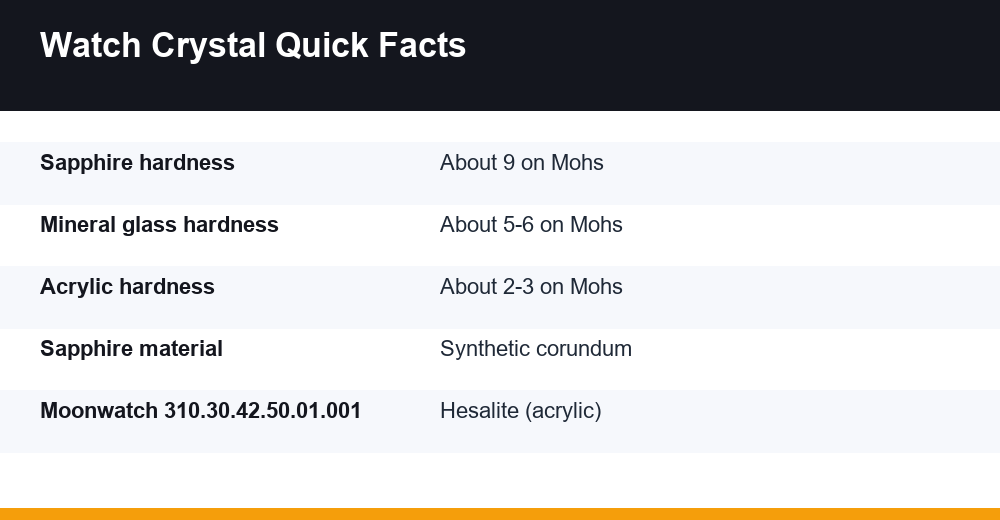
Watch sapphire is synthetic corundum, crystallised aluminium oxide grown in a lab, then sliced, ground and polished into discs or domes. It is the same mineral as natural sapphire and ruby, just colourless. On the Mohs scale it sits at 9, with only diamond (10) clearly above it.
Because it is so hard, sapphire is slow and expensive to cut and polish. That machining cost, rather than the raw material, is why sapphire is still treated as a selling point on watches above the entry-level price bracket.
Mineral crystal
Mineral crystal is ordinary glass that has been hardened by heat treatment, chemical treatment or both. It typically rates around 5 to 6 on the Mohs scale. It is cheap to produce, easy to shape and is the default on most fashion watches and many budget quartz models.
Acrylic crystal
Acrylic is a plastic, polymethyl methacrylate (PMMA), sometimes sold as Plexiglas. Omega calls its version Hesalite. It is the softest of the three, at roughly 2 to 3 on the Mohs scale, but also the most flexible and the easiest to polish back to clear.
- Sapphire: hardest, most scratch-resistant, most brittle under a sharp blow.
- Mineral: mid-range hardness, cheap, cracks more readily than people expect but is less brittle than sapphire.
- Acrylic: scratches easily, but rarely breaks apart and can be buffed clean at home.
Sapphire vs Mineral Crystal: The 5 Essential Differences
Spec sheets reduce the sapphire vs mineral crystal choice to a single hardness number. In daily wear, five separate factors matter, and they do not all point the same way.
1. Scratch resistance
This is sapphire’s decisive advantage. Ordinary dust and sand contain quartz, which is about 7 on the Mohs scale. Quartz grit is harder than mineral glass, so it leaves fine scratches over time, but it cannot scratch sapphire. That single fact explains why a mineral crystal looks hazy after a few years while sapphire on a similar watch still looks new.
2. Impact and shatter behaviour
Hardness and toughness are different properties. Sapphire is very hard but comparatively brittle, so a sharp knock on the edge can chip or crack it. Hardened mineral glass is softer yet a little more forgiving of shock. Neither is shatterproof, which is covered in detail below.
3. Clarity and glare
Sapphire has a high refractive index, so uncoated sapphire is quite reflective. Good sapphire watches use anti-reflective (AR) coating to fix this. Mineral glass reflects less on its own but rarely gets premium coatings at its price point.
4. Cost to the buyer
Sapphire adds cost at manufacture and at replacement. Mineral is cheap at both stages. For a fashion watch worn occasionally, the extra spend may never pay back.
5. Repairability
A scratched mineral crystal usually has to be replaced, since polishing glass is slow and can distort the surface. Sapphire is so rarely scratched that repair mostly means replacement after a crack. Acrylic is the outlier: light scratches can be polished out with a tube of plastic polish in minutes.
| Factor | Sapphire | Mineral | Acrylic / Hesalite |
|---|---|---|---|
| Mohs hardness (approx.) | 9 | 5-6 | 2-3 |
| Daily scratch resistance | Excellent | Fair | Poor |
| Behaviour under hard impact | Can chip or crack | Can crack | Usually cracks, rarely splinters |
| Glare without AR coating | High | Moderate | Low |
| Home repair of scratches | Not practical | Difficult | Easy with polish |
| Typical watch tier | Mid-range to luxury | Fashion and budget | Vintage, Moonwatch, some tool watches |
Can Sapphire Crystal Crack or Shatter?
Yes. Sapphire is scratch-resistant, not break-resistant. A crisp blow to the edge of the crystal, such as catching it on a stone countertop or a door frame, concentrates force at one point, and sapphire’s brittleness means it can chip, crack across or, in rare cases, break into pieces.
Watch design affects the risk a great deal. Several features help:
- A raised bezel that sits higher than the crystal takes knocks before the glass does, which is one reason dive watches with rotating bezels survive so well.
- Thicker crystals tolerate more stress. Tool watches often use noticeably thicker sapphire than dress watches.
- Flat or slightly domed profiles expose less edge than tall box or double-domed shapes.
- Proper gaskets let the crystal sit evenly in the case without stress points.
Mineral glass is not shatterproof either. Under a heavy impact it usually cracks into a spider pattern rather than chipping, and in practice it absorbs a little more shock before failing. If you work with your hands, the realistic risk with sapphire is an edge chip; with mineral it is a gradual build-up of scratches plus the occasional crack.
A cracked crystal of any type is a water-resistance problem. Stop wearing the watch near water and get the glass replaced quickly, because moisture can reach the dial and movement through even a hairline crack.
Anti-Reflective Coatings, Hardlex and Sapphire-Coated Mineral
Many watches fall between the two headline categories of the sapphire vs mineral crystal comparison. Reading spec sheets correctly means understanding the coatings and hybrids that brands use.
Anti-reflective coating: inside, outside or both
AR coating is a thin optical layer that cuts glare and makes the dial look as if there is no glass at all. The catch is that the coating is far softer than sapphire itself. That is why many brands, including several Swiss makers, apply AR only to the underside of the crystal, where it cannot be scratched.
Double-sided AR gives the best legibility, but the outer layer can wear or scuff. Those marks are often mistaken for scratches in the sapphire, when in fact the crystal underneath is untouched. If your sapphire watch seems to have ‘scratched’, a watchmaker can confirm whether only the coating is affected.
Hardlex and other hardened mineral glass
Seiko’s Hardlex is its proprietary hardened mineral glass, used across many affordable models, including much of the Seiko 5 Sports range. It is tougher and somewhat more scratch-resistant than basic mineral glass, but it is still glass, and quartz grit will mark it over time. Hardness figures quoted online vary widely, so treat any exact Mohs number for Hardlex as an estimate.
Sapphire-coated mineral crystal
Some budget brands advertise mineral glass with a thin sapphire layer on top, sometimes under trade names such as Invicta’s Flame Fusion. The surface layer resists light scratches better than plain mineral, but the coating is thin and the crystal does not have the full scratch resistance or longevity of solid sapphire. When comparing listings, treat sapphire-coated glass as an upgraded mineral crystal, not a sapphire equivalent.
| Spec sheet term | What it really means | Scratch resistance |
|---|---|---|
| Sapphire crystal | Solid synthetic corundum | Very high |
| Sapphire with AR inside | Solid sapphire, coating protected | Very high, coating safe |
| Sapphire with double AR | Solid sapphire, outer coating exposed | Glass very high, coating can wear |
| Sapphire-coated mineral | Glass with thin sapphire layer | Moderate to good |
| Hardlex | Seiko hardened mineral glass | Moderate |
| Mineral crystal | Hardened glass | Fair |
| Hesalite / acrylic | PMMA plastic | Low, but polishable |
Why Does the Speedmaster Still Use Hesalite?
The Omega Speedmaster Moonwatch Professional is the best-known modern watch still sold with an acrylic crystal. Omega’s own product page for reference 310.30.42.50.01.001 lists a Hesalite crystal with the Omega logo in the centre, a detail collectors look for.
The reason is history. The Speedmaster flown on NASA missions in the 1960s used Hesalite, and the usual explanation is that acrylic tends to crack rather than break into sharp fragments, a real concern in a weightless cabin where loose shards could float into eyes or equipment. That rationale is widely repeated by collectors and dealers, so treat it as the accepted account rather than a quoted NASA specification.
Today Hesalite is kept for three practical reasons:
- Heritage: it matches the flight-qualified configuration, which matters to many Moonwatch buyers.
- Look: the domed acrylic gives a warm, slightly distorted view of the dial at the edges that sapphire versions do not replicate exactly.
- Ease of care: surface scratches polish out with plastic polish, so an owner can restore clarity without a service visit.
Omega also sells Moonwatch Professional references with sapphire front and back, so buyers can choose, but check the exact reference before buying. Our full Speedmaster Moonwatch review compares the two versions in detail, including how they feel and wear day to day.
How to Tell If a Watch Has Sapphire Crystal
If a listing is vague or you are buying second-hand, a few simple checks will usually reveal the crystal type. None is perfect alone, so combine several.
- Check the official specs. Look up the exact reference number on the brand’s site. This is the most reliable method and the first step for any pre-owned purchase.
- Try the water drop test. Place a small drop of water on a clean, dry crystal. On sapphire it tends to bead up and hold its shape; on mineral glass it usually spreads out. Coatings and oils can skew the result.
- Feel the temperature. Sapphire conducts heat well and often feels noticeably cooler to the lips or fingertip than mineral glass or acrylic.
- Tap it lightly with a fingernail. Acrylic gives a dull, plasticky sound; glass and sapphire sound crisper.
- Inspect the reflections. Tilt the watch under a light. A blue or purple tint in reflections usually signals AR coating, which is more common on sapphire.
- Look for scratches with a loupe. Fine hairline scratches after years of wear suggest mineral or acrylic; older sapphire is often almost flawless.
The crystal is also a useful authenticity clue. Counterfeit makers often cut costs by fitting mineral glass where the genuine model uses sapphire, or by omitting details such as the centred logo in a Moonwatch’s Hesalite. Our guide on how to spot a fake watch covers crystal checks alongside dial, caseback and movement inspections.
Is It Worth Replacing Mineral Crystal With Sapphire?
Upgrading a mineral crystal to sapphire is a popular modification, especially on Seiko divers and other affordable mechanical watches. Whether it makes sense depends on the watch, its value to you and the availability of a correctly sized crystal.
Approximate replacement costs
Prices vary by country, watchmaker and crystal shape, so the figures below are rough estimates for independent repair shops, not brand service centres. Always ask for a quote that includes a water-resistance test.
| Job | Approximate cost (USD) | Notes |
|---|---|---|
| Generic mineral replacement | $30-$80 | Common sizes, fast turnaround |
| Aftermarket flat sapphire, fitted | $80-$200 | Depends on size and AR coating |
| Domed or shaped sapphire, fitted | $150-$300+ | Special shapes cost more |
| Hesalite or acrylic replacement | $40-$120 | Genuine brand parts cost more |
| Brand service centre crystal swap | Varies widely | Often bundled with a full service |
When the upgrade makes sense
- The watch is a daily wearer you plan to keep for many years.
- The current crystal is already scratched and needs replacing anyway.
- A reputable supplier makes a sapphire crystal in the exact diameter, thickness and profile, with a matching gasket.
- The watch is not a collectible whose value depends on original parts.
When it does not
- The fitting cost is close to what the watch itself is worth.
- It is a vintage or limited piece where originality affects resale value.
- You wear it only occasionally, so scratches build up slowly.
For a modern daily watch, settling the sapphire vs mineral crystal question in favour of sapphire at the first replacement is often sensible, because you pay the labour once and then rarely think about scratches again. Keep the original crystal in case you sell the watch later.
Which Crystal Suits Your Watch Use?
So, is sapphire crystal better than mineral glass? For most people who wear one watch daily, yes, because scratches are the most common form of wear and sapphire almost eliminates them. But the best choice depends on how and where you wear it.
| How you wear it | Best crystal | Why |
|---|---|---|
| Daily office and city wear | Sapphire with inner AR | Stays clear for years, little glare |
| Beach, hiking, sandy environments | Sapphire | Quartz grit scratches mineral, not sapphire |
| Manual work, workshops | Sapphire with raised bezel, or acrylic | Bezel protects edges; acrylic forgives knocks |
| Occasional fashion watch | Mineral | Low cost, light wear |
| Vintage-style or heritage pieces | Acrylic / Hesalite | Authentic look, easy polishing |
| Budget first mechanical | Hardlex or mineral, upgrade later | Keeps entry price down |
| Sports and diving | Thick sapphire | Scratch-proof, handles knocks at the bezel |
Budget buyers no longer have to compromise much. Sapphire has become standard on many well-made watches under a four-figure price, as our roundup of the best watches under $1,000 shows. Put simply, the sapphire vs mineral crystal choice comes down to this: pay a little more for sapphire on anything you will wear often, and accept mineral only where price matters more than longevity.
Whatever crystal you choose, a few habits extend its life: take the watch off for heavy manual work, avoid knocking it against hard edges, and wipe off grit with a soft cloth rather than rubbing it across the glass.
Frequently Asked Questions
Is sapphire crystal better than mineral glass?
For daily wear, usually yes. Sapphire rates about 9 on the Mohs scale versus roughly 5 to 6 for mineral glass, so everyday dust and grit cannot scratch it. Mineral glass costs less and is a little more forgiving of sharp knocks, which makes it acceptable on inexpensive fashion watches worn only occasionally.
Can sapphire crystal crack or shatter?
Yes. Sapphire resists scratches but is relatively brittle, so a sharp blow to its edge can chip or crack it, and in rare cases break it. Raised bezels, thicker crystals and flatter profiles reduce the risk. Mineral glass and acrylic can crack too, so no watch crystal is truly shatterproof.
How can you tell if a watch has sapphire crystal?
Check the reference number on the brand’s official site first. Physical clues help too: water drops tend to bead on sapphire and spread on mineral glass, sapphire feels cooler to the touch, and old sapphire rarely shows hairline scratches. Combine several tests, since coatings can skew individual results.
Is it worth replacing mineral crystal with sapphire?
It is worth it for a daily-wear watch you plan to keep, especially if the mineral crystal is already scratched and needs replacing. Make sure a correctly sized crystal and gasket are available and the water resistance is tested afterwards. Skip it on vintage pieces or when the fitting cost approaches the watch’s value.