
Most talk about colour-prediction round timers is about which mode feels most exciting, but a watch site sees them differently: as a measure of how much time, and money, a player hands over each hour. This explainer looks at the 30-second, 1-minute, 3-minute and 5-minute rounds these apps run, the arithmetic behind them, and how an ordinary watch alarm can act as a firm limit. It is for information only, written for adults, and does not encourage anyone to play.
Table of Contents
Why a Watch Site Cares About Countdown Apps
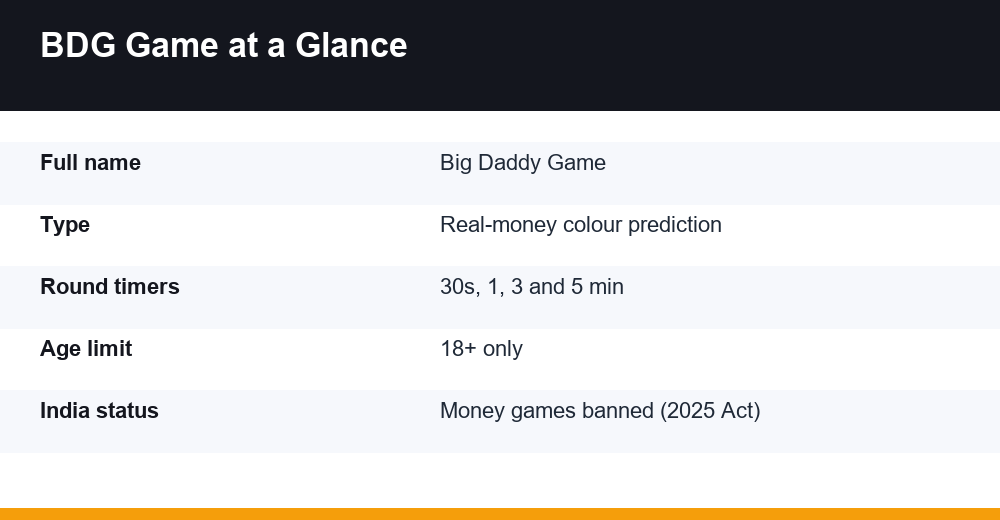
BDG Game, often expanded as “Big Daddy Game”, is a real-money colour-prediction and multi-game app marketed to players in India. In its best-known mode, players bet on the colour, digit or size of the next drawn number. A result arrives when a countdown reaches zero, and the next countdown starts straight away.
Let us be plain from the start. Real money is at risk, outcomes are decided by chance, and the payout structure carries a built-in house edge, so the expected value of every bet is negative for the player. The app is for adults (18+) only, and, as we explain later, Indian law now bans online money games outright.
If you have ever been tempted to treat colour prediction as a side income, compare it with something slower. Our guide to buying your first luxury watch is really about patience: saving steadily, doing the research and spending once on something that lasts. Fast-round apps are built on the opposite idea.
How the Round Timers Work
Like many colour-prediction platforms, this one runs its main game in several parallel “rooms”, each with its own countdown. Public descriptions usually list four standard speeds: 30 seconds, 1 minute, 3 minutes and 5 minutes.
Each room works the same way. A visible timer counts down, betting closes a few seconds before zero, a number is drawn and the result appears. The betting window then reopens almost at once. There is no interval and no closing bell. For a third-party overview of the timers and bet types, see this explainer of bdg game rounds, and read it as a description of the product, not a recommendation.
| Room | Round length | Max rounds per hour | Max rounds in a 2-hour evening |
|---|---|---|---|
| 30-second | 30 seconds | 120 | 240 |
| 1-minute | 60 seconds | 60 | 120 |
| 3-minute | 180 seconds | 20 | 40 |
| 5-minute | 300 seconds | 12 | 24 |
Turnover Maths and the House Edge
Players tend to think in terms of how much they deposited. A more useful figure is turnover: the total amount staked over a session, counting the same rupee again every time it is bet again. Turnover is stake size multiplied by the number of bets, and the round timer caps the number of bets.
Take an illustrative example. A player stakes ₹100 on every round for one hour. On the 5-minute timer that is at most 12 bets, or ₹1,200 of turnover. On the 30-second timer it is up to 120 bets, or ₹12,000. The stake has not changed at all. Only the clock has.
A house edge is the percentage the operator keeps, on average, from every rupee staked. Because it applies to turnover, a faster clock raises the expected loss in exactly the same proportion. The figures below use an illustrative 5 per cent edge simply to show how this works; the real figure depends on multipliers we could not verify.
| Timer | Illustrative turnover per hour (₹100 per round) | Expected loss at an illustrative 5% edge |
|---|---|---|
| 5-minute | ₹1,200 | ₹60 |
| 3-minute | ₹2,000 | ₹100 |
| 1-minute | ₹6,000 | ₹300 |
| 30-second | ₹12,000 | ₹600 |
Short-term results swing around this average, but over many rounds they drift towards it. A faster timer does not change the odds of any single bet; it just lets the average catch up with you sooner.
Why a Fast Clock Erodes Self-Control
Less time to think. In a 30-second round, only a few seconds may separate one result from the next betting window closing. That leaves little room for the pause in which people normally ask, “Should I stop?”
Chasing losses becomes effortless. Raising stakes to win back money already lost is a well-known pattern in harmful gambling, and a fast clock removes the friction: every loss is followed almost at once by a fresh chance to “fix” it.
Losing track of time. Countdown timers fix attention on the next few seconds and hide the wider hour. Warning signs that the clock has taken control include:
- You move to a faster room after a loss to “win it back quicker”.
- You cannot say, without checking, how many rounds you have played.
- You deposit again within the same session.
- You hide the time or money spent from family or friends.
Using Your Watch as a Hard Session Limit
The surest defence against these rapid clocks is not to play at all, and in India that is also what the law now requires. The lesson still applies to any fast-paced app: set the limit first and let an independent clock enforce it. A watch suits the job because it sits outside the app.
- Decide first. Choose a time limit, say 20 minutes, before you open any app, and write it down.
- Use a physical tool. A countdown timer on a digital or smart watch, or an alarm complication on a mechanical one, gives a firm signal from outside the screen.
- Use the bezel. On a diver’s watch, line up the rotating bezel’s marker with the minute hand, and elapsed time is visible at a glance.
- Treat the alarm as final. When it sounds, close the app straight away, without finishing “this round”.
The Legal Position in India in 2026
Parliament passed the Promotion and Regulation of Online Gaming Act, 2025 in August 2025. Broadly, it bans offering online money games, bans advertising and promoting them, and stops banks and payment systems from processing transactions for them.
The Promotion and Regulation of Online Gaming Rules, 2026 were notified by the Ministry of Electronics and Information Technology in April 2026 and came into force on 1 May 2026. They also set up the Online Gaming Authority of India, whose published tasks include classifying games, listing banned money games and handling user complaints.
On the face of it, a colour-prediction app in which users stake real money would fall within the Act’s definition of an online money game. This article is a general explanation, not legal advice. For a specific legal question, consult a qualified lawyer.
Red Flags and Where to Get Help
We have seen no evidence that would justify calling the platform a scam, and we do not do so. Even so, real-money apps of this type share features that call for caution:
- Distribution as an APK file outside official app stores, which skips store security checks.
- Payments routed through personal UPI IDs or frequently changing payment agents.
- Withdrawals held back until you pay an extra “fee”, “tax” or further deposit.
Never share OTPs or banking passwords, keep a record of every transaction, and treat anyone who claims to see patterns in random results with deep scepticism.
If you think you have been defrauded, report it on the national cybercrime portal, cybercrime.gov.in, or call the 1930 helpline as soon as possible. If gambling is affecting your mood, sleep or relationships, Tele-MANAS offers free, confidential mental-health support on 14416 or 1800-891-4416, around the clock and in many Indian languages.
Frequently Asked Questions
Do faster round timers improve my chances?
No. Each round is a chance-based draw with a built-in house edge, so every bet has a negative expected value whatever the timer. A faster clock only raises the number of bets you can place per hour, which increases your total turnover and, with it, your expected losses.
Are colour-prediction apps legal in India?
The Promotion and Regulation of Online Gaming Act, 2025 bans offering, advertising and facilitating online money games, and its rules took effect on 1 May 2026. A real-money colour-prediction app appears to fall within that ban. This is general information, not legal advice; consult a lawyer for specific questions.
How can a watch help me limit time on any app?
Decide your limit before opening the app, then start a countdown timer or alarm on your watch, or set a diver’s bezel. Because the watch sits outside the app, it gives an independent signal. When it goes off, stop straight away, even in the middle of a round.
Where can I get help in India for gambling problems or fraud?
For suspected online fraud, report it at cybercrime.gov.in or call 1930. For stress, anxiety or worries about compulsive gambling, Tele-MANAS provides free, confidential mental-health support on 14416 or 1800-891-4416, 24 hours a day and in many Indian languages.