Luxury watches that hold value are the exception, not the rule: in 2026 only a handful of brands, and a narrow set of references within them, trade at or above list price once they leave the boutique. This guide explains why some watches keep their money and most don’t, using published secondary-market data from 2026. We treat resale value as part of what a watch costs you to own, not as an investment case.
Table of Contents
Do luxury watches hold their value?
Most don’t. A typical Swiss watch loses a large share of its list price the moment it becomes “pre-owned”, and for many big names the average discount is a third or more. The watches that hold value make up a small slice of total production, and the market pays for scarcity, recognition and condition, in roughly that order.
2026 has been calmer than the boom-and-bust years. After a long slide from the 2022 peak, secondary prices largely stabilised in 2025, and the strongest brands have edged up again in 2026. WatchCharts reported the Big Three all rising in the second quarter, while its overall market index was essentially flat in September 2026, with Rolex slightly down that month and Patek Philippe up about 18% over the previous twelve months.
That split matters. The most sought-after brands and references have recovered, while much of the mid-market is still flat or soft. So the honest answer to “do luxury watches hold their value?” depends on which watch you mean, which reference, and what state it’s in when you sell.
- Holding value means selling close to what you paid, not making a profit.
- Resale is usually measured against the current retail price, and brands raise retail prices most years, so a watch can lose ground against list even when its market price is steady.
- Dealer buy prices sit below the public asking prices you see on listing sites, often by a meaningful margin. Private sales close some of that gap but take more time and carry more risk.
What drives secondary-market prices
Four things separate luxury watches that hold value from the rest: supply at retail, the specific reference, how complete the set is, and its service history. A famous brand name helps, but it isn’t enough on its own.
Supply versus demand at retail
If a boutique can’t hand you the watch today, the secondary market sets the real price. Rolex, Patek Philippe and Audemars Piguet keep output of their steel sports models below demand. Brands that discount through grey dealers, or that make a lot of every model, can’t hold that line. When retail supply loosens, as it did for some Rolex models in mid-2026, secondary prices soften quickly.
The reference, not just the brand
Value lives at the reference level. Within one brand, a steel sports watch may sell well above retail while a precious-metal dress watch from the same catalogue sells at a deep discount. Coverage of the mid-2026 Morgan Stanley and WatchCharts data put Patek’s Aquanaut roughly 90% above retail on average and the Royal Oak at a premium of about 36%, while the Royal Oak Offshore sat below list.
Completeness and condition
Original box, warranty card, spare links and receipts all add to what buyers will pay, and so does an unpolished case with crisp edges. Heavy polishing, aftermarket parts, replacement dials and swapped bracelets take money off, sometimes a lot.
Service history
A recent service by the manufacturer, with paperwork, removes uncertainty for the next owner. It can also cut the other way if the service involved heavy refinishing. We cover the trade-offs further down.
Which watch brands have the best resale value?
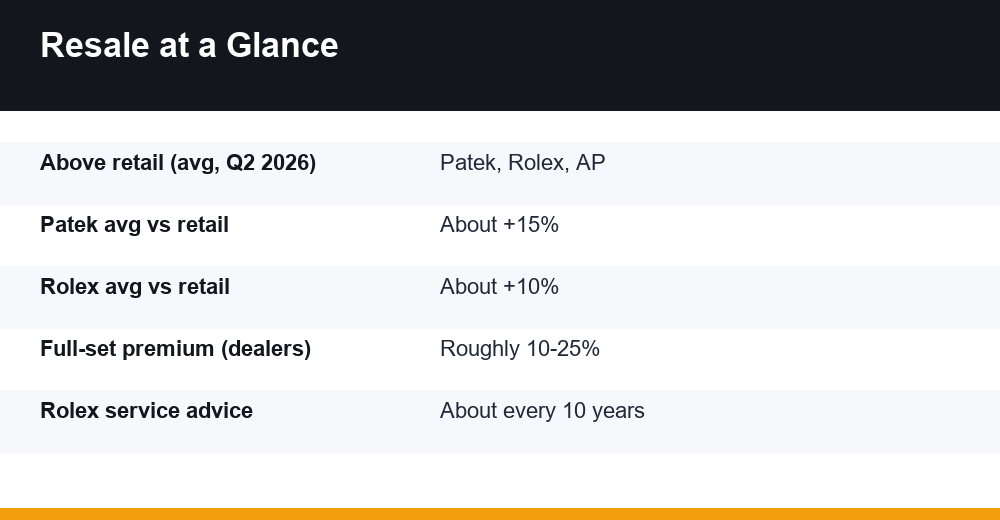
In 2026 the answer is short. Coverage of Morgan Stanley and WatchCharts data for the end of Q2 2026 found that only three major brands traded above retail on average: Patek Philippe, Rolex and Audemars Piguet. Most other big Swiss names averaged well below list price, several by more than a third.
| Brand | Average vs retail (mid-2026, approx.) | What it means for owners |
|---|---|---|
| Patek Philippe | About +15% | Aquanaut and Nautilus carry the average; dress pieces lag |
| Rolex | About +10% | Roughly half its tracked collections above retail |
| Audemars Piguet | About +3% | Royal Oak strong, Offshore below list |
| Cartier | About -27% | Best of the rest; classic models more liquid |
| Omega | About -32% | Varies widely by model |
| Tudor | About -36% | Better value bought pre-owned |
| Vacheron Constantin | About -37% | Expect a steep discount on resale |
| IWC | About -38% | Better bought pre-owned than sold |
These figures come from published coverage of the report, not the underlying dataset, and individual references stray a long way from their brand average. Use the table to see direction, not to price a specific watch.
The averages also hide how broad each brand’s strength is. Reported figures showed only about half of Rolex’s tracked collections trading above catalogue price, so even the most liquid brand has models that sell at a discount. Patek’s high average is driven by a few sports references selling far above list. When you shortlist luxury watches that hold value, check the reference, not the logo.
9 luxury watches that hold value in 2026
These picks are based on retail supply, how widely each model is recognised, and how its secondary prices behaved through the correction and the recovery. None of them is a guaranteed winner. They’re watches where the gap between what you pay and what you get back has historically been small for their price band.
- Rolex Submariner Date: the default liquid watch. Dealers everywhere know what to pay for it, which keeps the spread between buying and selling tight.
- Rolex GMT-Master II: steel versions are still hard to get at retail, and buyers like the travel complication.
- Rolex Cosmograph Daytona (steel): prices fell sharply from the 2022 peak, but steel references have stayed above retail.
- Patek Philippe Aquanaut: reported in 2026 coverage as Patek’s strongest collection against retail.
- Audemars Piguet Royal Oak (steel, time-only): the line that keeps AP’s average above water.
- Rolex Explorer or Datejust 36/41 in steel: less exciting, but there are always buyers, and any discount to retail tends to be small.
- Cartier Santos or Tank: Cartier posted the smallest average discount outside the Big Three in the mid-2026 data, and its core models sell easily.
- Omega Speedmaster Professional Moonwatch: below retail, but usually a smaller and more predictable loss than most Omegas (see below).
- Tudor Black Bay 58: Tudor averages a steep discount to retail, so buy this one pre-owned. Demand makes it easy to sell, and the further drop from a used price is usually modest.
Three of these come with a caveat. The Cartier, the Moonwatch and the Tudor don’t hold value the way a steel Rolex does. They’re on the list because they’re widely wanted and easy to resell, and because buying pre-owned lets the first owner absorb most of the drop. Our Speedmaster Moonwatch review and Black Bay 58 review cover the watches themselves in detail.
If this is your first serious purchase, the first luxury watch guide walks through budget, size and movement choices before resale comes into it. Among luxury watches that hold value, the best one for you is still the one you’ll actually wear. Resale should be a tiebreaker.
Does box and papers affect resale value?
Yes. Dealer guides published in 2026 put the full-set premium at roughly 10 to 25 percent on mainstream modern watches. It tends to be higher on sought-after sports references and lower on dress watches and high-volume models. Treat those numbers as approximate, since they come from businesses that buy and sell watches.
“Papers” mostly means the original warranty card, dated and filled in by an authorised dealer. The card matters most because it shows where and when the watch was sold. For Rolex, the international guarantee only applies when the card was completed by an Official Rolex Retailer at purchase and is presented with the watch.
What to keep from day one
- Warranty card or digital warranty record, plus the purchase receipt
- Inner and outer boxes, booklets and hang tags
- Every spare bracelet link, and any extra strap or tool
- Service invoices and the service guarantee card
Documents only count if they match. Reprinted cards, serial numbers that don’t match, or a box from another reference won’t earn a full-set premium. Papers also don’t prove a watch is genuine. They support authentication but can’t replace an inspection by someone qualified.
Does servicing a watch affect its resale value?
Servicing usually protects value, but the details matter. A documented service by the manufacturer tells the next buyer that the movement, gaskets and water resistance have been checked, which makes the watch easier to sell. The risk comes from refinishing: polishing that softens case lines, or swapping original parts on older watches.
Rolex’s own care FAQ recommends servicing approximately every 10 years, depending on the model and real-life use. After a service, Rolex returns the watch with a two-year international service guarantee and a Rolex Service Card. Other brands set their own intervals, so check the manual for your watch.
| Service decision | Effect on resale | Tip |
|---|---|---|
| Manufacturer service with paperwork | Usually positive | Keep the invoice and service card |
| Case polishing | Often negative for collectors | Ask for no polishing if the case is sound |
| Original parts replaced (vintage) | Can cut value sharply | Ask for the old parts back |
| Independent service, no records | Neutral to negative | Use a reputable, documented watchmaker |
| No service, running well | Small discount | Disclose it; buyers will price it in |
If you plan to sell soon, a full service just before listing doesn’t always pay for itself. Buyers will knock off the cost of a service they expect to need, but they won’t always pay back a recent invoice in full. Get a service estimate and compare dealer offers with and without it.
Do Omega watches hold their value?
Partly. Coverage of the mid-2026 Morgan Stanley and WatchCharts data put Omega’s average at about 32% below retail, a few points better than a year earlier. That’s better than IWC or Vacheron Constantin and far behind Rolex. Omega makes a lot of watches and its retail prices have risen faster than secondary prices, so the gap is still wide.
The model makes a big difference. The Speedmaster Professional Moonwatch is widely seen as one of Omega’s steadiest performers on the used market, because demand is broad and the design changes slowly. More complicated or precious-metal versions usually trade much lower relative to list.
- Stronger: core Speedmaster Professional, Seamaster Diver 300M in steel, limited editions with real collector demand
- Weaker: precious-metal pieces, complicated versions, and models sold at heavy discounts through grey channels
In practice, Omega is often a smart pre-owned buy because the first owner has already taken most of the depreciation. Omega’s five-year warranty on new watches also makes a lightly used example, still within its cover, more appealing to the next owner.
Thinking in ownership cost, not returns
The most useful way to compare luxury watches that hold value is a simple formula: purchase price, plus servicing and insurance, minus what you’d get back on sale. This isn’t investment advice. It’s a way to see what a watch actually costs you to wear for five or ten years.
| Illustrative example | Watch A (strong resale) | Watch B (weak resale) |
|---|---|---|
| Purchase price | $10,000 | $10,000 |
| Likely dealer offer after 5 years (approx.) | $8,500-$10,000 | $5,000-$6,000 |
| Insurance over 5 years (approx.) | $500-$800 | $500-$800 |
| Service during period | Usually none | Usually none |
| Estimated 5-year cost of ownership | $500-$2,300 | $4,500-$5,800 |
These figures are invented to show the method, not to forecast prices. Put in real quotes for your watch, your insurer and current dealer offers. You’ll usually find that the watch with stronger resale costs less to own, even when both carry the same price tag.
Habits that protect value
- Buy from an authorised dealer, or a reputable pre-owned seller with a clear return policy
- Keep the full set together and store the papers somewhere safe and dry
- Wear it, but avoid knocks; skip unnecessary polishing
- Service when the watch needs it, and keep every invoice
- Check recent sold prices for your exact reference before selling, not asking prices
Luxury watches that hold value give you something more useful than a return: the freedom to change your mind later without losing much. Pick the watch you’ll wear first, and let resale come second.
Frequently Asked Questions
Do luxury watches hold their value?
Most do not. In mid-2026 only Patek Philippe, Rolex and Audemars Piguet traded above retail on average, according to coverage of Morgan Stanley and WatchCharts data. Many other Swiss brands averaged a third or more below list. Value depends on the specific reference, its condition and completeness, so check recent sold prices for your exact model.
Which watch brands have the best resale value?
Patek Philippe, Rolex and Audemars Piguet lead in 2026, with reported averages of about 15, 10 and 3 percent above retail. Cartier had the smallest discount among the rest, at roughly 27 percent below list. Brands such as Vacheron Constantin and IWC averaged discounts of around 37 to 38 percent.
Does box and papers affect watch resale value?
Yes. Dealer estimates from 2026 put the full-set premium at roughly 10 to 25 percent for mainstream modern watches, and more for in-demand sports references. The original warranty card matters most. Documents must match the watch’s serial number, and papers alone never prove that a watch is authentic.
Do Omega watches hold their value?
Partly. Omega averaged about 32 percent below retail in mid-2026 coverage of secondary-market data, an improvement on the previous year. The Speedmaster Professional Moonwatch is among its steadiest models, while complicated and precious-metal pieces lose more. That makes a pre-owned Omega a sensible buy, since the first owner absorbs most of the depreciation.