
The best dress watches share a quiet confidence: a slim case, an uncluttered dial and proportions that slip beneath a shirt cuff rather than fighting it. This guide names real models across every budget, explains the traits that genuinely matter, and helps you buy once instead of twice. There is no hype and no affiliate padding here, only honest guidance for 2026.
Table of Contents
What Actually Makes a Dress Watch
The dress watch has one ancestral job: to slip unseen beneath a buttoned cuff while you wear formal clothing, then reveal itself only when you check the time. Every design choice descends from that single purpose. Restraint is the whole philosophy, so the watch complements the outfit instead of competing with it.
The classic template is easy to hold in your head: a slim case, a calm and legible dial, and a supple leather strap. Precious metal is traditional, but well-finished steel now does the job beautifully at far friendlier prices.
- Thickness: ideally under 8mm, and comfortably under 10mm for a more modern interpretation.
- Diameter: roughly 36-40mm flatters most wrists, with smaller sizes reading more traditional.
- Dial: two or three hands, slender indices or Roman numerals, and minimal printed text.
- Case and strap: polished precious metal or steel on slim black or dark-brown leather.
- Complications: few or none, with a discreet date the most a purist will usually tolerate.
A true dress watch keeps complications to a minimum so the dial stays serene. Movement type matters less than proportions: a slim quartz can look more formal than a bulky automatic, though many enthusiasts still prize the craft of a mechanical calibre.
Materials shape the feel as much as the formality. A high-polish case catches candlelight at a dinner table, while brushed steel leans a touch more casual. A sapphire crystal resists scratches and keeps the dial crisp for years, and a well-cut strap flatters the wrist as much as the case does. None of this has to be costly, only considered.
It helps to know where the style comes from. As pocket watches moved to the wrist in the early twentieth century, the most formal examples stayed deliberately understated, and that DNA survives today. A dress watch is less about technology than about manners: a piece designed to be quiet, precise and appropriate to the moment.
How We Chose the Best Dress Watches
We are not chasing the loudest names or the steepest price tags. Our shortlist of the best dress watches rewards timepieces that honour the brief, staying thin, clean and comfortable under a cuff, and that remain desirable after years of real-world wear.
- Proportions first: case thickness and lug-to-lug length that sit flat and tuck away neatly.
- Dial discipline: legible, uncluttered layouts that read as formal rather than sporty.
- Honest value: sensible pricing for the finishing, movement and strap you actually receive.
- Real availability: models you can genuinely buy in 2026, not hyped waitlists or unicorns.
- Longevity: serviceable movements and brands with a track record of holding their value.
A quick word on our stance. We earn no commission from these picks, so nothing here is chosen to push a sale. Where a watch has a genuine flaw, such as a case that wears large or accuracy that trails its rivals, we say so plainly, because a buying guide is only useful if it tells the truth.
It is worth understanding the movement trade-off before you spend. Quartz is accurate, low-maintenance and allows the thinnest cases, which suits pure formality. An automatic winds itself from the motion of your wrist and appeals to enthusiasts, while a hand-wound calibre offers the same mechanical charm in a slimmer package, at the cost of a daily winding ritual. None is inherently more correct; each simply fits a different owner.
Prices throughout are approximate and shift with markets, currency and demand. We hedge with around on purpose: treat every figure as a compass bearing, then confirm the current price at a trusted retailer or authorised dealer before you buy.
10 Essential Picks Across Every Budget
These are our essential picks for the best dress watches in 2026, anchored to a budget rather than forced into a rigid ranking. Treat them as reliable reference points, whether you want a first formal watch or a piece to hand down.
Under around $500: honest starters
This tier proves you do not need to spend heavily to look the part. Movements are simpler and finishing is modest, but the silhouettes are right and the value is real.
- Orient Bambino (around $150-250): a domed, vintage-styled automatic that punches above its price. Some references wear a little large, so check the fit against your wrist.
- Timex Marlin (around $220): a hand-wound throwback with genuine mid-century charm. Accuracy is modest for a mechanical watch, but the look is impeccable for the money.
- Seiko Presage Cocktail Time (around $425): a sunburst dial that plays with light, driven by a dependable Seiko automatic and beautifully finished for the price.
Around $800-2,000: the value sweet spot
Here the finishing sharpens, the cases slim down, and the movements earn real respect. For many buyers, this is where a dress watch becomes a lifelong keeper.
- Hamilton Intra-Matic (around $850-1,050): clean Swiss styling, a thin profile, and an automatic movement with a notably long power reserve.
- Junghans Max Bill (around $1,100-1,300): Bauhaus minimalism at its purest, with one of the most quietly perfect dials in watchmaking, in hand-wound or automatic form.
- Longines Master Collection (around $1,800-2,200): refined finishing and a long-reserve automatic calibre that genuinely reads as a step up in class.
Around $2,000-6,000: benchmarks
At this level you are buying design pedigree and finishing you can study up close. These are pieces that shape taste rather than follow it.
- Nomos Glashutte Tangente (around $2,000+): German hand-wound minimalism, remarkably thin and full of quiet character.
- Cartier Tank (around $3,000+): the archetypal dress watch, its rectangular case a genuine design landmark rather than a passing trend.
The grail tier
If budget is no object, these are the references others are measured against: watches built to be serviced, worn, and passed on.
- Jaeger-LeCoultre Master Ultra Thin (around $6,000+): a byword for elegant slimness and immaculate finishing.
- A. Lange & Sohne Saxonia Thin (aspirational): understated German haute horlogerie for a lifetime, with the Patek Philippe Calatrava as its equally iconic rival.
How do you choose a tier? Match the watch to how often you will wear it and how formal your life actually is. If a suit is rare for you, start affordable; if you dress up weekly, the sweet spot repays its cost in finishing and durability.
A final route worth knowing is the pre-owned market. Because dress watch designs change slowly, last year’s model is often mechanically identical to this year’s at a meaningful discount. Buy from a reputable dealer, ask for service history where it matters, and you can reach a higher tier than a new-only budget would allow.
One honest caveat: an integrated-bracelet sports watch is not a true dress watch, however smart it looks. If you want a single versatile piece and can accept a slightly casual lean, the value-packed Tissot PRX 40 205 bridges the gap, but for black tie you should still reach for a slim case on leather.
Dress Watch Comparison Table
Use the table below to weigh the traits that actually decide comfort and formality. Figures are typical for current versions and rounded for clarity; confirm exact specifications with the retailer before buying.
| Model | Approx. price | Movement | Diameter | Best for |
|---|---|---|---|---|
| Orient Bambino | $150-250 | Automatic | ~38-41mm | First dress watch |
| Timex Marlin | ~$220 | Hand-wound | ~34mm | Vintage charm |
| Seiko Cocktail Time | ~$425 | Automatic | ~40.5mm | Dial lovers |
| Hamilton Intra-Matic | $850-1,050 | Automatic | ~38mm | Everyday formal |
| Junghans Max Bill | $1,100-1,300 | Hand/auto | ~34-38mm | Minimalists |
| Longines Master | $1,800-2,200 | Automatic | ~40mm | Affordable luxury |
| Nomos Tangente | $2,000+ | Hand-wound | ~35-38mm | Design purists |
| Cartier Tank | $3,000+ | Quartz/mech. | Varies | Timeless icon |
Getting the Size and Fit Right
Diameter gets all the attention, but two quieter numbers decide whether a watch sits elegantly: case thickness and lug-to-lug length. A thin case slides under a cuff, while a short lug-to-lug stops the watch overhanging a narrow wrist.
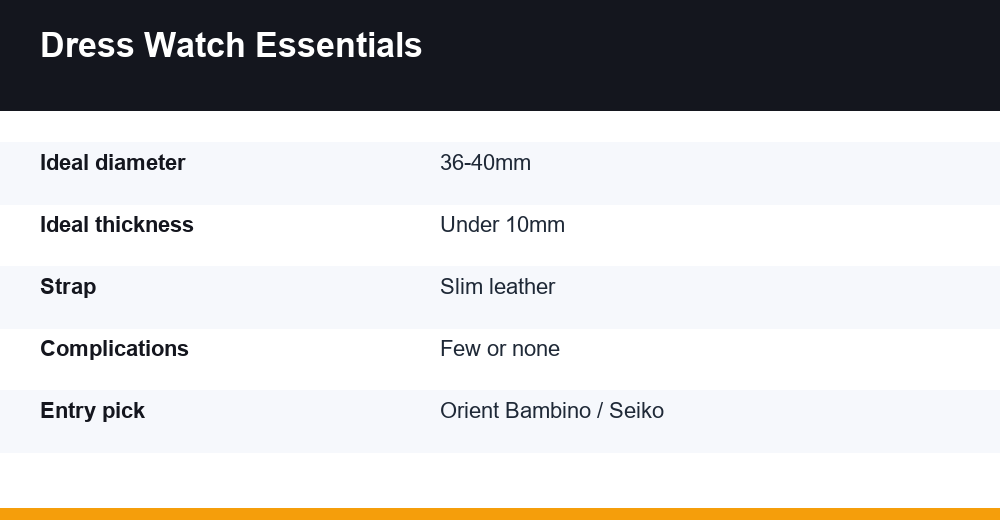
As a rule of thumb, a 36-40mm dress watch flatters most wrists, and a profile under 10mm keeps things sleek. Slim wrists suit the lower end and shorter lugs; broader wrists can size up a touch without sacrificing formality.
One overlooked factor is dial colour. White, silver and champagne read as the most formal and versatile; black is a close, slightly sportier second; while blue has become a modern staple that still works under most cuffs. Bolder colours are fun, but they narrow the occasions a watch suits.
The buckle is the last piece of the puzzle. A simple pin buckle keeps the profile flat and formal, whereas a folding clasp adds security and a little thickness. For the dressiest look, a slim tang buckle on supple leather is hard to beat, and it makes the watch easier to slide beneath a cuff.
Strap width matters too. A tapering strap of roughly 18-20mm looks refined, whereas a thick, padded band undermines the whole effect. Measure before you commit: our watch size guide covers wrist measurement, lug-to-lug and how proportions translate into real comfort, which is the surest way to avoid an expensive return.
Styling: Cuff, Strap and Formality
A dress watch earns its name at the wrist, and the classic proof is the cuff test. The watch should vanish under a buttoned shirt and reappear only when you reach for something. If it snags or bulges, it is simply too thick.
- Black tie: the thinnest case you can find, a white or precious-metal dial, plain black leather, time only.
- Business formal: slim steel or gold on dark leather, where a discreet date window is perfectly acceptable.
- Smart casual: more freedom, so brown leather, textured dials and even a slim, well-integrated bracelet all work.
Match metals to your hardware for a pulled-together look. Warm gold pairs with brown leather and gold buckles, while steel and white gold sit best with black straps and silver-toned fittings. Coordinating the watch with your belt and shoe leather is a small detail that reads as real polish.
Formality is a spectrum, not a switch. The same slim, silver-dialled watch on black leather can carry you from a wedding to a boardroom to a dinner, which is exactly why a single well-chosen dress piece is such an efficient purchase. Build your collection outward from that versatile core.
Common Mistakes to Avoid
A few recurring errors turn a promising watch into the wrong watch. Sidestep these and the rest is easy.
- Going too big: an oversized case is the quickest way to look casual in a suit.
- Ignoring thickness: a watch can be the right diameter yet still refuse to slide under a cuff.
- Busy dials: chronograph sub-dials and dive bezels belong on other kinds of watches.
- Cheap straps: a poor strap cheapens an otherwise good watch, so upgrade it first.
- Chasing hype: the loudest models tend to age fastest, while restraint stays elegant.
It is also worth resisting the urge to buy several cheap watches instead of one good one. A single, correctly sized piece on a quality strap will outclass a drawer full of compromises, and it is far easier to live with day to day.
Finally, do not overlook servicing. A mechanical dress watch benefits from professional attention every few years, and a well-kept piece from a reputable maker holds its value far better than a fashion-branded alternative.
The Verdict
The best dress watches are the ones you forget you are wearing until someone else notices them. Whatever your budget, favour thin over thick, calm over cluttered, and quality leather over gimmicks, and you will rarely put a foot wrong.
Start where you are. An Orient Bambino or Seiko Cocktail Time teaches you the genre; a Hamilton, Longines or Nomos rewards years of daily wear; a Cartier Tank or Jaeger-LeCoultre becomes something you pass on. Get the proportions right, and the elegance takes care of itself.
Frequently Asked Questions
What size should a dress watch be?
For most wrists, a diameter of 36-40mm and a case under 10mm thick strikes the right balance of presence and discretion. Slim wrists suit the lower end and shorter lugs, while broader wrists can size up slightly without losing the formal, cuff-friendly proportions that define the style.
Are quartz dress watches acceptable?
Absolutely. A quartz movement lets makers build an exceptionally thin case, which is the essence of formality. Purists may prefer a mechanical calibre for its craft, but for pure elegance under a cuff a slim quartz dress watch is entirely legitimate and often more practical day to day.
Which are the best dress watches for beginners?
Start with proven value. The Orient Bambino, Timex Marlin and Seiko Presage Cocktail Time all deliver classic looks and reliable movements for a modest outlay. They teach you what you like about the genre before you invest more, and they hold up well as second watches later.
Can I wear a dress watch every day?
Yes, within reason. A slim leather-strapped watch handles offices, dinners and events with ease, but it is less suited to sport, water or heavy knocks. Many enthusiasts pair a hardy everyday watch with a dress piece reserved for smarter occasions and gentler wear.