A watch water resistance rating is one of the most widely misread numbers in the whole of horology. The figure stamped on a caseback looks like a depth you could descend to, and it is not. It describes a pressure the case survived in a laboratory tank, briefly, when the watch was new and nobody had opened it. A watch marked 30 metres will not survive thirty metres of swimming, and the gap between what the number implies and what the watch tolerates has ruined a great many perfectly good movements. What follows is what each marking actually permits, why the seals fail long before the case does, and the handful of habits that matter far more than the number itself.
Table of Contents
Watch water resistance is measured in a static tank
The rating comes from a test in still water, at a constant pressure, on a new and sealed case. Nothing moves. There is no arm swinging through a stroke, no impact as a hand hits the surface, no temperature change, and no three-year-old gasket that has gone hard.
Real swimming adds all of those. A hand entering the water at speed can briefly generate pressure well above the static equivalent of the depth you are at, which is the single clearest reason why a 30-metre marking is not permission to swim in three metres of pool.
Why metres and not something useful
The convention is historical and the industry has been stuck with it for decades. Some manufacturers now print ATM instead, which is the same information in different clothes: 1 ATM is roughly 10 metres of static pressure. Neither unit tells you what activity is safe, which is why the table below is in activities.
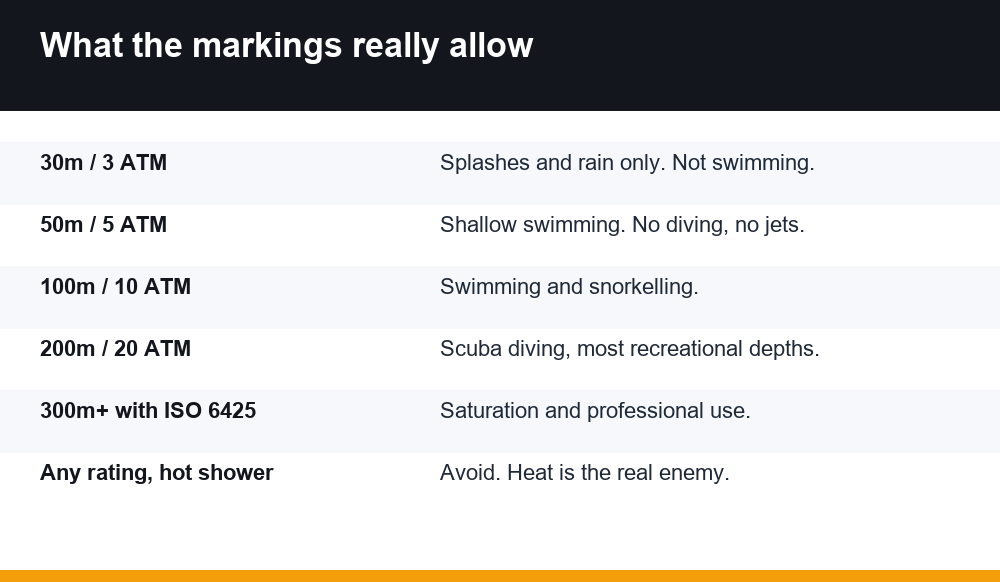
What each rating actually permits
Treat these as ceilings for a watch in good condition with its seals intact, not as targets.
| Marking | Realistic use |
|---|---|
| No marking at all | Keep it dry. Assume a splash could reach the movement. |
| 30m / 3 ATM | Rain, handwashing, an accidental splash. Not swimming, not showering. |
| 50m / 5 ATM | Shallow swimming at a gentle pace. No diving in, no water jets. |
| 100m / 10 ATM | Swimming properly, snorkelling, watersports at the surface. |
| 200m / 20 ATM | Recreational scuba. This is where the rating stops being theoretical. |
| 300m and above | Technical and saturation diving, usually alongside ISO 6425 certification. |
The practical takeaway is that the first rating most people would consider genuinely swim-safe is 100 metres, and the first that is dive-safe is 200. Everything below is a splash rating wearing a confident number.
Why a diver’s watch is a different animal
The phrase diver’s watch is not decorative when it appears on a dial. Under the ISO 6425 standard it carries obligations: a unidirectional rotating bezel, legibility at distance in darkness, resistance to magnetism and shock, and crucially, testing of every single watch rather than a sample from the batch.
That last point is the one that matters most and the one nobody mentions. A watch merely marked 200m may have been type-tested, meaning a representative example passed. A certified diver’s watch is tested individually, and it is also tested at 125 per cent of its rated pressure.
If a dial says 200m but not diver’s, it is telling you something by omission. That does not make it a bad watch; it makes it a watch to swim in rather than dive with.
Gaskets are consumable parts
The case does not fail. The rubber does. Every opening in a watch, which means the caseback, the crown, the pushers and the crystal, is sealed by a gasket, and gaskets are made of material that hardens, shrinks and cracks with age, heat and ultraviolet light.
A five-year-old watch that has never been serviced may have the water resistance of a sieve while still carrying a 200-metre marking, because the marking refers to when it left the factory. This is the most common way a watch floods, and it is entirely preventable.
- Have gaskets replaced at every service, not only when a problem appears
- Replace them after any battery change, since the caseback has been opened
- Assume a watch bought second-hand has unknown seals until proven otherwise
- Treat a fogged crystal as an emergency, not a curiosity
Condensation under the glass means moisture is already inside and is already in contact with steel parts. Getting it to a watchmaker the same week is the difference between a dried movement and a rusted one.
Heat and soap do more damage than depth
The most frequent cause of water damage is not swimming. It is the shower, and the reason is temperature rather than pressure.
Hot water expands the metal case and the air inside it, and as the watch cools afterwards the contraction draws air, and any moisture with it, back past the seals. Repeat that daily and even a well-sealed watch will eventually take on water. Soap and shampoo compound it by degrading the rubber itself.
Steam rooms and saunas are worse again, combining high heat with saturated air. No consumer watch water resistance rating is designed around that, including dive ratings, because the test is conducted at room temperature.
The simplest rule there is
Take it off for showers, baths, hot tubs and saunas. This costs nothing, removes the most common failure mode entirely, and is easier than remembering what your particular rating allows.
The one button never to press underwater
An unscrewed crown turns a sealed watch into an open one. If your watch has a screw-down crown, water resistance exists only when it is screwed fully home, and a crown left a quarter-turn loose after setting the time has effectively no rating at all.
Chronograph pushers are the same problem with a sharper edge. Unless the watch specifically states its pushers can be operated underwater, pressing one while submerged drives water directly past the pusher seal. It is a momentary action with a permanent result, and it is responsible for a surprising share of flooded chronographs.
Get into the habit of checking the crown before water, every time, the way you would check a car door is shut. It becomes automatic quickly and it is the single most valuable habit on this page.
Saltwater, chlorine and what to do afterwards
Seawater and pool chemicals both attack a watch, in different ways and on different timescales. Salt crystallises as it dries, working into the gaps around the crown, the bezel and the bracelet links, where it holds moisture against the metal and accelerates corrosion. Chlorine is less visible and harder on gaskets and on some case coatings.
The remedy takes a minute. Rinse the watch under cool fresh water with the crown screwed down, work the bezel through a full rotation so the water reaches underneath it, and dry it with a soft cloth. On a bracelet, pay attention to the clasp, which traps more salt than anywhere else.
- Check the crown is fully screwed down before you rinse
- Use cool water, never hot
- Rotate the bezel while rinsing so debris flushes out from under it
- Dry thoroughly, including between bracelet links
- Leave it somewhere ventilated rather than sealed in a box while still damp
Straps and bracelets get wet too
Discussion of watch water resistance almost always stops at the case, which leaves out the part actually touching the water for longest. A strap that holds moisture against the lugs will cause problems on a watch whose seals are perfect.
Leather is the clear loser. Repeated wetting stiffens it, then cracks it, and the stitching rots from the inside where you cannot see it. A leather strap that has been swum in a few times will fail at the spring bar, usually without warning, which is how watches end up on the floor of a changing room.
Rubber, silicone and modern synthetic straps are made for it and rinse clean. NATO-style fabric straps are fine in water but hold moisture afterwards, so they want drying properly rather than being left on the wrist. Steel bracelets are durable but trap salt and skin debris in the links and especially in the clasp, which is the part most people never rinse.
- Swap to rubber or synthetic for anything beyond an accidental splash
- Dry fabric straps away from the watch rather than on the wrist
- Rinse bracelet clasps deliberately, since they collect the most
- Check spring bars yearly on any watch that goes in water
The spring bars themselves deserve one line. They are small steel pins under constant tension and they corrode, and a corroded spring bar gives way under load. Replacing them is a few pounds and a few minutes, and it is cheap insurance on a watch you swim with.
Getting it tested, and when
Pressure testing is quick, cheap relative to a service, and the only way to know where a particular watch actually stands. A watchmaker can perform a dry test that detects case deformation under pressure without wetting the watch at all, and a wet test that confirms the result.
Worth doing annually for anything that goes in water regularly, after any battery change or caseback opening, before a holiday involving swimming, and whenever a watch has been dropped hard enough to worry you. For a watch that never leaves dry land it is not a priority.
One note on resale listings: a description saying a vintage watch is water resistant is describing the marking, not the condition. Assume the seals on anything older than a few years are unknown until a test says otherwise, which is the same caution worth applying to the movement generally. Our comparison of automatic and quartz movements goes into what else changes with age and use.
None of this is a reason to be precious. A watch with a real rating, intact seals and a screwed-down crown will handle an ordinary life in and around water without complaint. The failures almost always trace back to one of three things: an old gasket, a hot shower, or a crown nobody checked.
Frequently Asked Questions
Can I swim with a 30m watch?
No. A 30-metre marking covers rain, handwashing and accidental splashes. The figure comes from a static pressure test, and swimming adds movement and impact that briefly push pressure well above the equivalent static depth. For swimming, 100 metres is the first rating worth trusting.
Why did my watch fog up after a shower?
Hot water expands the case and the air inside it, and as everything cools the contraction draws moisture back past the seals. Soap also degrades the rubber over time. Fogging means water is already inside and touching steel parts, so it needs a watchmaker within days, not months.
How often should water resistance be tested?
Once a year for a watch that regularly goes in water, and always after a battery change or any time the caseback has been opened. A dry pressure test is quick and inexpensive, and it is the only way to know the condition of seals you cannot see.
What is the difference between 200m and a diver’s watch?
A 200-metre marking may come from type testing, where one example from a batch passed. A watch marked diver’s under ISO 6425 is tested individually, at 125 per cent of its rated pressure, and must also meet requirements for the bezel, legibility, magnetism and shock resistance.
Does water resistance wear off?
Effectively yes, because it depends on rubber gaskets that harden and shrink with age, heat and ultraviolet exposure. The case keeps its marking for life; the seals do not. A watch that has gone years without a service may have little resistance left regardless of what the caseback says.