
Yes, you can wear a dive watch with a suit, and most of the time nobody will think twice, provided the watch has the right shape and is dressed the right way. The trouble is that most advice on the subject stops at “it depends.” This guide gives you numbers instead: thickness, diameter, lug length and contrast checks you can test on your own wrist before the next meeting, wedding or interview.
Table of Contents
Can you wear a dive watch with a suit?
Short answer: yes, in almost every business and social setting. Steel divers have been worn with tailoring for decades, and today a plain diver is one of the most common watches in any office full of suits. The old rule that a suit demands a thin dress watch on leather has softened into a guideline rather than a law.
What has not changed is that proportion decides whether the combination looks deliberate or accidental. A dive watch is built around function: a rotating bezel, large luminous markers and a case that can resist pressure. The international standard for divers’ watches, ISO 6425:2018, applies to watches designed for diving to at least 100 metres with a secured diving-time indication readable in darkness. Those features add bulk, and bulk is what clashes with a slim shirt cuff.
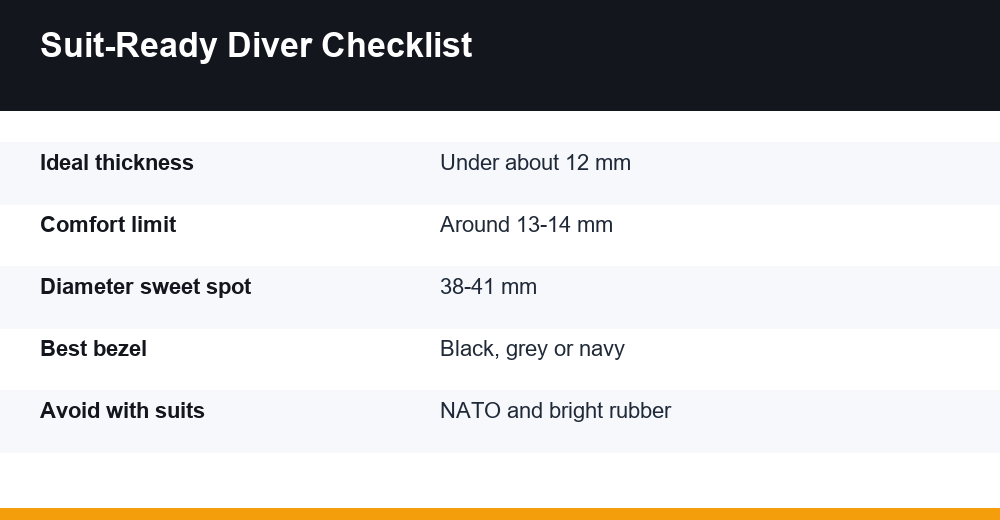
So the real question is not whether a diver is allowed, but which diver and how you wear it. The seven rules below turn that into checks you can measure:
- Keep case thickness under roughly 12 mm where possible.
- Make sure the watch slides under your shirt cuff without forcing it.
- Choose a diameter and lug-to-lug length that sits inside your wrist.
- Favour a black, grey or navy bezel over bright colours.
- Wear a polished or brushed steel bracelet, or a dark leather strap.
- Match the metal to your other accessories.
- Know when the dress code calls for a proper dress watch.
If you are still choosing a watch, our guide to the best dive watches flags which models pass these tests and which are better left for weekends.
What thickness of watch fits under a shirt cuff?
Thickness matters more than diameter when you wear a diver with tailoring. A wide but flat watch slips under a cuff; a narrower watch that stands tall catches on it every time you reach for a pen. The number to watch is total case height, crystal included.
As a practical rule, divers at about 12 mm or less disappear under a standard single (barrel) cuff with normal sleeve ease. Between roughly 12 and 13.5 mm you will usually get away with it if your cuffs are not tight. Above about 14 mm, most shirts will need altering or the watch will sit on top of the cuff, which looks sloppy with a suit.
| Case thickness (approx.) | Cuff behaviour | Suit suitability |
|---|---|---|
| Under 11 mm | Slides under almost any cuff | Excellent, close to dress-watch territory |
| 11-12.5 mm | Fits standard barrel cuffs easily | Very good |
| 12.5-13.5 mm | Fits if the cuff has some ease | Good, check your shirts |
| 13.5-15 mm | Often catches or rides on top | Fair, best with relaxed tailoring |
| Over 15 mm | Rarely fits under a cuff | Poor, keep it for casual wear |
How to test cuff clearance at home
- Put on the shirt you wear most with suits and fasten the cuff on its usual button.
- Wear the watch on its normal hole, then bend your arm to 90 degrees as if reading the time.
- The cuff should drop back over the case on its own when you straighten your arm.
- If it hooks on the crown or bezel, either the watch is too tall or the cuff is too tight.
A tailor can add a few millimetres to the circumference of the cuff on the watch arm. It is a small, inexpensive change and many well-dressed watch owners do exactly that. French (double) cuffs are naturally roomier and handle taller cases better than barrel cuffs.
Diameter, lug-to-lug and proportion
Once thickness is under control, look at how much wrist the watch covers. Diameter gets the headlines, but lug-to-lug length is the measurement that tells you whether the case overhangs your wrist. A watch whose lugs extend past the edges of the wrist looks oversized, especially next to a crisp shirt sleeve.
For most wrists between about 16 and 19 cm, a diver between 38 and 41 mm in diameter with a lug-to-lug under roughly 48-49 mm looks proportionate with tailoring. Larger wrists can carry 42 mm comfortably; smaller wrists often look better with 36-39 mm.
| Model (current steel versions) | Diameter | Thickness (approx.) | Suit verdict |
|---|---|---|---|
| Tudor Black Bay 58 | 39 mm | About 11.9 mm | Among the easiest divers to dress up |
| Rolex Submariner Date | 41 mm | About 12.9 mm | Works with most tailoring |
| Omega Seamaster Diver 300M | 42 mm | About 13.6 mm | Good, but check your cuffs |
| Typical 44 mm tool diver | 44 mm | 15 mm or more | Better kept for casual days |
Thickness figures in the table are approximate because dealers and brands measure slightly differently and references change over time. Always confirm the exact reference on the brand’s own specification page. The Black Bay 58 is a good case study in getting the proportions right; we cover its fit in detail in our Tudor Black Bay 58 review.
Weight counts too
A heavy steel diver on a full bracelet tends to slide down the wrist and settle against the hand, where it pushes the cuff up. Sizing the bracelet snugly, with room for one finger, keeps the watch higher on the wrist bone and under the sleeve.
Dial and bezel contrast: keep it quiet
A suit is a calm, mostly monochrome outfit. The more visual noise a watch adds, the more it reads as sports equipment. That noise comes mainly from the bezel and the dial.
The safest choice for wearing a dive watch with a suit is a black dial with a black bezel insert, followed by navy, dark grey or deep green. Two-tone bezels such as red-and-blue or black-and-blue are classic, but they draw the eye and clash more easily with patterned ties.
- Best: black, navy or charcoal dial and bezel; applied steel or white-gold markers.
- Good: dark green or dark grey; ceramic inserts with a soft sheen.
- Risky: orange, yellow or bright blue dials; heavy lume plots; busy minute tracks.
- Avoid with formal suits: fluorescent rubber-strap divers and digital dive computers.
A date window is not a problem in a business setting. What matters more is legibility at a glance and a dial that does not compete with your shirt and tie. If you own several suits in blue and grey, a black or navy diver will work with all of them.
Match the metals
A steel case looks best with silver-toned cufflinks, belt buckles and tie bars. Gold or two-tone divers can work with a navy suit, but they shift the look toward statement rather than understatement, so keep other accessories minimal.
Bracelet or leather strap with a suit?
Both work. The decision depends on the formality of the suit, the bracelet design and your own taste. What does not work with tailoring is a canvas, nylon NATO or bright rubber strap; those read as holiday wear.
| Option | Best with | Watch-outs |
|---|---|---|
| Steel bracelet (brushed) | Business suits, most daily office wear | Size it snugly so it does not slide under the hand |
| Steel bracelet with polished centre links | Evening suits, smarter occasions | Shows scratches more quickly |
| Black or dark brown leather | Darker or more formal suits | Leather and water do not mix; swap before swimming |
| Black rubber (integrated, discreet) | Smart casual, travel days | Looks sporty with a formal suit |
| NATO or canvas | Weekends only | Too casual for tailoring and adds height under the case |
A strap swap is the single easiest way to make a diver look dressier. A smooth black calfskin strap with minimal stitching can make a steel diver look almost like a sports-elegant watch. Note that NATO-style straps pass under the case and add a millimetre or more to the height, which works against cuff clearance.
If you swap straps often, check lug width (commonly 20 mm on many divers, but it varies by model) and invest in a spring-bar tool to avoid scratching the lugs.
Is a Submariner too sporty for a suit?
No. The Rolex Submariner is probably the best-known diver ever worn with tailoring, and it has been seen in boardrooms for generations. Its black dial, black bezel and steel bracelet tick most of the boxes in this guide.
The current 41 mm generation has slightly wider lugs than older references, but its proportions remain manageable for most wrists, and at just under 13 mm thick it clears a standard cuff with a little ease. The no-date version has a cleaner dial, which some people prefer with formal tailoring.
Where a Submariner becomes less suitable is at strict formal events. Its rotating bezel, large lume plots and Oyster bracelet are unmistakably sporty, so at a black-tie dinner or a very traditional ceremony it can look out of place. In everyday business, though, it is entirely appropriate.
Other sporty divers that still pass
- Divers with slim cases and simple dials, such as vintage-inspired 39-40 mm models.
- Divers on well-finished bracelets with tapering links, which look less bulky.
- Watches with a dark ceramic bezel rather than coloured aluminium.
Dive watches at weddings and formal events
Is it fine to wear a diver to a wedding? Usually yes, as long as you read the dress code. For a daytime wedding, a garden ceremony or a lounge-suit dress code, a black or navy diver on a bracelet or dark leather strap is perfectly acceptable. Many grooms wear their everyday diver precisely because it carries personal meaning.
The calculation changes as formality rises. Morning dress and black tie are traditional dress codes with clearer expectations, and a thin dress watch on black leather is the classic choice. If a wedding invitation says black tie, our guide to choosing a black tie watch explains the conventions and the alternatives.
| Dress code | Diver acceptable? | Best approach |
|---|---|---|
| Smart casual / blazer | Yes | Any tasteful diver; leather or bracelet |
| Business / lounge suit | Yes | Black or navy diver, slim case, steel bracelet |
| Daytime wedding guest | Usually | Dark dial, dark leather strap |
| Groom or best man | Depends on style | Discuss with the couple; slim and simple wins |
| Black tie | Rarely ideal | Switch to a thin dress watch |
| White tie | No | Dress watch or no watch at all |
A simple test: if you would not wear trainers with the outfit, think twice about a bulky tool diver. If you would happily wear brogues or loafers, a refined diver almost always fits.
When to switch to a dress watch
Even the best-dressed diver has limits. Switch to a dress watch, or at least a slim time-only piece, when any of these apply:
- The invitation says black tie, white tie or morning dress.
- Your shirts have slim, close-fitting cuffs and the diver is thicker than about 13 mm.
- The occasion is solemn and traditional, such as some religious ceremonies or state events.
- Your diver has a bright dial, coloured bezel or rubber strap you cannot swap.
- You want the watch to disappear rather than be noticed.
For everyone else, wearing a dive watch with a suit is about editing rather than abandoning the idea. Choose a slimmer case, a dark dial and a quality bracelet or leather strap, and the watch will look intentional. A single well-chosen diver can genuinely cover office days, weddings and weekends.
Quick checklist before you leave the house
- Does the watch slide back under the cuff when you straighten your arm?
- Do the lugs stay inside the edges of your wrist?
- Is the bezel black, grey, navy or another muted shade?
- Is the strap steel or dark leather rather than nylon or bright rubber?
- Does the metal match your cufflinks, belt and tie bar?
Five yes answers mean your dive watch with a suit will look as considered as the rest of your outfit.
Frequently Asked Questions
Can you wear a dive watch with a suit?
Yes. A steel diver with a dark dial, a muted bezel and a case under roughly 12-13 mm thick works with most business and lounge suits. Pair it with a steel bracelet or dark leather strap, make sure it slides under your shirt cuff, and avoid bright rubber or NATO straps, which look too casual next to tailoring.
Is it OK to wear a dive watch to a wedding?
For most weddings, yes. Daytime, lounge-suit and smart-casual weddings suit a black or navy diver on a bracelet or dark leather strap. If the dress code is black tie, white tie or morning dress, a thin dress watch on black leather is the traditional choice and usually the safer option for guests and the wedding party.
What thickness of watch fits under a shirt cuff?
As an approximate guide, watches about 12 mm thick or less slip under a standard barrel cuff easily. Between 12 and 13.5 mm usually works if the cuff has some ease. Above roughly 14 mm the case tends to catch or sit on top of the cuff, unless a tailor widens the cuff on your watch arm.
Should you wear a bracelet or leather strap with a suit?
Both are correct. A brushed or polished steel bracelet suits everyday business suits and keeps the diver’s character, while a smooth black or dark brown leather strap makes the watch look dressier for evening or formal suits. Skip canvas, nylon NATO and bright rubber straps, which read as casual and can add height under the case.