
Automatic watch service cost can run from a couple of hundred dollars at a local bench to well over a thousand at a brand service centre, and the gap is rarely explained on the counter. This guide breaks the price down by movement type, compares independents with official centres, and shows the point where servicing an inexpensive automatic stops making financial sense.
Table of Contents
What happens during a full watch service
Most of a service bill is skilled labour, not parts. A full service (often called an overhaul) means the movement leaves the case and is taken apart down to its individual wheels, springs and jewels. Nothing is simply sprayed with oil and sent back.
Rolex describes its own procedure in stages. A watchmaker examines the watch and draws up an estimate, and work begins only once the owner approves it. The movement is then dismantled, every part is checked, anything below standard is replaced, and the components go through an ultrasonic bath before reassembly and lubrication.
The case gets the same attention: it is taken apart, its surfaces can be re-polished or satin-finished, the seals are replaced and water resistance is tested. Rolex then runs the watch through a test of at least 24 hours, quotes a minimum of four to six weeks for a complete overhaul, and returns it with a two-year international service guarantee.
An independent watchmaker follows broadly the same sequence, although case refinishing is usually optional and priced separately.
The typical steps on the bench
- Inspection, timing check and written estimate.
- Case opening, removal of the movement, dial and hands.
- Complete disassembly of the movement.
- Ultrasonic cleaning of every component.
- Replacement of worn parts, commonly the mainspring, gaskets and sometimes the crown or crystal.
- Reassembly with fresh lubricants applied at each specified point.
- Regulation across several positions to bring timekeeping back into tolerance.
- Case cleaning, new seals and a pressure test.
- A period of observation, often a day or more, before the watch is returned.
What you are buying is time. A simple three-hand automatic can take a skilled watchmaker several hours of bench work, and a chronograph considerably more. That is why price tracks complexity so closely, and why there is no quick swap-and-go fix for a mechanical watch the way there is for a quartz battery.
Full service versus partial work
Not every visit to a watchmaker is an overhaul. A crystal replacement, a new crown, a gasket change or a regulation adjustment can each be done without stripping the movement. These targeted jobs cost far less, but they do not reset the clock on lubrication. For day-to-day habits that stretch the gap between overhauls, see our watch care and maintenance guide.
Automatic watch service cost by movement type
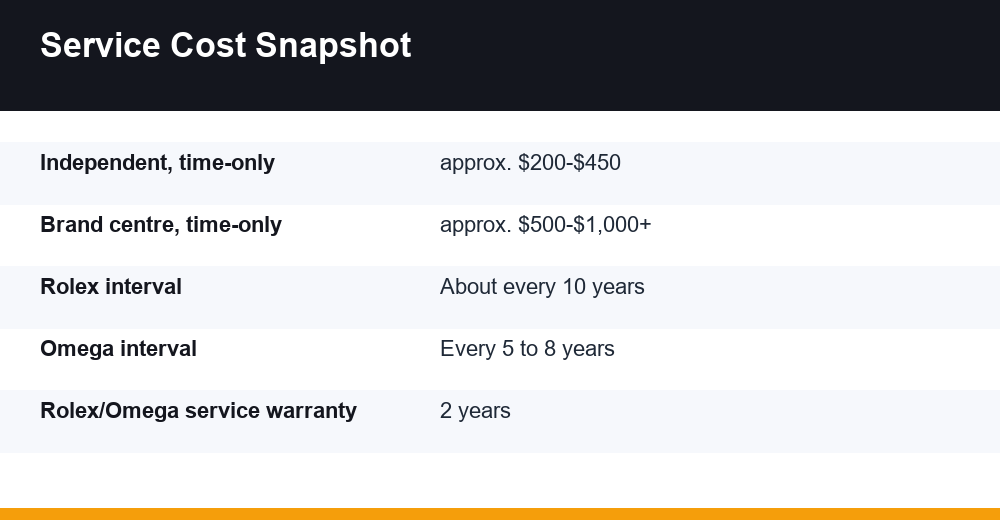
The single biggest driver of automatic watch service cost is the movement itself. Every extra function adds parts to clean, lubricate and adjust. The table below summarises typical US price ranges reported across retailer and watchmaker guides published in 2026. Treat every figure as approximate: regional labour rates and parts pricing vary widely.
| Movement type | Independent watchmaker (approx.) | Brand service centre (approx.) | Typical turnaround |
|---|---|---|---|
| Time-only or date automatic | $200 – $450 | $500 – $1,000+ | 2-4 weeks indie; 4-10 weeks brand |
| GMT / dual time | $300 – $550 | $700 – $1,100+ | Similar to time-only, slightly longer |
| Automatic chronograph | $400 – $750 | $750 – $1,200+ | Often 6-10 weeks at brand level |
| Vintage or discontinued calibre | Quoted case by case | May require restoration pricing | Depends on parts sourcing |
These ranges come from third-party sources rather than official price lists, and published figures often disagree, sometimes by hundreds of dollars for the same model. Omega is one of the few brands that publishes service prices on its own site, so it is worth checking the official Omega watch servicing and prices page for current figures before sending a watch in.
Why a chronograph costs so much more
A chronograph adds a column wheel or cam, clutch, reset hammers and counters on top of the base timekeeping train. More parts mean more cleaning, more lubrication points and a longer regulation phase. Expect a chronograph to cost noticeably more than a three-hand watch from the same brand.
Where a GMT sits
A GMT complication usually adds a fourth hand and an extra wheel or two, so it lands between a time-only watch and a chronograph. Brands with proprietary escapements, such as Omega’s Co-Axial, may require a watchmaker with specific training and tooling, which can narrow your choice of independents.
Date, day-date and other small extras
A simple date adds only a modest amount of work, which is why most price lists group it with time-only watches. A day-date, a power-reserve indicator or a moon phase adds a few more parts and lubrication points. Expect a small step up rather than the jump you see with a chronograph.
Is an independent watchmaker cheaper than the brand?
Usually, yes, and the difference in automatic watch service cost between the two routes can be substantial. Retailer and watchmaker guides commonly place independent pricing roughly 30% to 50% below official service centres for comparable work, although the exact gap depends on the brand and the shop. Independents also tend to turn watches around faster, often within two to four weeks.
The lower price is not a free lunch. Here is what each route really offers.
| Consideration | Brand service centre | Independent watchmaker |
|---|---|---|
| Price | Higher, often fixed by category | Lower, often negotiable |
| Service warranty | 2 years at Rolex and Omega | Varies; often 1 year |
| Parts | Genuine factory parts guaranteed | Depends on parts access |
| Case and bracelet polishing | Often included by default | Usually optional |
| Turnaround | Rolex quotes at least 4-6 weeks | Typically 2-4 weeks |
| Direct contact with the watchmaker | Rarely | Usually |
When the brand route makes sense
- The watch is still under its factory warranty and a fault needs fixing.
- You plan to sell soon and want official service papers.
- The movement is proprietary and parts are restricted to authorised workshops.
- You want a two-year service warranty backed by the manufacturer.
When an independent is the smarter spend
- The watch is out of warranty and worn daily.
- You want original case finishing preserved, with no automatic polishing.
- The movement is a common workhorse calibre, such as an ETA, Sellita, Miyota or Seiko base movement.
- You prefer to speak directly with the person doing the work.
One caution: ask any independent whether they can source genuine parts for your brand. Some manufacturers restrict parts supply, and a watchmaker without an account may rely on aftermarket components, which can affect resale value.
Vintage owners have an extra reason to be careful. Brand workshops may replace original hands, dials or bezels with current parts as standard practice, which can reduce collector value. If originality matters, say so in writing and ask for any removed parts back.
7 factors that move the final quote
Two watches that look similar can receive very different quotes, because automatic watch service cost is built from several variables. These are the factors watchmakers weigh when they price a job.
- Movement complexity. Time-only is cheapest; GMT, chronograph and annual calendar functions add labour.
- Brand and service channel. Official centres charge set category prices that are typically higher than independents.
- Condition on arrival. Water ingress, rust or a broken balance staff can turn a routine overhaul into a repair.
- Parts replaced. Mainspring, gaskets and crown are routine; a new crystal, dial restoration or bezel insert adds to the bill.
- Case and bracelet refinishing. Polishing and bracelet tightening add cost and are optional at most independents.
- Water-resistance requirements. Dive watches need new seals and pressure testing, which adds a little to the bill.
- Parts availability. Vintage or discontinued calibres may need parts fabricated or sourced from donor movements.
Ask for an itemised estimate that separates the base service from extras. That makes it easy to decline polishing or cosmetic work you do not want.
Location matters too. Bench rates in large cities are usually higher than in smaller towns, and shipping a watch to a well-regarded workshop elsewhere adds insured postage both ways. Factor that into any comparison between a local shop and a mail-in service.
How often should you service an automatic watch?
There is no single answer, because modern lubricants and movement designs have stretched recommended intervals considerably. Follow the manufacturer’s guidance first, then adjust for how you wear the watch.
- Rolex recommends servicing approximately every 10 years, depending on the model and real-life use.
- Omega recommends a complete service every 5 to 8 years, plus an annual water-resistance check, noting that frequency depends on use and environment.
- Other brands vary; check the user manual or the brand’s care pages for your specific model.
Do not wait for a fixed date if the watch tells you something is wrong. Signs that a service is due include timekeeping drifting well outside its usual rate, a power reserve that suddenly shortens, a grinding feel when winding, condensation under the crystal or a chronograph that does not reset cleanly to zero.
A water-resistance check is cheap insurance in between services, especially for a dive watch. Omega points out that gaskets age and can be affected by shocks even when the movement is running perfectly.
Does wearing the watch less extend the interval?
Not as much as many owners hope. Lubricants still age in a watch that sits in a drawer, and a movement that has stopped for years can need more work, not less, once it is restarted. Occasional wear or a few minutes of hand winding now and then keeps the oils distributed.
Is it worth servicing a cheap automatic watch?
This is where the maths gets honest. Many entry-level automatics retail for a few hundred dollars or less. If the automatic watch service cost for a full overhaul is roughly as much as a new watch, servicing rarely makes financial sense unless the piece has sentimental value.
Take a watch like the one in our Seiko SRPD review. It runs on the Seiko 4R36, a robust workhorse calibre. When such a movement eventually wears out, a complete replacement movement is often cheaper than paying a watchmaker for hours of disassembly and cleaning, and many watchmakers will simply swap it.
A simple rule of thumb
- If the quoted overhaul is more than about half the price of a new equivalent watch, consider a movement swap or replacement.
- If the watch is discontinued, a limited edition or a family piece, servicing usually wins regardless of cost.
- If only the gaskets or crystal need attention, pay for that targeted repair rather than a full overhaul.
- If it still keeps good time and winds smoothly, keep wearing it and monitor it.
| Situation | Usually the better value |
|---|---|
| Entry-level watch, overhaul near purchase price | Movement swap or new watch |
| Mid-range Swiss watch, out of warranty | Independent overhaul |
| Luxury watch under warranty | Brand service centre |
| Heirloom or discontinued piece | Full service, whatever the price |
Running costs like these are one reason some buyers choose quartz for a daily beater. Our automatic vs quartz comparison lays out the long-term ownership trade-offs in more detail.
How to get a fair quote
A good watchmaker is happy to explain the estimate. A vague price without a breakdown is a warning sign. Use this checklist before you approve any work.
- Get at least two quotes, ideally one from the brand and one from a recommended independent.
- Ask whether the price is a complete overhaul or only a clean-and-oil.
- Confirm which parts will be replaced and whether they are genuine.
- State clearly whether you want the case polished or left untouched.
- Ask for the length of the service warranty and what it covers.
- Request the old replaced parts back if originality matters to you.
- Get the turnaround time in writing.
Brand centres typically assess the watch first and only start once you approve the estimate, as the Rolex procedure describes. Independents work the same way, so you are rarely committed before seeing a number.
Before handing the watch over, note its current rate and power reserve, photograph its condition for your own records and keep the receipt. If something goes wrong under the service warranty, that baseline makes the conversation far easier.
Budgeting for service over ten years
Thinking in decades makes automatic watch service cost easier to plan for. Divide the expected service bill by the recommended interval and you get a realistic annual cost of ownership.
| Example scenario | Assumed service price (approx.) | Interval | Approx. annual cost |
|---|---|---|---|
| Time-only watch, independent | $350 | Every 7 years | About $50 per year |
| Omega-style time-only, brand centre | $700 | Every 6 years | About $115 per year |
| Rolex time-only, brand centre | $900 | About every 10 years | About $90 per year |
| Automatic chronograph, brand centre | $1,000 | Every 6 years | About $165 per year |
These are illustrative estimates, not quotes. Still, they show something useful: a long recommended interval can make an expensive single bill cheaper per year than a mid-priced watch serviced more often.
Setting aside a small amount each year turns a large one-off invoice into a predictable running cost, and it removes the temptation to postpone an overdue service until damage makes it pricier.
The bottom line is simple. Match the service channel to the watch: brand centres for in-warranty, high-value or proprietary pieces, a trusted independent for out-of-warranty daily wearers, and replacement or a movement swap for inexpensive automatics where the overhaul approaches the purchase price.
Frequently Asked Questions
How much does it cost to service an automatic watch?
Approximate 2026 figures put a time-only automatic at about $200 to $450 with an independent watchmaker and roughly $500 to $1,000 or more at a brand service centre. Chronographs usually cost noticeably more. Final prices depend on the brand, the condition of the watch, any parts needed and whether you ask for case polishing.
How often should you service an automatic watch?
Follow the manufacturer’s guidance. Rolex recommends servicing roughly every 10 years depending on the model and how it is used, while Omega suggests a complete service every 5 to 8 years plus a yearly water-resistance check. Service sooner if timekeeping drifts badly, the power reserve drops or moisture appears under the crystal.
Is it cheaper to service a watch at an independent watchmaker?
Usually. Guides commonly put independent pricing about 30 to 50 percent below brand centres, and turnaround is often shorter. The trade-offs are a service warranty that may be shorter and parts access that varies, since some brands restrict supply. For watches still under warranty or with proprietary movements, the brand centre is often the safer option.
Is it worth servicing a cheap automatic watch?
Often not. If the overhaul quote is more than about half the cost of a new equivalent watch, a replacement movement or a new watch is usually the better value. Common calibres such as the Seiko 4R36 can often be swapped whole. Sentimental, discontinued or limited pieces are the exception, as they justify servicing whatever it costs.