
Good watch care and maintenance is mostly a set of small habits, not a workshop full of tools. A wipe after wearing, a screwed-down crown before rinsing, a quick check for magnetism and a sensible service rhythm will keep a watch accurate and watertight for decades. This guide covers every part of that routine, material by material.
Table of Contents
Watch care and maintenance basics for daily wear
Most damage to watches is not dramatic. It comes from sweat drying in bracelet links, a crown left unscrewed, a phone resting on the dial overnight or a knock against a door frame. Effective watch care and maintenance starts by removing those everyday risks.
The single most useful habit is a post-wear wipe. Skin oils, sunscreen and dust settle on the case and crystal and slowly work into gaps. A soft microfibre cloth used each evening keeps that layer from building up and takes less than a minute.
Habits that prevent most problems
- Check that a screw-down crown is fully tightened, and a push-in crown pressed home, every time you put the watch on.
- Never set the time, change the date or press chronograph pushers while the watch is wet or underwater, unless the manual explicitly allows it.
- Take the watch off for heavy impact work: hammering, golf, tennis and weight training can shock the balance and loosen parts.
- Keep perfume, hand sanitiser and sunscreen off the case and strap; apply them first and let them dry before putting the watch on.
- Avoid rapid temperature swings, such as moving from a sauna or hot tub straight into cold water, which stress the gaskets.
It also pays to know what is inside your watch. A quartz watch, an automatic and a hand-wound mechanical each have different needs, and the differences matter for winding and servicing. If you are unsure which you own, our guide to how watch movements work explains how to tell them apart.
How to clean your watch at home safely
A deeper clean every few weeks removes the grime a cloth misses, especially between bracelet links and around the bezel. The method depends on two things: the watch’s water resistance and the case material.
If a watch has no water resistance rating, is vintage or has not been pressure tested in years, keep water away from the case entirely. Use a barely damp cloth and a dry soft brush instead.
Step-by-step clean for a water-resistant watch
- Confirm the crown is screwed down or pushed fully in.
- Remove a leather or fabric strap first; these should never be soaked.
- Mix a few drops of mild, fragrance-free dish soap into lukewarm water, never hot.
- Dip a soft toothbrush and work gently around the bezel, lugs, caseback and between links.
- Rinse under a gentle stream of lukewarm tap water.
- Pat dry with a microfibre cloth, then let it air dry fully before storing it.
Cleaning by case material
Each metal or composite reacts differently to polishing cloths and chemicals. This table summarises what is safe and what to avoid.
| Material | Safe cleaning | Avoid |
|---|---|---|
| Stainless steel | Soapy water, soft brush, microfibre | Abrasive pastes on brushed surfaces |
| Gold (yellow, white, rose) | Soapy water, gentle cloth | Frequent polishing; gold is soft and wears away |
| Titanium | Soapy water, soft brush | Polishing cloths; scratches show easily on matte finishes |
| Ceramic | Soapy water, soft cloth | Drops and hard knocks; ceramic resists scratches but can crack |
| Bronze | Mild soap, dry thoroughly | Vinegar or acids unless you intend to strip the patina |
| Carbon or resin | Soapy water, soft cloth | Solvents, alcohol and acetone |
| Sapphire crystal | Microfibre cloth | Nothing special; it is highly scratch resistant |
| Acrylic crystal | Microfibre, plastic polish for scuffs | Solvents, which can craze the surface |
Ultrasonic cleaners are excellent for a metal bracelet removed from the case, but do not put the watch head in one. Vibration and heat are bad news for gaskets, lume and an assembled movement.
Caring for straps and bracelets
Straps take more abuse than the case, and they age faster. Treat each type on its own terms.
- Leather: keep it away from water, damp and long periods in direct sun, which cause discolouration, deformation and fading. Wipe with a dry cloth, rotate straps so each one can dry out, and keep cosmetics off it, as leather is permeable.
- Rubber and FKM: rinse with fresh water after the sea or a pool, wash with mild soap occasionally and dry before storing.
- Fabric and NATO: remove from the watch and hand wash in soapy water, then air dry flat.
- Metal bracelets: scrub between links with a soft brush; grime here is what causes stretch and wear over time. Check spring bars and clasp screws every few months.
Skip household leather cleaners and conditioners unless the strap maker recommends one, as they can stain or soften the leather. If a strap smells, cracks or the stitching fails, replacing it is usually cheaper and more hygienic than trying to restore it.
Can a watch get magnetized and how do you fix it?
Yes, and it is one of the most common reasons a healthy mechanical watch suddenly runs badly. The hairspring inside the balance is a very fine coil of metal. When it becomes magnetized, its coils can cling to each other, effectively shortening the spring.
Signs your watch is magnetized
- It suddenly gains a lot of time, often several minutes a day, without having been dropped.
- The rate becomes erratic from day to day.
- The problem appeared soon after time near a laptop, tablet case, speaker or magnetic bag clasp.
Modern life is full of magnets: phone accessories, tablet covers, laptop lids, induction hobs and handbag closures. Resting a watch on a laptop or next to a phone for a night can be enough to cause trouble.
How to check and fix it
A simple test is to hold a compass, or a phone compass app, close to the watch. If the needle swings noticeably as the watch passes, the movement has likely picked up magnetism. The fix is demagnetization: a watchmaker passes the watch through a demagnetizer, which takes seconds and is often done free or for a small fee.
Inexpensive demagnetizers are sold for home use, and they work when used correctly: switch on, hold the watch over the unit, then draw it slowly away before switching off. If the rate does not return to normal afterwards, the issue is probably mechanical, and the watch should go to a professional.
How much resistance is normal?
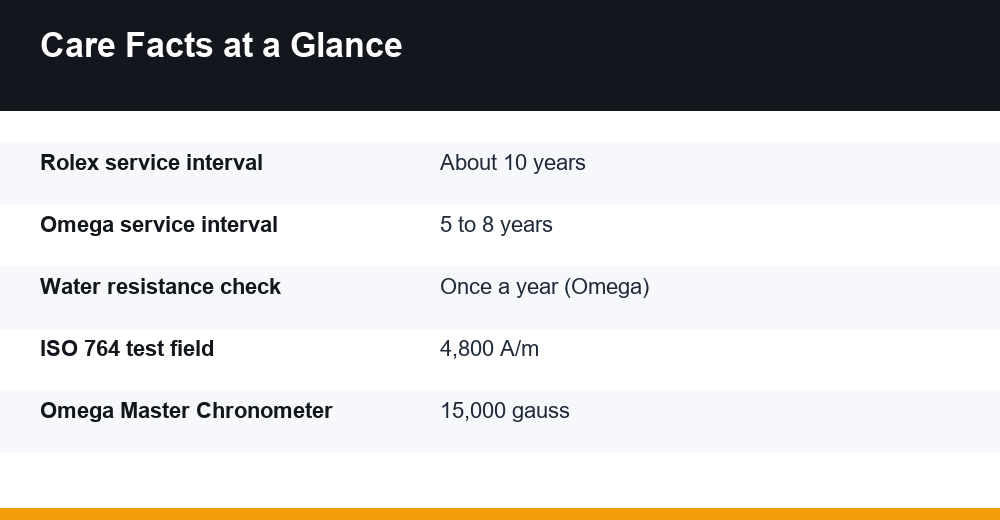
The international standard ISO 764 bases its magnetic resistant label on exposure to a field of 4,800 A/m, roughly 60 gauss, after which the watch must keep its rate within a set tolerance (commonly cited as about ±30 seconds a day). Some brands go much further: Omega tests its Master Chronometer watches in a field of 15,000 gauss. Quartz watches are less affected; a strong field may stop the motor temporarily, but they generally resume once removed from it.
Should you wind an automatic watch every day?
If you wear an automatic daily, no. The rotor winds the mainspring as your wrist moves, and an ordinary day of wear keeps it running. Rolex notes that a watch worn every day does not need winding, and once taken off it keeps running for two days or more depending on the model.
Manual winding helps in two cases: when the watch has stopped, and when you wear it only for a few hours at a desk. Give a stopped automatic around 20 to 40 turns of the crown before setting the time; the exact number varies by movement. Automatics have a slipping clutch on the mainspring, so you cannot overwind them.
Hand-wound watches
A manual-wind watch needs winding every day, ideally at the same time, usually in the morning. Turn the crown until you feel firm resistance and stop there. Forcing past that point can damage the mainspring or winding train.
| Movement example | Type | Approximate power reserve |
|---|---|---|
| ETA 2824-2 | Automatic | About 38 hours |
| Seiko 4R35 | Automatic | About 41 hours |
| Rolex 3235 | Automatic | About 70 hours |
| Powermatic 80 | Automatic | About 80 hours |
Winding tips that protect the crown
- Take the watch off before winding, so you are not pulling the crown at an awkward angle.
- Wind with gentle, even turns rather than fast spins.
- On many date movements, avoid changing the date by hand roughly between 9 pm and 3 am, when the date wheels are engaged. Check your manual, as some modern calibres are protected.
- Screw a screw-down crown back in carefully, without forcing it past the point where it seats.
How to store watches you are not wearing
Storage is the quiet half of watch care and maintenance, and it comes down to four things: dry air, stable temperature, no magnets and no contact between watches. A box with separate cushioned compartments prevents cases and bracelets scratching each other. Keep it out of direct sunlight, away from bathrooms and away from speakers or electronics.
In humid climates, a silica gel sachet in the box helps keep moisture down. Replace or dry the sachet out when it becomes saturated.
Let it stop or use a winder?
Letting a mechanical watch run down while it sits is not harmful. Many watchmakers suggest running it for a day or so every few weeks so the lubricants keep moving. A watch winder is a convenience for complicated watches such as perpetual calendars or moon phases that are tedious to reset; it is not a requirement.
If you do use a winder, set the turns per day and direction recommended for your movement. More rotation is not better and simply adds wear.
Long-term storage for quartz
A dead battery left in a quartz watch can leak and corrode the movement. If you will not wear a quartz watch for many months, have the battery replaced promptly when it dies, or ask a watchmaker to remove it.
Gaskets, crowns and water resistance checks
A watch stays watertight because of small rubber or synthetic gaskets at the crown, pushers, crystal and caseback. They deteriorate over time with temperature changes, pollution and chemicals, and no rating protects a watch with a tired seal.
How often should watch gaskets be replaced?
Gaskets are normally replaced at every full service and often during a battery change, when the caseback is opened. Between services, the practical step is a pressure test. Omega recommends having water resistance checked once a year, and its official guidance on preserving your watch explains why gasket ageing and accidental knocks to the crown, pushers or crystal make that check worthwhile.
If you swim or dive with a watch, test it before each season. If it is a dress watch that never meets more than rain, a test every couple of years is reasonable.
Warning signs of a failing seal
- Condensation or fogging under the crystal, even briefly.
- A crown that feels loose or no longer screws down smoothly.
- Visible damage to the crystal edge or caseback after a knock.
Condensation is urgent: moisture inside a movement causes rust quickly, so take the watch to a watchmaker straight away. Also remember that ratings in metres do not mean safe diving depth; they describe test pressures. Our explainer on what water resistance ratings really mean covers this in detail. After sea swimming, rinse the watch in fresh tap water.
How often should a watch be serviced?
There is no universal number, because modern lubricants, materials and escapements differ widely. The best answer is the one in your manual, and leading brands now publish their own intervals.
| Watch type | Typical guidance | Source of guidance |
|---|---|---|
| Rolex | About every 10 years, depending on model and use | Rolex |
| Omega | Complete service every 5 to 8 years; water check yearly | Omega |
| Older or vintage mechanical | Often every 3 to 5 years (approximate) | Common watchmaker practice |
| Quartz | Battery change every few years; reseal each time | Varies by model |
Treat those intervals as a ceiling, not a target. A watch that is dropped, gets wet inside or starts behaving oddly needs attention sooner, regardless of age.
Signs a service is due
- The rate drifts badly and demagnetizing does not cure it.
- The power reserve is noticeably shorter than it used to be.
- Winding feels gritty, or the crown grinds.
- The rotor rattles or you hear unusual noises.
- The date changes sluggishly or stops halfway.
A full service typically involves dismantling, cleaning and lubricating the movement, replacing worn parts and all gaskets, and testing for rate and water resistance. Rolex, for example, describes a precision test lasting at least 24 hours and a two-year international guarantee on its overhauls. Prices vary widely by brand and complication; our breakdown of what an automatic watch service costs helps you budget.
Regular service is the part of watch care and maintenance that owners most often postpone. Skipping it rarely saves money, as dried-out lubricants accelerate wear on pivots and wheels and can turn a routine service into a costly parts replacement.
A simple maintenance calendar
Pulling everything together, the routine below covers almost any watch. Adjust it for your brand’s guidance and how hard you wear the piece.
| When | Task |
|---|---|
| Every wear | Check the crown; wipe with microfibre afterwards |
| Weekly | Brush bracelet links; air out leather straps |
| Monthly | Soapy-water clean if water resistant; check spring bars |
| When rate changes | Compass test; demagnetize if needed |
| Yearly | Pressure test for water resistance |
| Every 5 to 10 years | Full service as your brand recommends |
None of this takes long. A few seconds of attention each day and a short visit to a watchmaker once a year is the whole of good watch care and maintenance for most owners, and it is what keeps a watch ready to be handed down.
Frequently Asked Questions
How do I clean my watch at home safely?
Wipe it with a microfibre cloth after each wear. For a deeper clean on a water-resistant watch, screw the crown down, remove any leather strap, then use lukewarm water with a drop of mild soap and a soft toothbrush. Rinse gently, pat dry and air dry. Keep water away from vintage or untested watches entirely.
How often should a watch be serviced?
Follow your brand’s interval. Rolex suggests roughly every 10 years depending on model and use, while Omega recommends a complete service every 5 to 8 years and a yearly water resistance check. Older mechanical watches often benefit from shorter intervals. Any drop, moisture or sudden change in accuracy means a service is due sooner.
How often should watch gaskets be replaced?
Gaskets are normally replaced at every full service and often whenever the caseback is opened for a battery change. Between services, a yearly pressure test tells you whether the seals are still doing their job. Swimmers and divers should test before each season, as heat, chemicals and age all weaken gaskets over time.
How do you store watches you are not wearing?
Keep them in a box with separate soft compartments, somewhere dry, cool and out of direct sunlight, away from speakers and magnets. Add silica gel in humid climates. Mechanical watches can safely stop, though running them every few weeks helps. Replace dead quartz batteries promptly so they cannot leak.