
Choosing among the best field watches means valuing legibility, toughness and honest simplicity over flash — the very qualities that first put these tools on soldiers’ wrists a century ago. This guide groups ten genuinely worthwhile models by budget, from sub-$100 quartz workhorses to Swiss mechanical classics. Every pick is a real, current watch, described plainly with approximate prices, so you can match one to your wrist and your wallet.
Table of Contents
What Makes a Great Field Watch
The field watch is one of horology’s purest ideas: a rugged, legible tool built to tell the time at a glance and shrug off knocks. The template was forged in the trenches of the First World War and formalised in the Second, when the US Army’s A-11 specification called for high accuracy, easy legibility and a hacking seconds hand — typically a black dial with white Arabic numerals — that soldiers could stop to synchronise an attack.
Britain’s wartime ‘Dirty Dozen’ commission and the later American MIL-W-46374 standard refined the same recipe. Strip away the military lineage, though, and the modern field watch keeps the traits that still matter to civilians: you can read it instantly, wear it anywhere, and mostly forget it is there.
- Instant legibility: a high-contrast dial, bold numerals and luminous hands you can read at a glance or in the dark.
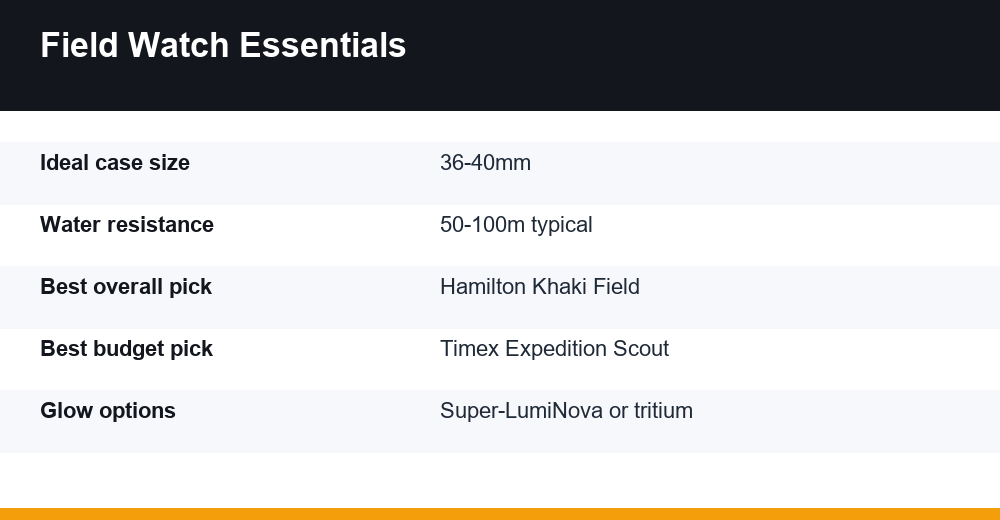
- A compact, flat case: classic sizing runs 36-40mm and slips easily under a shirt cuff.
- Genuine toughness: a hardened mineral or sapphire crystal, a solid caseback and a well-sealed or screw-down crown.
- Sensible water resistance: usually 50-100m, which handles rain, hand-washing and swimming, though not serious diving.
- A low-fuss movement: dependable quartz, solar, or a robust automatic or hand-wound mechanical.
Look closely and most dials share a few practical touches: an inner 24-hour track for military time, a fine minute scale for precise reading, and sometimes a date. None of it is decoration — every marking is there to help you read the time faster and more accurately.
Lume: Super-LumiNova versus tritium
Two systems keep the dial glowing after dark, and the difference is worth understanding before you buy. Super-LumiNova is a photoluminescent paint that charges under light and shines brightly for a few hours before fading, so it needs a light source to top it up.
Tritium gas tubes, used by brands such as Marathon and Luminox, glow continuously for years with no charging at all — dimmer, but always on. Tritium gradually fades over a decade or so, while Super-LumiNova never wears out but goes dark once its charge runs down.
Everything else on a good field watch serves readability and endurance. That focus is also why the category offers some of the best value in watches: there is little to pay for beyond the essentials, and the essentials are done well even at the bottom of the market.
Field Watch vs Dive, Pilot and Everyday Watches
Field watches are easy to confuse with their close cousins, so it helps to know the differences before deciding whether one is really the tool you want on your wrist.
- Versus a dive watch: a diver adds a rotating timing bezel and 200m-plus sealing, at the cost of extra bulk. A field watch trades that depth rating for a slimmer, lighter, everyday feel.
- Versus a pilot watch: both share the legible, high-contrast look, but pilot watches tend to be larger, with oversized crowns and often a chronograph. Field watches stay smaller and simpler.
- Versus a dress watch: where a dress watch is thin and formal, a field watch is casual and rugged. It looks at home with a tee and boots, less so under a dinner jacket.
- Versus a smartwatch: a field watch never needs a nightly charge, will still be running in twenty years, and asks nothing of your attention.
In short, the field watch is the generalist. It is the one you can wear hiking on Saturday and to the office on Monday, and that versatility is why so many enthusiasts suggest one as a first serious watch.
How We Picked the Best Field Watches
Our shortlist rests on fundamentals rather than marketing. We favoured genuine legibility, honest build quality, a movement with a solid track record, fair pricing, and models you can actually buy today. We run no affiliate deals that could sway these picks.
- Legibility: can you read it instantly, day or night?
- Build: a quality crystal, case and crown for the money.
- Movement: a proven quartz, solar or mechanical calibre.
- Value: honest pricing with no luxury tax for a badge.
- Availability: a current model you can order now.
The prices below are approximate and quoted at recommended retail. Field watches are discounted often, so treat every figure as a guide rather than gospel. Where a brand sells several near-identical references, we point to the version that best represents the line — and only watches we would happily wear ourselves made the cut.
Best Budget Field Watches (Under ~$200)
You do not need to spend much to get the real thing. Some of the best field watches on a tight budget cost less than a nice dinner, yet still nail legibility and durability without pretending to be luxury objects. To cast a wider net, see our guide to the best affordable watches.
Timex Expedition Scout – around $55
The default answer to ‘a cheap field watch that just works.’ A 40mm quartz piece with a clean dial, a date window and Timex’s Indiglo backlight, which lights the whole dial at the push of the crown. Water resistance is 50m and the battery lasts years. It feels plasticky in places, but few watches offer this much honest utility for the money, and a new strap transforms the look.
Timex Expedition North Field Post Solar – around $130
A grown-up take on the Scout. The 36mm case suits smaller wrists, the solar movement means you never change a battery, and the North line adds 100m water resistance, a sapphire crystal and more considered finishing in recycled materials. It is the pick if you want budget practicality with a slightly more refined feel on the wrist.
Citizen Eco-Drive Garrison – around $200
Citizen’s Eco-Drive charges from any light and keeps running for months in the dark, so like the Timex solar it is effectively maintenance-free. The Garrison wraps that around a compact 37mm case, a legible 12/24-hour dial and 100m water resistance. For the money it delivers a lot of genuine durability, and its classic proportions sit comfortably on almost any wrist.
Best Mid-Range Field Watches (~$200-$700)
This is the sweet spot of the category, where mechanical movements, better materials and real heritage arrive without the luxury tax. If you buy one watch to keep for years, it will most likely come from this tier.
Seiko 5 Sports (field style) – around $250
Seiko’s 5 Sports family includes several field-inspired references running the automatic 4R36 movement, complete with hacking seconds and hand-winding, 100m water resistance and a display caseback. Fit and finish are outstanding for the price, and the dials stay clean and easy to read. It is a brilliant, no-worries first automatic and a common gateway into mechanical watches.
Hamilton Khaki Field Mechanical – around $625
For many enthusiasts this is the definitive modern field watch. The 38mm case is period-correct, the hand-wound H-50 movement delivers an impressive 80-hour power reserve, and the matte dial with warm, old-radium-toned Super-LumiNova is a genuine pleasure to read. Water resistance is a modest 50m, so treat it as splash-proof rather than swim-ready. We go deep on it in our Hamilton Khaki Field Mechanical review.
Marathon General Purpose Mechanical (GPM) – around $325
A genuine military supplier’s take on the genre. The 34mm high-impact composite ‘fibershell’ case is light and tough, the automatic Seiko NH35 movement can also be hand-wound, and the tritium tubes glow around the clock with no charging. Water resistance is only 30m, but for authentic mil-spec character and that ever-present glow at this price, it is hard to beat.
Best Premium Field Watches (~$700 and Up)
Spend more and you buy in-house movements, sapphire crystals, higher water resistance and finishing that rewards a closer look. These are the best field watches money can sensibly buy before you cross into pure collector territory, and each should last a lifetime with the occasional service.
Hamilton Khaki Field Automatic – around $775
The automatic sibling of the Mechanical swaps in the self-winding H-10 movement — also with an 80-hour reserve — and steps water resistance up to 100m, in either 38mm or 42mm. If you want a single field watch to swim, travel and work in without a second thought, this is the pragmatic all-rounder.
Seiko Prospex Alpinist – around $725
Part field watch, part mountaineering companion. The Alpinist adds an internal compass bezel, a rich sunburst dial, the reliable 6R35 automatic with a 70-hour reserve and a strong 200m water resistance. It is more decorative than a strict field watch, but supremely capable outdoors and a favourite for good reason.
Longines Spirit – around $2,000
Longines occupies the ground between accessible and outright luxury. The Spirit pairs a COSC-certified chronometer movement with a beautifully printed dial, a silicon balance spring and 100m water resistance, and Swiss finishing that punches above the price. The vintage-leaning Heritage Military line offers a smaller-cased alternative for anyone chasing period looks.
Tudor Ranger – around $3,375
The upmarket benchmark. A 39mm case, the in-house MT5402 movement with a 70-hour reserve and COSC certification, 100m water resistance and a design lifted straight from Tudor’s expedition history. It is a lot of money for a field watch, but a genuinely excellent one that could easily be the last watch you buy for a long time.
Field Watches Compared at a Glance
Here are our ten picks side by side. Prices are approximate recommended retail and move around with sales, so shop the discounts.
| Model | Approx. price | Case | Movement | Water resist. |
|---|---|---|---|---|
| Timex Expedition Scout | $55 | 40mm | Quartz | 50m |
| Timex Exp. North Field (solar) | $130 | 36mm | Solar quartz | 100m |
| Citizen Eco-Drive Garrison | $200 | 37mm | Solar (Eco-Drive) | 100m |
| Seiko 5 Sports (field) | $250 | ~40mm | Automatic | 100m |
| Marathon GPM | $325 | 34mm | Automatic | 30m |
| Hamilton Khaki Field Mech. | $625 | 38mm | Hand-wound | 50m |
| Seiko Prospex Alpinist | $725 | 39.5mm | Automatic | 200m |
| Hamilton Khaki Field Auto | $775 | 38/42mm | Automatic | 100m |
| Longines Spirit | $2,000 | 40mm | Automatic (COSC) | 100m |
| Tudor Ranger | $3,375 | 39mm | Automatic (COSC) | 100m |
Read across a row and each watch’s character becomes obvious: cheap and carefree at the top, mechanical heritage in the middle, and luxe engineering at the bottom. That spread is exactly why a field watch suits almost everyone — there is a right one at every budget and wrist size.
How to Choose the Right Field Watch
The best field watches share the same DNA, so choosing between them comes down to a handful of honest questions about how you actually live and dress.
- Set your budget first. Every tier above is genuinely good; as you climb you pay for finishing and movement pedigree, not better timekeeping.
- Decide quartz or mechanical. Quartz and solar are more accurate and truly grab-and-go; a mechanical is more involving but needs winding or regular wear.
- Match the case to your wrist. If in doubt, 38mm is the classic all-rounder; drop to 34-36mm for slim wrists, and go 42mm only if you like a bolder look.
- Pick your lume. Choose tritium for a permanent glow, or Super-LumiNova for maximum brightness straight after a light source.
- Check the water resistance you truly need. 50m handles daily life; step up to 100m or more if you swim regularly or work outdoors.
Straps, servicing and living with one
Part of a field watch’s charm is how easily it changes character. A NATO, leather or canvas strap costs little and transforms the look, and most cases take a standard 20mm lug width. Quartz models need only the occasional battery, or nothing at all with solar, while a mechanical benefits from a service roughly every five years to keep it running sweetly.
Mistakes to avoid
- Over-sizing. A 44mm ‘field’ watch defeats the point of a flat, unobtrusive tool.
- Confusing a field watch with a dive watch. Most are not rated for serious diving despite looking rugged.
- Paying for a name you will not appreciate. A $100 Timex tells the same time as a $3,000 Tudor.
- Ignoring the strap. A cheap NATO or leather swap can transform comfort and looks for very little money.
Frequently Asked Questions
Are field watches waterproof?
No watch is truly waterproof, but most field watches are water resistant to 50 or 100 metres, which covers rain, hand-washing and swimming. A few, such as the Marathon GPM, are rated to just 30m. If you plan to dive, choose a dedicated dive watch rated to 200m or more.
Should I buy a quartz or mechanical field watch?
It depends on how you use it. Quartz and solar field watches are more accurate, cheaper and truly grab-and-go. Mechanical watches are more engaging and often better finished, but they cost more and need regular wear or winding. For a rugged daily beater, quartz is hard to beat.
What size should a field watch be?
The classic field watch measures 36-40mm, which sits flat under a cuff and stays true to the military originals. A 38mm case is the safest all-rounder for most wrists; slimmer wrists can drop to 34-36mm, while 42mm reads as a bolder, more modern interpretation.
Is the Hamilton Khaki Field worth it?
For most buyers, yes. The Khaki Field Mechanical offers Swiss build, an 80-hour movement and near-perfect field-watch looks at a fair price, which is why it is so widely recommended. If you want automatic convenience and 100m water resistance, the pricier Khaki Field Automatic is the better pick.