Watch water resistance is one of the most misread numbers in horology, and getting it wrong is an expensive mistake. The figure stamped on a caseback describes pressure measured in a laboratory, not the depth you can safely swim to. This guide explains what each rating actually permits, why “water resistant” is never the same as “waterproof”, and how gaskets, crowns and a few simple habits keep your watch dry for years to come.
Table of Contents
What Watch Water Resistance Really Measures
The number on your dial or caseback is a pressure rating, not a depth limit. A “30m” watch was never lowered thirty metres into a pool. Instead, it was held in a testing chamber and subjected to the static pressure that thirty metres of still water would exert. That distinction matters far more than most buyers realise, and it shapes everything else in this guide.
Testing happens under calm, controlled conditions at a fixed temperature. Real life is far messier. Swimming, diving off a board, or even rinsing your hands under a strong tap creates dynamic pressure spikes that briefly exceed the static figure the laboratory used. Motion, in effect, adds depth.
Because of this gap between the bench and the beach, treat every rating as a ceiling to stay well below, not a target to reach. A generous safety margin is precisely what keeps a movement dry when conditions are less than perfect.
- What it tells you: the static water pressure the sealed case survived when it was new, clean and correctly assembled.
- What it does not tell you: how the watch behaves during sudden movement, temperature swings, or after years of daily wear.
- What quietly changes it: age, servicing history, a crown left unscrewed, and knocks to the case or crystal.
For that reason, watch water resistance is best understood as a snapshot of a factory-fresh, sealed case, rather than a lifelong guarantee that holds however you treat the watch.
Why ‘Water Resistant’ Never Means ‘Waterproof’
You will almost never see the word waterproof on a modern watch, and there is a sound reason for that. In the United States, the Federal Trade Commission discouraged the term decades ago, because no seal is permanent and no case is immune to pressure. Given enough depth, heat or age, any watch can eventually let water in.
“Water resistant” is the honest alternative: it states a tested limit instead of promising the impossible. Two identical models can behave very differently once one has a flattened gasket or a crown that was not pushed fully home. The printed rating quietly assumes the watch is in perfect, showroom condition.
Think of it like tyre tread. A fresh set grips confidently in the wet, yet nobody sensibly calls a tyre “skid-proof”. The same realism should shape how you read any figure on a caseback, whatever the marketing suggests.
Older watches sometimes still carry the word, and vintage collectors treasure those dials. On a modern piece, though, its absence is a sign of honesty rather than weaker engineering. The maker is describing what it actually measured, not what it hopes.
ATM, Bar and Meters: Decoding the Numbers
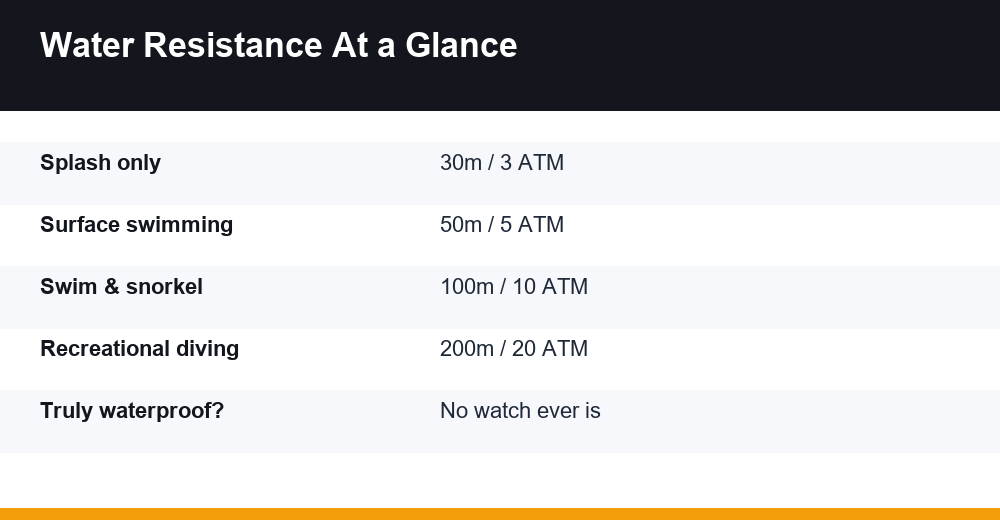
Manufacturers express the same value in three ways, which causes needless confusion. One ATM (atmosphere) is almost exactly one bar, and each unit corresponds to the pressure exerted by roughly ten metres of water. So 5 ATM, 5 bar and 50 metres all describe the identical laboratory test, just in different units.
- 3 ATM = 3 bar ≈ 30 metres
- 5 ATM = 5 bar ≈ 50 metres
- 10 ATM = 10 bar ≈ 100 metres
- 20 ATM = 20 bar ≈ 200 metres
The “metres” unit is where people slip. It expresses a pressure equivalence, not a diving depth. Reading “100 metres” as “safe to swim down to 100 metres” is exactly the misunderstanding the industry has spent years trying to correct, because dynamic pressure from an ordinary swim eats into that headroom surprisingly quickly.
How Water Resistance Is Tested
Ratings do not appear by guesswork. Everyday watches are checked against ISO 22810, a standard that defines several distinct trials each case must pass before a figure can be printed. Understanding these tests explains why a rating is a starting point, not a promise for the life of the watch.
The core checks combine pressure and temperature. A case is submerged and subjected to its rated overpressure, then examined for any water that has entered. A separate condensation test warms the watch, places a cool droplet on the crystal, and looks for fogging inside, a sensitive way to reveal a compromised seal.
- Overpressure test: the case is held at its rated pressure and inspected for ingress.
- Condensation test: heat plus a cool droplet reveals internal fogging from a weak seal.
- Operating test: the crown and any pushers are worked while submerged to check dynamic sealing.
Dive watches face a far tougher regime. Beyond higher pressures, they are checked for thermal shock, resistance to salt water over many hours, and reliable operation of the bezel and crown. This extra scrutiny is why a certified diver inspires confidence that a bare depth number cannot.
Crucially, these trials are run on fresh, correctly assembled cases in a laboratory. They confirm the watch was capable on the day it left the factory, but they cannot predict how gaskets will age once heat, chemicals and daily knocks begin to take their toll.
The Ratings Table: What Each Level Allows
Here is how the common ratings translate into real activities. Treat the “sensible for” column as everyday guidance for a watch in good condition, and the “avoid” column as the line you should not cross.
| Rating | Pressure | Sensible for | Avoid |
|---|---|---|---|
| 30m | 3 ATM / 3 bar | Rain, splashes, hand-washing | Swimming, showering, any submersion |
| 50m | 5 ATM / 5 bar | Brief, gentle surface swimming | Snorkelling, water sports, diving |
| 100m | 10 ATM / 10 bar | Swimming, snorkelling | Scuba diving, high-board dives |
| 200m | 20 ATM / 20 bar | Recreational scuba, water sports | Deep technical or saturation diving |
| 300m+ | 30 ATM+ / 30 bar+ | Serious and professional diving | Complacency about servicing |
Notice how modest the low end is. A 30m dress watch belongs nowhere near a sink full of dishes, and a surprising number of ruined watches are simply victims of hand-washing. When in doubt, take the watch off; it costs nothing and prevents the most common accidents.
The jump most people care about is the one between 50m and 100m. If you want to swim laps or wear a watch in the sea without a second thought, 100m is the sensible floor. Affordable automatics such as the Seiko 5 Sports family reach this mark comfortably; our Seiko SRPD review examines a popular 100m everyday example in detail.
For anything involving actual diving, look for 200m or more that is built to a genuine dive standard, not a plain number alone. We round up dependable options in our guide to the best dive watches. These figures are the backbone of watch water resistance, but they only hold while the seals inside remain intact.
Gaskets, Crowns and the Case: How Water Is Kept Out
A watch stays dry thanks to a handful of unglamorous parts working together. The stars are gaskets: thin rubber or silicone O-rings seated where the caseback, crystal and crown meet the case. Squeezed into their grooves, they close the microscopic gaps that water would otherwise slip through.
The crown is the weakest point on most watches, simply because it is the one seal you routinely disturb. A screw-down crown threads tightly against its gasket for extra security, while a push-pull crown relies on that gasket alone. Either way, water walks straight in the moment the crown is left out.
- Screw or push the crown fully home before the watch goes anywhere near water.
- Never operate the crown while the watch is wet or submerged.
- Treat a chronograph’s pushers with the same caution, and never press them underwater unless the maker states they are rated for it.
Gaskets are consumables, not fixtures. They dry out, flatten and crack over a few years, and every heat cycle, hard knock and battery change ages them a little further. That is exactly why a rating printed at the factory quietly erodes long before anything looks wrong from the outside.
What Not to Do With a Water-Resistant Watch
Most flooded watches are not casualties of extreme depth. They fail during perfectly ordinary moments that quietly overwhelm tired seals. The two most common culprits are heat and time, not pressure.
- Hot showers, saunas and hot tubs: heat expands the case metal and thins its lubricants, while hot steam slips through seals that would easily block liquid water. Skip them whatever the rating says.
- Sudden temperature shocks: leaping from a hot poolside deck into cold water stresses the gaskets and can even draw moisture inside as the trapped air contracts.
- Soap, shampoo and sunscreen: these surfactants lower water’s surface tension, helping it creep past seals it would otherwise resist. If the watch gets soapy, rinse it in clean water.
- Salt water left to dry: salt crystals are abrasive and corrode both seals and case metal. Rinse the watch under fresh water after every swim in the sea.
- Ignoring age: a decade-old sports watch still wearing its original seals is no longer the 200m watch it was on day one.
None of this means a well-rated watch is fragile. It means the printed number assumes calm, cool, clean conditions, and the everyday exceptions above are what actually let water in.
Warning Signs Water Has Got In
Catching a leak early can save a movement, so it pays to know what trouble looks like. The clearest signal is condensation: a light mist or visible droplets on the inside of the crystal, especially as the watch moves between warm and cold air. Treat any fogging as a reason to act.
Other clues are slower to appear. A movement that gains, loses or stops without explanation can point to moisture reaching the mechanism. Rust-coloured spots on the dial, a musty smell after opening, or hands that look discoloured all suggest water has already done damage inside the case.
- Fogging or droplets under the crystal, particularly after temperature changes.
- A movement that suddenly runs erratically or stops altogether.
- Discoloured hands, a spotted dial, or a stale smell inside the case.
If you spot any of these, do not open the watch yourself. Keep it away from further heat and take it to a watchmaker promptly. The sooner a case is opened, dried and resealed by a professional, the better the odds of avoiding permanent corrosion.
Testing, Servicing and Choosing the Right Rating
Because seals degrade invisibly, resistance should be re-checked rather than assumed. A watchmaker can run a dry (air-pressure) test that detects leaks without ever wetting the movement, followed by a wet test to confirm. Have any watch you swim with checked before the season, and whenever the case has been opened.
A full service, which replaces the gaskets, is the reliable way to restore a rating. As a rough guide, have the seals inspected every couple of years and a mechanical watch serviced roughly every four to six years, or as the manufacturer advises. Treat these as ranges, not hard rules.
It also pays to understand the standards behind the marketing. Everyday pieces are typically tested to ISO 22810, while true dive watches meet the stricter ISO 6425 standard, which demands a “DIVER’S” marking, testing to 125% of the rated depth, and features such as a legible dial and a unidirectional bezel. A plain “200m” is not automatically a certified diver.
Match the rating to how you actually live
The smart approach is to fit the rating to your habits instead of chasing the biggest figure. Decide honestly how you use a watch, then read watch water resistance as a comfort margin sitting above that reality.
- Desk, dinner and no swimming: 30m to 50m is plenty.
- Regular swimming and poolside holidays: 100m removes the worry.
- Snorkelling, water sports or recreational diving: 200m built to a dive standard.
- Technical or professional diving: 300m or more, serviced strictly on schedule.
Frequently Asked Questions
Can I shower with a 50m water-resistant watch?
It is best not to. A 50m rating covers brief, gentle surface swimming in cool water, but hot showers combine heat, soap and steam, the three things that age seals fastest. Removing the watch first protects its watch water resistance over the long run.
Is a 100m watch safe for scuba diving?
Not for scuba. 100m is ideal for swimming and snorkelling, but recreational diving calls for at least 200m built to a recognised dive standard. That extra margin absorbs dynamic pressure, real depth, and the wear your gaskets inevitably pick up over the years.
Why does my new watch say water resistant but not waterproof?
No watch is genuinely waterproof, so the term fell out of use. Seals wear, cases flex and heat opens tiny gaps, meaning any watch can eventually leak. “Water resistant” honestly states a tested limit rather than promising permanent, absolute protection.
How often should water resistance be tested?
Have the seals pressure-tested before you swim with a watch each year, and any time the case is opened for a battery or a service. Gaskets often last only a few years, so a figure printed at the factory should never simply be taken for granted.