
The best dive watches balance genuine underwater capability with the kind of everyday charm that keeps them on your wrist long after the last swim. This guide names ten real models across every budget, from sub-$300 workhorses to the icons that defined the genre, and explains what actually separates a true diver from a rugged lookalike. No affiliate spin and no invented specs, just honest picks and the reasoning behind each one.
Table of Contents
What Actually Makes a Dive Watch
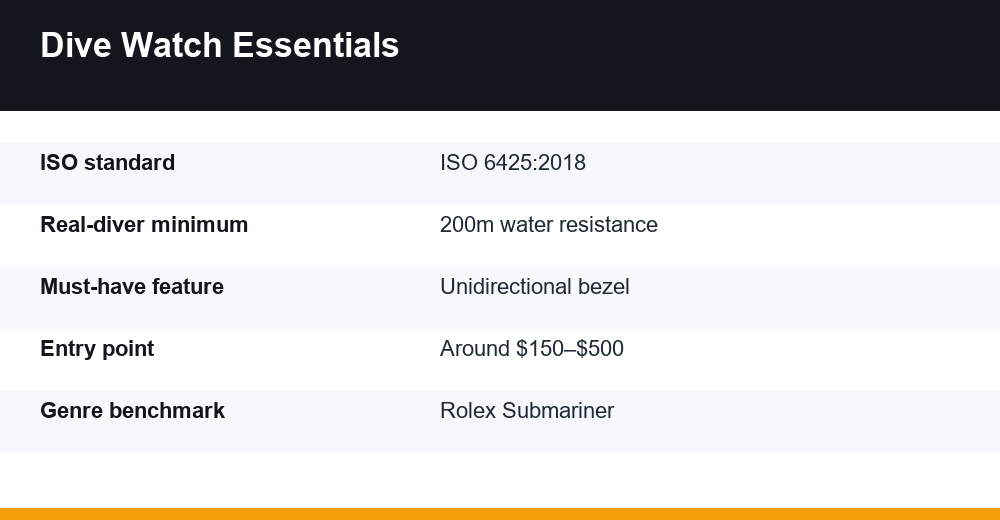
A dive watch is not simply a rugged-looking watch with a rotating ring, however much marketing blurs that line. The genre has a real definition. The internationally recognised benchmark is ISO 6425, the divers’ watch standard, and it asks for far more than a bold dial and a smear of lume.
Under that standard a watch must survive a static overpressure test at 125% of its rated depth, so a 200m diver is verified to roughly 250m. It must also resist salt-water corrosion, thermal shock and magnetism, shrug off physical knocks, and stay legible in total darkness at arm’s length.
- Water resistance of at least 100m, though serious divers and most enthusiasts start at 200m
- A unidirectional timing bezel, or equivalent, marked clearly at five-minute intervals
- Luminescence bright enough to read the time and bezel at 25cm in complete darkness
- Demonstrated resistance to shock, magnetic fields, temperature change and corrosion
- A secured sealing system, usually a screw-down crown, to keep water pressure out
The rotating bezel is the one control that truly earns its keep. Line its zero marker up with the minute hand as you descend and the elapsed time reads off at a glance. It is built to turn one way only, so an accidental knock can shorten the time you believe you have left but never lengthen it, always erring on the side of caution.
Build quality matters as much as the rating on paper. Look for a sapphire crystal, which resists the scratches that mineral glass and acrylic pick up, and a case in surgical-grade stainless steel, titanium or bronze. These are the materials that live happily in salt water and survive years of daily abuse.
It also pays to read depth ratings correctly. They come from static laboratory pressure rather than swimming, so arm movement, temperature swings and water jets all eat into that margin in the real world. This is precisely why a proper 200m rating gives such comfortable everyday headroom.
It also helps to be clear about the modern role. Almost every recreational diver now trusts a wrist computer for depth, no-decompression limits and air supply, which leaves the watch as a mechanical backup and, honestly, a keepsake. That very heritage is why the genre still thrives long after the technology moved on.
One last caveat: ISO certification is voluntary. Plenty of excellent watches meet the spirit of the standard without paying for the stamp, while a case back reading water resistant to 30m or 50m is not a diver at all, no matter how tough it looks.
How We Judged the Best Dive Watches
Every model here had to earn its spot as one of the best dive watches on merit rather than marketing, and brand prestige counted for nothing on its own.
We weighed how each watch performs and, just as importantly, how it lives on the wrist. Then we grouped the picks by budget instead of forcing one flat ranking, because the right diver depends entirely on your wrist size, your habits and your wallet.
- Genuine water resistance, with 200m or more preferred for real use
- Bezel feel, meaning a firm unidirectional action with minimal back-play
- Lume quality and low-light legibility, day or night
- Movement reliability, accuracy and ease of future servicing
- Wearability, judged more by lug-to-lug span than headline diameter
- Long-term value and track record over short-term hype
We also leaned on reputation for the long haul. A dive watch is a tool meant to last decades, so parts availability, a watchmaker’s ability to service it and a proven movement matter more than a clever one-off feature. Nothing made this list simply for being new or fashionable.
Finally, we tried to be honest about trade-offs. Every watch here has a compromise somewhere, whether in size, price or finishing, and we call those out rather than pretend the perfect all-rounder exists.
Affordable Dive Watches That Punch Above Their Weight
You do not need four figures for real capability. Some of the best dive watches for the money sit comfortably under $500, and a couple cost less than a nice dinner for two.
The Seiko 5 Sport SRPD is the classic gateway. It borrows the beloved SKX silhouette, runs Seiko’s dependable 4R36 automatic and typically costs around $150 to $275. Be honest about it, though: it is rated to 100m without a screw-down crown, so it is diver-styled rather than a true tool diver.
For a genuine 200m rating on a shoestring, the Orient Kamasu is hard to beat at roughly $150 to $250. You get a screw-down crown, a sapphire crystal and Orient’s in-house automatic, and its Mako and Ray siblings offer the same engine in different dress.
Prefer never to wind or set a watch? The Citizen Promaster Diver runs on light through Eco-Drive, is genuinely ISO 6425 certified and sells for around $250 to $350. It is arguably the most fuss-free capable diver you can buy at any price.
Stretch toward $400 to $500 and Seiko’s Prospex Turtle delivers a cushion-cased 200m automatic that clears the tool-watch bar, with excellent lume and a cult following to match.
What do you give up down here? Mostly finishing and precision. Bracelets can feel slightly hollow, accuracy may drift several seconds a day, and bezel or chapter-ring alignment is not always flawless. None of it stops these watches doing the actual job remarkably well.
The Mid-Range Sweet Spot: $500 to $2,000
Between $500 and $2,000 the choices explode, and this is where sharper finishing, better movements and genuine heritage arrive without the full luxury tax.
Oris anchors the segment. Its Aquis offers 300m of water resistance and a confidently modern design, while the vintage-flavoured Divers Sixty-Five charms at 100m, though that gentler rating makes it more of a skin diver than a scuba tool.
Christopher Ward’s C60 Trident is the value benchmark, pairing 300m and 600m ratings with crisp finishing and direct-to-consumer pricing around $800 to $1,300. Few watches feel this expensive for the money.
The Longines HydroConquest brings Swiss polish and 300m capability for roughly $1,300 to $1,800, while its sister brand Certina undercuts it near $700 with the DS Action Diver at the same depth. For heritage, Squale’s 1521 traces its lineage to the golden age of diving at 500m, and Mido’s Ocean Star 200 delivers dependable Swiss value.
The Baltic Aquascaphe shows how far independents have come, channelling 1960s charm with a 200m rating and a compact, characterful case. Micro-brands now compete hard on both design and specification.
At the top of the band, Seiko’s Prospex SPB143 reissues the 1965 62MAS with the refined 6R35 movement, a 200m rating and beautifully judged modern proportions for around $1,000 to $1,300. Step up here and the extra outlay buys real things: solid bracelets, longer power reserves and finishing you can appreciate under a loupe.
What unites this band is quiet confidence. Bracelets feel solid rather than hollow, movements are regulated more tightly, and the finishing rewards a closer look. You stop forgiving small flaws and start enjoying details instead. For most enthusiasts this is where a diver graduates from a starter piece into a genuine keeper.
Luxury Divers Worth Saving For
Above roughly $3,000 you pay for in-house movements, chronometer certification, superb bracelets and, frankly, the badge and its resale. The value is real, but so is the premium.
The Tudor Black Bay 58 is the enthusiast’s darling. Its 39mm case wears beautifully, the in-house MT5402 movement is chronometer-certified with a 70-hour reserve, and at around $3,900 it delivers Rolex-group quality for a fraction of a Submariner. For many buyers it is the smart-money luxury diver.
Speaking of which, the Rolex Submariner remains the genre’s benchmark. Its 300m rating, near-flawless bracelet and cultural weight are unmatched, though retail near $9,000 and persistent waitlists mean most buyers end up paying a premium on the secondary market.
Omega’s Seamaster Diver 300M answers with a co-axial Master Chronometer movement, serious anti-magnetism and a helium escape valve, typically around $5,500. Its Planet Ocean sibling goes deeper for those who want more, and both wear like proper modern tools.
Want a genuine tool over vintage looks? The Tudor Pelagos adds titanium, a 500m rating and a helium valve for serious use. For something rarer still, a Grand Seiko Spring Drive diver offers uncanny accuracy and exquisite hand-finishing, while the Blancpain Fifty Fathoms, the 1953 watch that arguably launched the modern genre, sits at the historic and very expensive summit.
A word on buying at this level: retail price and reality often diverge, especially for steel sports models. Decide in advance whether the badge is worth a grey-market premium or a long authorised-dealer wait. Many buyers happily find that a Tudor or an Omega scratches the same itch at a fairer, in-stock price.
One practical note at this level: resale cushions the cost. An established diver from Rolex, Omega or Tudor holds value far better than most watches, which quietly softens the real price of ownership over time.
Dive Watch Comparison at a Glance
Here is how the picks stack up side by side. Prices are approximate, vary by region and shift with the market, so treat them as guidance rather than gospel.
| Model | Water resistance | Movement | Approx. price | Best for |
|---|---|---|---|---|
| Seiko 5 Sport SRPD | 100m | Automatic (4R36) | Around $150–$275 | A first diver with daily style |
| Orient Kamasu | 200m | Automatic (F6922) | Around $150–$250 | A true 200m tool on a budget |
| Citizen Promaster Diver | 200m | Eco-Drive (solar) | Around $250–$350 | Zero-maintenance capability |
| Seiko Prospex Turtle | 200m | Automatic (4R36) | Around $400–$500 | Affordable tool-watch character |
| Certina DS Action Diver | 300m | Automatic (Powermatic 80) | Around $700 | Swiss value at 300m |
| Christopher Ward C60 Trident | 300m+ | Automatic (Sellita) | Around $800–$1,300 | Finishing per dollar |
| Seiko Prospex SPB143 | 200m | Automatic (6R35) | Around $1,000–$1,300 | A vintage-styled everyday diver |
| Longines HydroConquest | 300m | Automatic (L888) | Around $1,300–$1,800 | A polished Swiss all-rounder |
| Tudor Black Bay 58 | 200m | In-house (MT5402), COSC | Around $3,900 | Smart-money luxury |
| Omega Seamaster Diver 300M | 300m | Co-Axial Master Chrono | Around $5,500 | An anti-magnetic modern icon |
| Rolex Submariner | 300m | In-house (3235) | Around $9,000+ | The genre benchmark |
Read down the table and the pattern is hard to miss: water resistance and movement quality climb steadily with price, yet the leap in real capability from a $250 diver to a $9,000 one is far smaller than the leap in cost, finishing and prestige. Buy the tier that fits your life, not your ego.
Dive Watch Jargon, Decoded
The genre carries its own vocabulary, and a little fluency makes every spec sheet far easier to read. Here are the terms that matter most, translated into plain language.
| Term | What it actually means |
|---|---|
| Unidirectional bezel | A timing ring that turns one way only to track elapsed minutes underwater, so a knock can never flatter your remaining time. |
| Lug-to-lug | The distance from top lug tip to bottom lug tip, and the truest measure of whether a case will fit your wrist. |
| Screw-down crown | A crown that threads shut against a gasket, sealing the case so water pressure cannot force its way inside. |
| Lume | Photoluminescent coating, such as Super-LumiNova or Seiko’s LumiBrite, that glows to keep the hands and bezel readable in darkness. |
| ISO 6425 | The international divers’ watch standard, covering water resistance, legibility, shock, magnetism and corrosion. |
| Helium escape valve | A relief valve that vents trapped helium during decompression, relevant only to saturation divers in pressurised habitats. |
| Power reserve | How long a mechanical movement keeps running once off the wrist, commonly 40 to 70 hours on a modern diver. |
| Sapphire crystal | A synthetic sapphire lens, far harder and more scratch-resistant than the mineral glass or acrylic used on cheaper watches. |
How to Choose the Right Dive Watch
Specifications get a watch shortlisted; fit gets it worn. The best dive watches for you are simply the ones that suit your wrist, your budget and how you will genuinely use them.
- Prioritise lug-to-lug length over diameter, since it decides whether a watch actually sits well on your wrist
- Judge your real depth needs honestly; for nearly everyone 200m is ample and 300m is generous headroom
- Test the bezel, as a 120-click unidirectional action should feel firm with no wobble or back-play
- Check the lume grade, such as Super-LumiNova or Seiko’s LumiBrite, for true low-light legibility
- Look for a bracelet clasp with a dive extension or micro-adjustment for comfort over a wetsuit or through the day
- Insist on a screw-down crown if the watch will ever go near the water
- Choose your power source deliberately: solar for zero fuss, automatic for tradition, quartz for accuracy
Think about material and strap as well. Steel is the versatile default, titanium is lighter and warmer against the skin, and bronze develops a patina that some adore and others avoid. A good rubber strap or NATO can also transform how a diver wears and is easy to swap by season.
Do not overlook second-hand, either. Divers are among the most robust watches on the market, so a well-kept pre-owned example from a reputable seller can stretch your budget dramatically. Just confirm the water resistance has been recently tested before you trust it below the surface.
And match the movement to your patience. An automatic wants regular wear or winding, a solar module needs light, and any mechanical piece will eventually ask for a service. There is no wrong answer, only the one that fits your routine.
Servicing, Helium Valves and a Dose of Reality
Water resistance is not permanent. The rubber gaskets that seal a case degrade with age, heat and pressure, so if you truly swim or dive, have the seals pressure-tested every one to two years.
Never operate the crown or any pushers underwater, rinse the watch in fresh water after the sea, and budget for a full movement service roughly every five years on a mechanical piece. These small habits are what keep a diver waterproof for decades.
As a rough guide to the numbers, 30m suits handwashing, 50m light splashes, 100m swimming, and 200m and beyond real diving. Anything rated below 100m should stay out of serious immersion regardless of how tough it looks on the wrist.
Ignore the helium escape valve anxiety, too. That feature matters only to saturation divers living in pressurised habitats; for swimming, snorkelling or recreational scuba it solves a problem you will never actually have.
And here is the liberating truth: the vast majority of dive watches never touch salt water, and that is completely fine. The best dive watches are, in the end, the ones that get worn, so choose the one you will reach for every single morning.
Frequently Asked Questions
What water resistance do I actually need in a dive watch?
For real snorkelling and recreational scuba, 200m is plenty, since most divers rarely pass 40m. A 100m rating handles swimming and showering, but a screw-down crown and 200m give genuine peace of mind. Anything beyond 300m is mostly headroom and bragging rights.
Is a Seiko a good first dive watch?
Yes. Seiko’s affordable divers offer real capability, dependable in-house automatics and a huge support community. Entry models like the 5 Sport SRPD are diver-styled at 100m, while the Prospex Turtle and 62MAS reissues clear the 200m tool-watch bar comfortably.
Do I need a helium escape valve?
Almost certainly not. Helium valves matter only to saturation divers living in pressurised habitats for days at a time. For everyday wear, swimming or recreational scuba it simply adds cost and one more potential failure point without any practical benefit to you.
How often should a dive watch be serviced?
If you genuinely swim or dive with it, have the seals pressure-tested every one to two years and a full mechanical service roughly every five. A desk diver that never gets wet can wait longer, but remember the gaskets still age regardless of use.